


Mr Quyen - Santiago. Posted 03/11/2026
A PVC roof tile sheet goes on in 8 steps: set the purlins 440 or 660 mm apart, check the frame and slope, lay the first sheet at the eave, lap each new sheet one wave over the last, screw through the top of the wave above a purlin, cap every screw, fit the ridge and edge pieces, then check the roof. A 64 m² roof needs about 256 – 320 screw sets.

Blue ASA/PVC roof tile sheets on a blue steel truss frame, Chau Thanh, Vietnam
Who can install PVC roof tile sheets?
Any installer who already builds metal roofs and steel frames can lay ASA/PVC roof tile sheets; no special crew is needed. Santiago supplies the sheets and accessories but does not install. With each order it sends installation videos to the installer and answers questions by WhatsApp. The steps below are for the Santiago Spanish-style roof tile sheet: 1,050 mm wide, 960 mm cover, a 219 mm tile step along the slope.
What has to be ready before the sheets arrive?
- The length of the building and the slope length of each roof face.
- Sheet lengths in multiples of the 219 mm tile step.
- A roof slope between 20% and 45%.
- The ridge, hip and edge pieces for your roof shape, listed in the accessories checklist.
- Self-drilling screws about 70 mm long, with caps that take a 6 mm hole.
How should the sheets be stored and lifted?
Lay the sheets flat on level ground, away from bricks and stone, with nothing heavy on top. The truck must be long enough that the sheets do not hang far over the end, and a crane lift needs a spreader bar. Carry long sheets with several people and never fold them; sheets bent by bad handling are not covered by the warranty.
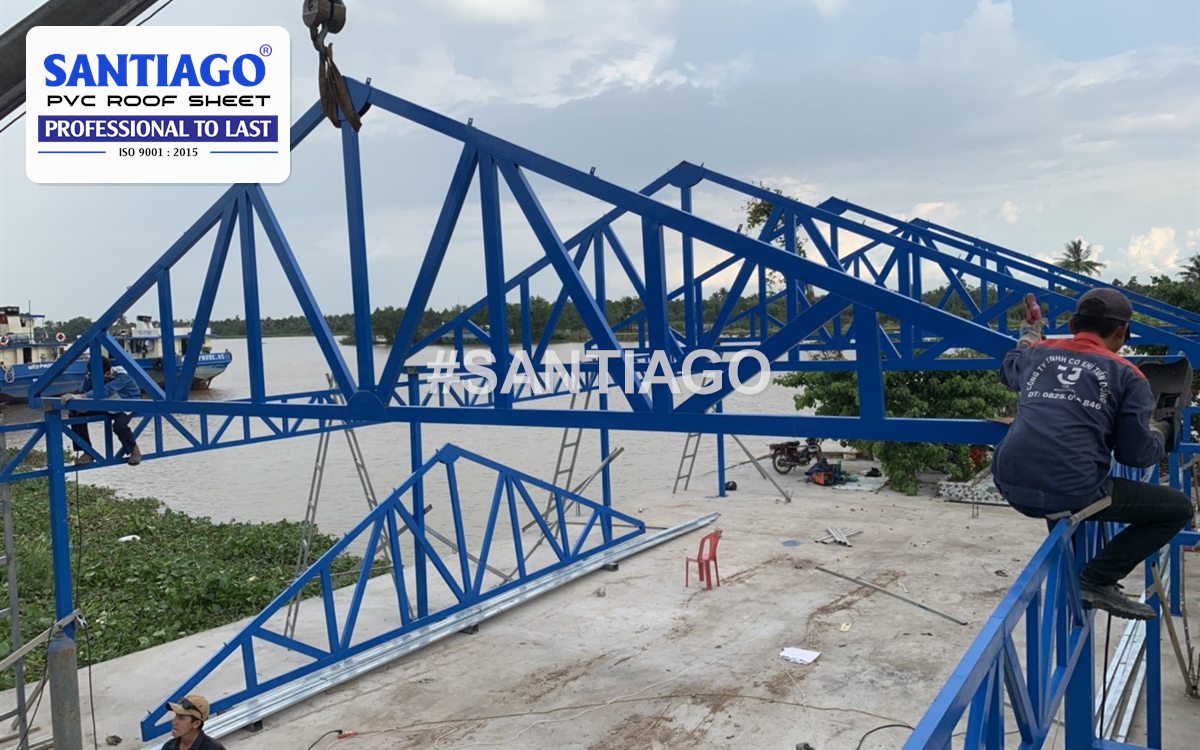
A steel roof truss being lifted into place before the tile sheets go on
What are the 8 installation steps?
- Set the purlins. The top purlin sits 15 – 18 cm below the ridge so the ridge piece has something to screw into; the others go 440 or 660 mm apart and never more than 700 mm; the lowest is no more than 20 cm from the lower edge of the sheet. Each purlin must sit under the foot of a tile step, not in the middle of one.
- Check the frame: purlins flat and in line, slope 20 – 45%.
- Lay the first sheet at the eave, standing on the purlins, with the steps running the right way.
- Lap the next sheet one wave over the first, the wide edge over the narrow one.
- Screw: place the cap base on the top of the wave directly over a purlin and drive the 70 mm screw into the purlin. Tighten until the base sits snug and stop there.
- Clip a cap over every screw head.
- Fit the ridge after both roof faces are laid, then the ridge terminals, hip and edge pieces.
- Check the roof: every screw capped, laps closed, edges finished; sweep off metal filings and offcuts.

The tile-sheet roof seen from below, with the steel truss and purlins carrying the sheets
Example: purlins and screws for a 64 m² roof
A gable house 8 m long with a slope of 4 m on each face has 64 m² of roof.
| Item | Working | Result |
|---|---|---|
| Purlins per face at 660 mm | 4 m minus 15 cm at the ridge and about 20 cm at the eave leaves 3.65 m; 3.65 ÷ 0.66 = 5.5, round up to 6 spaces | 7 purlins |
| Purlins per face at 440 mm | 3.65 ÷ 0.44 = 8.3, round up to 9 spaces | 10 purlins |
| Screw sets | 64 m² × 4 – 5 per m² | 256 – 320 sets |
The 440 mm spacing uses more steel and gives a stiffer roof, so it is the better choice where wind is strong.
Which installation mistakes cause leaks?
| Mistake | What happens | Do this instead |
|---|---|---|
| Purlins 700 – 800 mm apart | Sheets sag and laps open | 440 or 660 mm |
| Purlin under the middle of a tile step | The screw misses and the sheet does not lie flat | Space purlins in multiples of 219 mm |
| Top purlin far from the ridge | Nothing to fix the ridge piece to | 15 – 18 cm below the ridge |
| Screw in the valley | Water runs into the screw hole | Top of the wave |
| Screw too tight | The wave dents | Snug, no more |
| No cap | The screw head rusts and streaks the sheet | One cap on every screw |
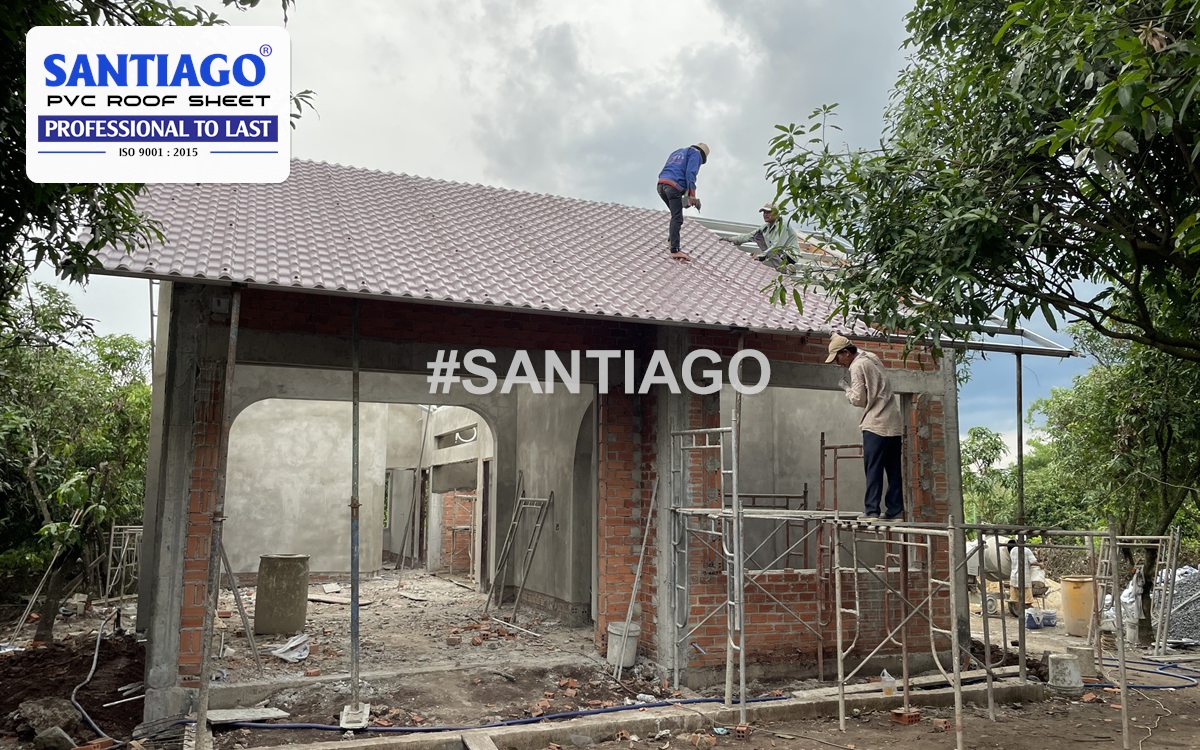
A chocolate tile-sheet roof being laid on a new house, Dinh Quan, Dong Nai
What does a PVC tile roof look like during installation?
Mr Quyen shows a green ASA/PVC sheet in the Santiago factory, then climbs onto a grey tile-profile roof that installers are still screwing down. Near the end he and a colleague walk along a finished grey tile roof next to the gutter.
Santiago uPVC tile roofs on site (Santiago video on YouTube).
More short videos: before and after installation
Three short clips in English, filmed by Santiago. Tap a video to play it here on the page.
What do Santiago roofs look like after installation?
Red ASA/PVC tile sheets are carried up to a house, a flame is put to a stack of sheets, and the short ends on a blue warehouse roof being fitted and grey sheets on the factory roller line.
Santiago PVC roofing tiles in real conditions (Santiago video on YouTube).
What should the top and underside of a sheet look like before you fix it?
Filmed inside the Santiago factory: a worker steps onto a white tile sheet, red and blue sheets get a torch test, and the last scene is the team beside an export container.
Santiago tile sheets at the factory (Santiago video on YouTube).
What does a finished tile-sheet roof look like from the gutter line?
Mr Quyen stands among stacks of brown tile sheets in the Santiago factory, then walks with a colleague along a finished grey tile roof near the gutter. Installers carry a grey tile sheet into place, and the WhatsApp number is shown at the end.
Santiago uPVC tile sheets from the factory to the roof (Santiago video on YouTube).
Santiago – a leading exporter of ASA/PVC roofing from Vietnam
Santiago roofing is produced and loaded into containers at our factory in Vietnam. It has been exported to India since 2023, Thailand since 2024 and the USA since 2025. Every export shipment comes with a commercial invoice, packing list, bill of lading and a certificate of origin (C/O) issued by Vietnam's Ministry of Industry and Trade, which importers use to claim the duty preference of their trade agreement.
| Item | Details |
|---|---|
| HS code | 3925.90.00 (ASA/PVC roofing sheets) |
| Certificate of origin | Form D (ASEAN), Form AI (India), Form AK / VK (Korea), Form AJ / VJ (Japan), Form VC (Chile), CPTPP proof of origin |
| Shipped from | Vietnam, by container |

Certificate of origin Form AI (ASEAN–India) for Santiago ASA/PVC roofing sheets, HS 39259000, certified on 24 September 2026. Buyer details are hidden.
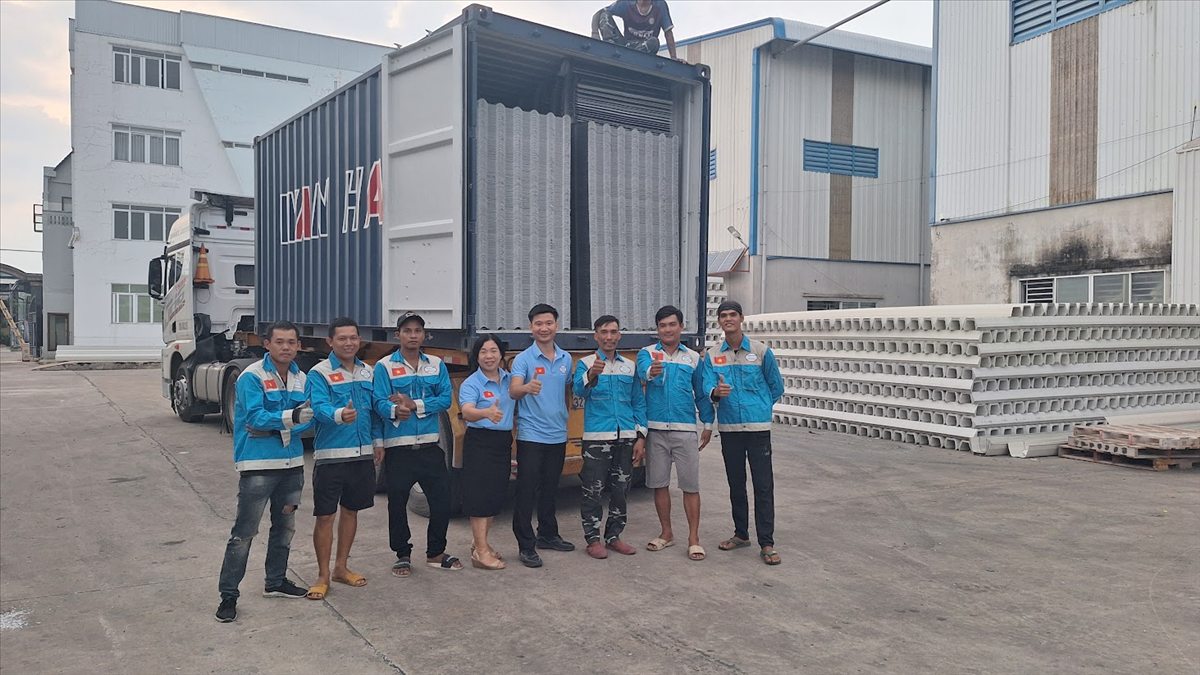
The Santiago team beside a loaded export container at the factory, November 2024
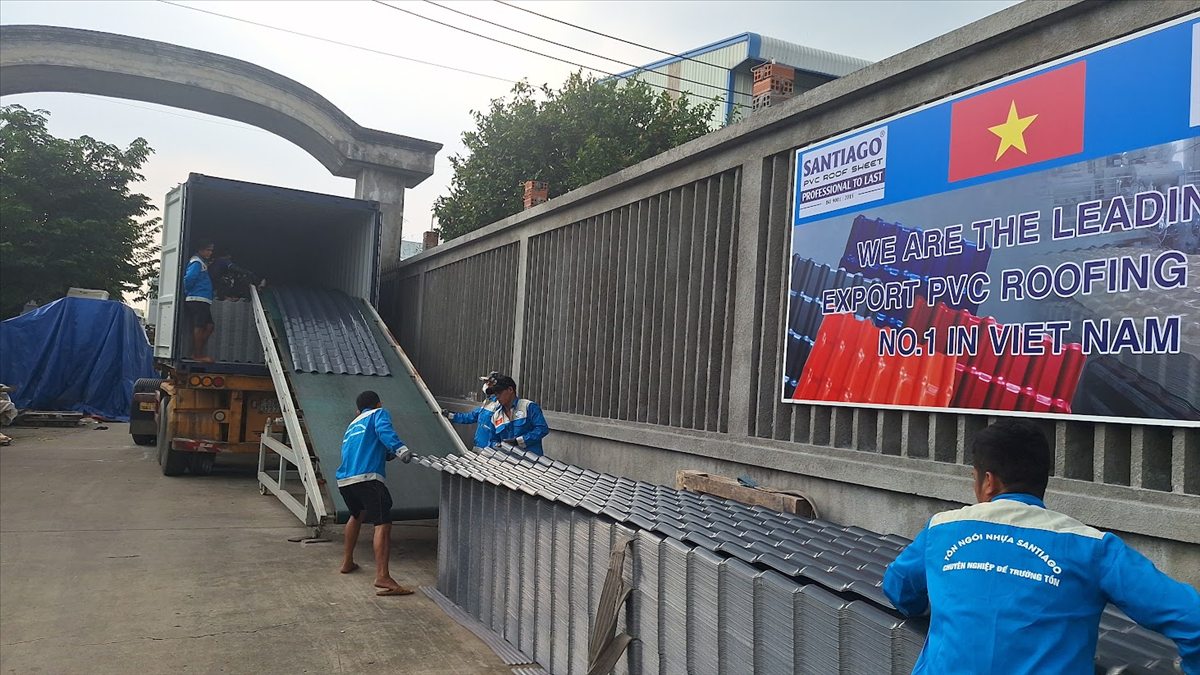
Loading Santiago roof tiles into an export container
Frequently asked questions
How far apart should purlins be for PVC roof tile sheets?
440 or 660 mm, never more than 700 mm, with each purlin under the foot of a 219 mm tile step and the top purlin 15 – 18 cm below the ridge.
How many screws does a PVC tile roof need?
4 – 5 screw sets per m² of roof, so a 64 m² roof needs about 256 – 320 sets.
Where do you screw PVC roof tile sheets?
Through the top of the wave, directly over a purlin, with a cap on every screw. Never screw in the valley where water runs.
What is the minimum slope for a PVC roof tile sheet?
20%. Santiago recommends a slope between 20% and 45%.
Does Santiago install the roof?
No. Santiago supplies sheets and accessories and sends installation videos to your installer; any metal-roof installer can lay the sheets.
Read more
- Screws and ASA caps: fixing through the top of the wave
- Roof tile accessories checklist
- Pyramid roofs on gazebos and kiosks
- ASA/PVC roof tile sheet
Sources for the figures in this article
- Profiles, 2.5–3.0 mm thickness and 10-year warranty: Santiago ASA/PVC product specification.
- HS code 3925.90.00: Harmonized System Chapter 39 (builders' ware of plastics), as applied in Vietnam's export tariff.
- Certificates of origin (Form D, AI, AK/VK, AJ/VJ, VC, CPTPP): issued by Vietnam's Ministry of Industry and Trade under the country's free trade agreements.
- Minimum order of one 40 ft container (about 5,000 m) and about 5 days for production and loading: Santiago export desk, October 2026.
Updated 03/11/2026. Santiago Import Export Co., Ltd, Vietnam. WhatsApp +84 935 391 495 (Mr. Quyen), hotline +84 965 437 316 (Mrs. Ly), email salessantiagoroofing@gmail.com.


