


Mr Quyen - Santiago. Posted 03/11/2026
A PVC roof tile is a good roof when it is at least 2.5 mm thick, has an ASA top layer, is made of virgin PVC and comes with a written warranty; thin sheets without an ASA layer are the ones that fade and turn brittle. Santiago's tile sheet keeps the space under it 6 – 8 °C cooler than bare metal sheet, cuts rain noise by about 80% and carries a 10-year warranty from 2.5 mm. Santiago has no hail test result, so it makes no hail claim.

House with a new grey tile-sheet roof, an old clay tile roof in the foreground, Vietnam
Why do some PVC roof tiles have a bad name in Brazil?
Search for "telha de pvc é boa ou ruim" and you find both answers, from people who mean them. The complaints repeat: a sheet that sags between purlins, a colour that goes pale after a few summers, a tile that cracks when someone steps on it or splits around a screw hole.
Those faults come from how a sheet is made more than from PVC itself. Many PVC tiles sold in Brazil are thin. A sheet without a UV-blocking top layer leaves bare PVC facing the sun, and over the years that is what fades and turns brittle. A thin sheet laid on purlins spaced for a heavier roof sags in the gaps.
We will not name brands or compare ours with any of them. What follows is a list of checks you can run on any sample, ours included.
How can you tell a good PVC tile from a weak one?
Ask for a sample and a full specification, then check these points. A caliper and a scale are enough for most of them.
| What to check | How to check it | Santiago tile sheet |
|---|---|---|
| Thickness | Caliper on the cut edge and on flat parts of the sheet, at several points | 2.5 or 3.0 mm; 2.5 mm is the minimum Santiago accepts for a roof |
| Weight per m² of roof | Weigh a sheet, then divide by its length × its cover width | About 5.4 kg per m² at 2.5 mm: a 4.38 m sheet (20 tile steps) covers 4.2 m² and weighs about 22.7 kg |
| Top layer | Look at a cut edge for a separate coloured skin on top | ASA top layer; four co-extruded layers with no glue, milky-white PVC base underneath |
| Material | Ask in writing whether the PVC is virgin or recycled | Virgin material, not recycled |
| Warranty | Ask for it in writing, with its conditions | 10 years for 2.5 mm and thicker, installed as Santiago recommends |
| Papers | Ask for test results and a certificate for your lot | ISO 9001:2015 certificate ICI-23087.D, Quatest test results, quality certificate (CQ) with every lot |
Weight is the quickest test. Two sheets of the same size can look the same on a shelf, and the lighter one has less material in it. Per running metre, a 2.5 mm Santiago tile sheet weighs about 5.2 kg (5.4 kg × 0.96 m of cover). If a seller cannot tell you the thickness and the weight per m² of their sheet, that tells you something too.
Does a PVC roof get very hot, and can it take the Brazilian sun?
On heat, the honest comparison is with metal. In Santiago's tests the space under the tile sheet stays 6 – 8 °C cooler than under bare metal sheet, and rain noise is about 80% lower. Santiago has not tested its sheet against cerâmica or fibrocimento, so we give no figure for those. Like any roof, the top surface itself gets warm in the midday sun; the figures above are for the room or the veranda underneath.
On sun damage, the ASA layer does the work. It showed no colour change after 2,000 hours of artificial UV; the colour is rated for 30 years and real roofs last 25 – 30 years. With no metal in the sheet there is nothing to rust. Bending strength is above 1,000 N.
Can a PVC tile roof take hail (granizo)?
We do not know, and we will not guess. Santiago has no hail test result for its tile sheet, so it makes no claim either way. If a seller says a PVC tile "aguenta granizo", ask which test, which hailstone size and which thickness, and ask to see the report.
What we can tell you: the sheet is 2.5 or 3.0 mm thick, its bending strength is above 1,000 N, and it is laid on purlins less than 700 mm apart, so the unsupported span is short. Those figures describe stiffness under a slow load, not the strike of a hailstone. If hail storms are common where you build, get a sample, talk it through with your builder and read the hail terms of your home insurance before choosing any light roof.

New orange tile-sheet roof next to an old corrugated roof, Quang Ngai, Vietnam
Can you walk on a PVC roof?
Only over the purlins, and better on a board. Between purlins the sheet carries the load on its own, and a foot in the middle of a span or in a valley puts a person's whole weight on a short piece of plastic. Lay a plank across at least two purlins and stand on the plank. Installers work this way while laying the roof, and anyone who goes up later to clean a gutter or fix an antenna should do the same. Stay off a wet roof.
Can you lay a PVC roof over an old roof?
Not by screwing the new sheets onto the old tiles. Every screw has to go through the top of the wave into a purlin, and the purlins must be less than 700 mm apart. That leaves two ways to do it. You can strip the old covering, repair the frame and add purlins at 440 or 660 mm. Or you can leave the old roof in place and build a new row of purlins above it, fixed through to the rafters or trusses.
With an old cerâmica roof, stripping the clay tiles takes a lot of weight off the frame: the tile sheet weighs about 5.4 kg per m², and clay tile is much heavier. Leaving them in place means the frame carries both roofs. In either case have the builder check the old timber before the new sheets go up.
PVC tile, cerâmica, fibrocimento or aluzinco: how do they compare?
The table only gives figures Santiago can back up. Where we have no tested figure we say so, and you should ask the maker of that material.
| Point | ASA/PVC tile sheet (Santiago) | Cerâmica (clay tile) | Fibrocimento | Aluzinco (metal sheet) |
|---|---|---|---|---|
| Look | Rows of curved tiles; 5 standard colours, more to order | Real clay tile | Usually plain grey corrugated sheet | Plain metal; tile-shaped versions exist |
| Weight on the frame | About 5.4 kg per m² at 2.5 mm | Much heavier | Ask the maker | Ask the maker |
| Heat under the roof | 6 – 8 °C cooler than bare metal sheet (Santiago test) | Not tested by Santiago | Not tested by Santiago | Bare metal is the reference in Santiago's test |
| Rain noise | About 80% lower than metal (Santiago test) | Not tested by Santiago | Not tested by Santiago | Reference in Santiago's test |
| Rust | None, no metal in the sheet | None | None | Steel core: watch cut edges and screw holes over the years |
| Written warranty | 10 years from 2.5 mm, installed as recommended | Ask the seller | Ask the seller | Ask the seller |
A PVC tile sheet is not always the right answer. On a heritage house where the roof has to match the neighbours in clay, use clay. If your old roof is sound and dry, there is no reason to replace it. The tile sheet makes the most sense on a new roof, on a frame that cannot take heavy tile, or where a metal roof is too hot and too loud.
Does a thick ASA/PVC sheet crack when you bend or cut it?
Mr Quyen stands in the Santiago factory in Vietnam and bends and cuts beige and orange sheets with metal shears while he explains in English, with captions, how the sheet holds up. Cutting with shears is a demonstration of toughness; a roof still needs purlins less than 700 mm apart.
Bending and cutting test on Santiago ASA/PVC sheets (Santiago video on YouTube).
Short videos for buyers in Brazil
Three short clips in English, filmed by Santiago. Tap a video to play it here on the page.
Is a PVC roof hotter or cooler than metal and clay?
A one-minute short with English captions: Mr Quyen compares metal and clay roofs with Santiago ASA/uPVC tile sheets, first in the factory and then on finished red and grey roofs.
Heat and rain noise: Santiago ASA/uPVC roofing explained (Santiago video on YouTube).
How tough is a 2.5 mm sheet? The truck test
Mr Quyen sets two blue sheets on the ground at the factory and a Santiago truck drives across them. It shows how tough the material is; the roof itself still needs purlins spaced less than 700 mm apart.
Truck test on Santiago ASA/PVC sheets (Santiago video on YouTube).
What happens when a flame is put to the sheets?
The short starts with a torch on the sheet stack and finishes on a warehouse roof where Mr Quyen, in a white helmet, stands on new blue sheets while installers work. A flame test is not a fire rating.
Heat test and a warehouse re-roof with uPVC sheets (Santiago video on YouTube).
Santiago – a leading exporter of ASA/PVC roofing from Vietnam
Santiago roofing is produced and loaded into containers at our factory in Vietnam. It has been exported to India since 2023, Thailand since 2024 and the USA since 2025. Every export shipment comes with a commercial invoice, packing list, bill of lading and a certificate of origin (C/O) issued by Vietnam's Ministry of Industry and Trade, which importers use to claim the duty preference of their trade agreement.
| Item | Details |
|---|---|
| HS code | 3925.90.00 (ASA/PVC roofing sheets) |
| Certificate of origin | Form D (ASEAN), Form AI (India), Form AK / VK (Korea), Form AJ / VJ (Japan), Form VC (Chile), CPTPP proof of origin |
| Shipped from | Vietnam, by container |

Certificate of origin Form AI (ASEAN–India) for Santiago ASA/PVC roofing sheets, HS 39259000, certified on 24 September 2026. Buyer details are hidden.
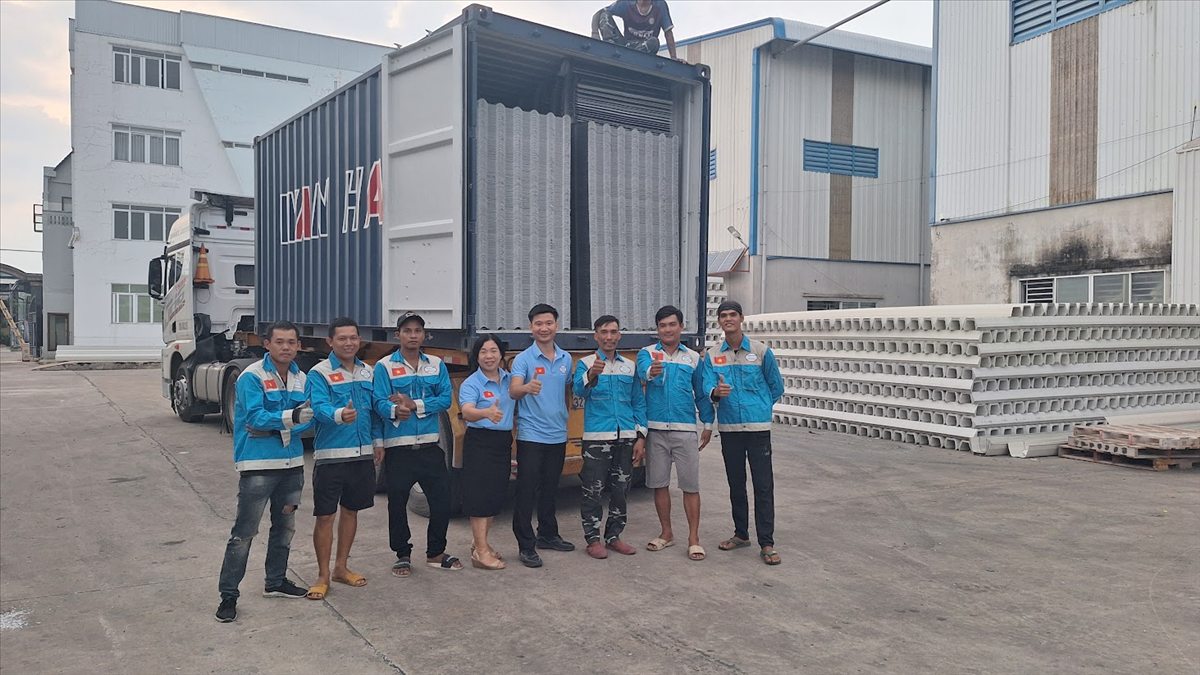
The Santiago team beside a loaded export container at the factory, November 2024
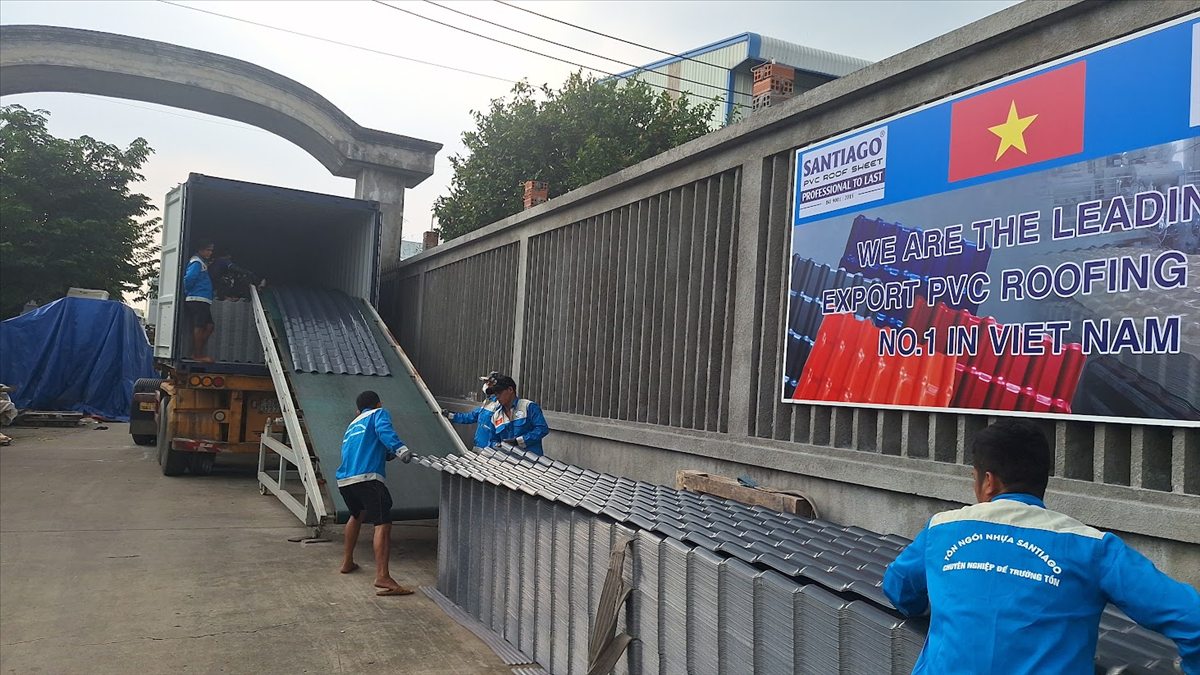
Loading Santiago roof tiles into an export container
Frequently asked questions
Is a PVC roof tile good or bad?
It depends on the sheet. A PVC tile that is at least 2.5 mm thick, has an ASA top layer, is made of virgin PVC and has a written warranty is a sound roof; thin sheets without an ASA layer are the ones that fade and turn brittle.
Does a PVC roof get very hot?
Compared with metal, no. In Santiago's tests the space under its ASA/PVC tile sheet stays 6 – 8 °C cooler than under bare metal sheet. Santiago has not tested against cerâmica or fibrocimento.
Can a PVC tile roof take hail?
Santiago has no hail test result and makes no hail claim. Its sheet is 2.5 or 3.0 mm thick with bending strength above 1,000 N on purlins less than 700 mm apart; ask for a sample and check with your builder.
Can you walk on a PVC roof?
Only over the purlins, standing on a plank laid across at least two of them. Never step in the middle of a span or in a valley, and stay off the roof when it is wet.
Can a PVC roof go on top of an old roof?
Only on new purlins less than 700 mm apart, fixed through to the rafters or trusses; the screws never go into the old tiles. The frame then carries both roofs, so the builder checks it first.
Read more
- ASA/PVC roof tile: what it is (Portuguese)
- PVC roofing sheet thickness and weight
- Santiago heat, noise and corrosion tests
- What to check before buying PVC roofing sheets
- ASA/PVC roof tile sheet
Versão em português
A telha de PVC é boa quando tem pelo menos 2,5 mm de espessura, camada superior de ASA, PVC virgem e garantia por escrito; as telhas finas sem ASA são as que desbotam e ficam quebradiças. A telha colonial ASA/PVC da Santiago deixa o ambiente 6 a 8 °C mais fresco do que a telha metálica sem isolamento, reduz o barulho da chuva em cerca de 80% e tem garantia de 10 anos a partir de 2,5 mm. A Santiago não tem teste de granizo e por isso não promete resistência a granizo.
Telha de PVC é boa ou ruim? O que conferir antes de comprar
As reclamações sobre telhado de PVC se repetem: telha que embarriga entre as terças, cor que desbota depois de alguns verões, telha que racha quando alguém pisa ou ao redor do parafuso. Isso vem do jeito como a telha é feita. Muita telha de PVC vendida no Brasil é fina, e sem uma camada que bloqueie o UV o próprio PVC fica exposto ao sol, desbota e perde resistência com os anos. Não vamos citar marcas; estas são conferências que você faz em qualquer amostra, inclusive na nossa:
- Espessura: meça com paquímetro na borda cortada e em vários pontos; a Santiago fabrica 2,5 e 3,0 mm, e 2,5 mm é o mínimo para telhado
- Peso por m²: pese a telha e divida pelo comprimento × largura útil; a da Santiago tem cerca de 5,4 kg/m² em 2,5 mm, cerca de 5,2 kg por metro linear
- Camada ASA: na borda cortada aparece uma película colorida separada por cima, sobre a base de PVC branco leitoso
- PVC virgem ou reciclado: peça a resposta por escrito
- Garantia por escrito, com as condições: na Santiago, 10 anos para 2,5 mm ou mais, instalada como recomendado
- Documentos: certificado ISO 9001:2015 ICI-23087.D, resultados de ensaio Quatest e certificado de qualidade (CQ) de cada lote
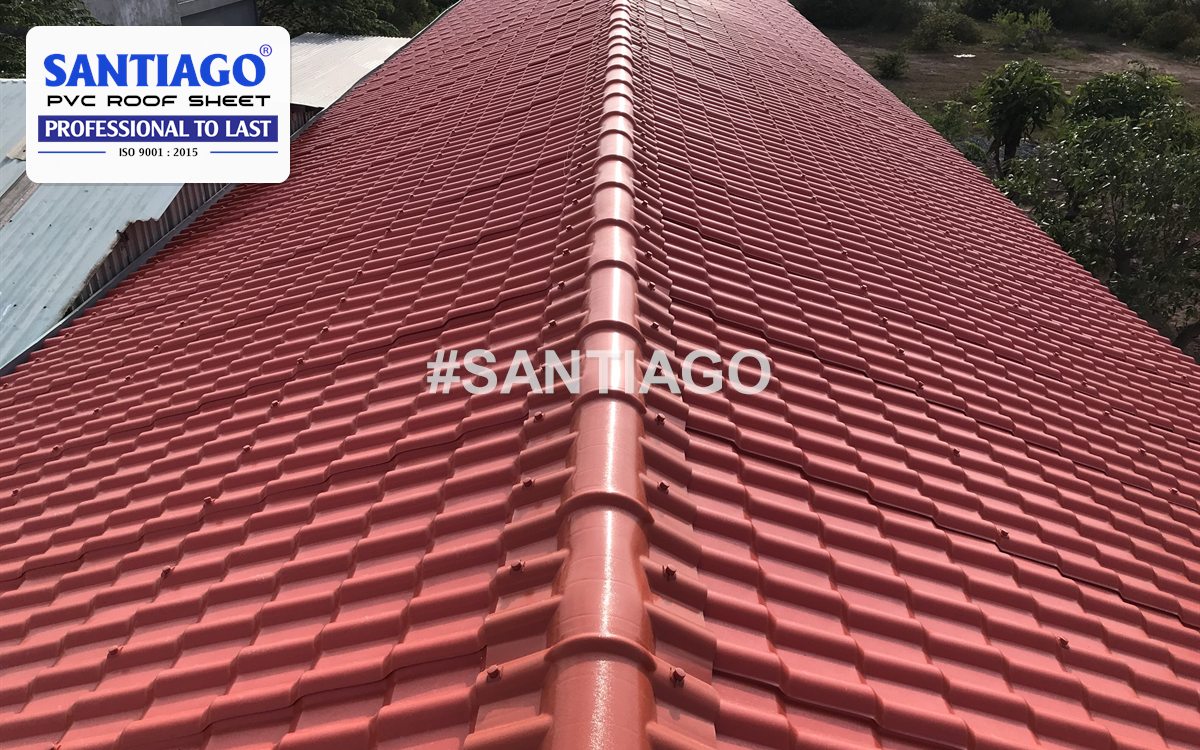
Telhado de telha ASA/PVC vermelha com cumeeira, Da Nang, Vietnã
Telhado de PVC esquenta muito? Aguenta sol?
Comparado com telha metálica, não. Nos testes da Santiago o ambiente sob a telha ASA/PVC fica 6 a 8 °C mais fresco do que sob telha metálica sem isolamento, e o barulho da chuva cai cerca de 80%. A Santiago não testou contra cerâmica nem fibrocimento, então não damos número para esses casos. Quanto ao sol, a camada ASA não mudou de cor depois de 2.000 horas de UV artificial; a cor tem estimativa de 30 anos e a vida útil real é de 25 a 30 anos. Sem metal, a telha não enferruja.
Telha de PVC aguenta granizo?
Não sabemos, e não vamos chutar. A Santiago não tem resultado de teste de granizo para a sua telha e não afirma nada sobre isso. Se um vendedor disser que a telha "aguenta granizo", pergunte qual teste, qual tamanho de pedra e qual espessura, e peça o laudo. O que sabemos: espessura de 2,5 ou 3,0 mm, resistência à flexão acima de 1.000 N e terças a menos de 700 mm, o que deixa o vão livre curto. Esses números falam de rigidez sob carga, não de impacto de pedra. Onde chove granizo com frequência, peça uma amostra e converse com o seu construtor antes de escolher qualquer cobertura leve.
Pode andar em cima do telhado de PVC? E colocar por cima do telhado antigo?
Pode andar só sobre as terças, de preferência em cima de uma tábua apoiada em pelo menos duas delas. Nunca pise no meio do vão nem no canal, e não suba com o telhado molhado. Já o telhado de PVC sobre telhado antigo não pode ser parafusado nas telhas velhas: cada parafuso vai na crista da onda e entra numa terça, com terças a menos de 700 mm. Ou se retira a cobertura antiga e se colocam terças novas a cada 440 ou 660 mm, ou se monta uma nova linha de terças acima do telhado velho, presa nos caibros ou nas tesouras. Tirar telhas de barro alivia muito a estrutura, porque a telha ASA/PVC pesa cerca de 5,4 kg/m² e a cerâmica é bem mais pesada. Peça ao construtor que confira a madeira antiga antes.
Telha PVC ou cerâmica, fibrocimento ou aluzinco?
| Ponto | Telha ASA/PVC (Santiago) | Cerâmica | Fibrocimento | Aluzinco |
|---|---|---|---|---|
| Aparência | Fileiras de telha colonial; 5 cores padrão | Telha de barro de verdade | Geralmente chapa ondulada cinza | Chapa metálica; há versões em formato de telha |
| Peso na estrutura | Cerca de 5,4 kg/m² (2,5 mm) | Bem mais pesada | Consulte o fabricante | Consulte o fabricante |
| Calor sob o telhado | 6 a 8 °C mais fresco que metal sem isolamento (teste Santiago) | Não testado pela Santiago | Não testado pela Santiago | Referência do teste Santiago |
| Barulho de chuva | Cerca de 80% menor que metal (teste Santiago) | Não testado pela Santiago | Não testado pela Santiago | Referência do teste Santiago |
| Ferrugem | Não, sem metal | Não | Não | Base de aço: atenção às bordas cortadas e furos |
| Garantia por escrito | 10 anos a partir de 2,5 mm | Consulte o vendedor | Consulte o vendedor | Consulte o vendedor |
A telha de PVC não é a resposta para tudo. Em casa antiga que precisa combinar com telhado de barro, use barro; se o telhado antigo está bom e sem goteira, não há motivo para trocar. Ela faz mais sentido em telhado novo, em estrutura que não aguenta telha pesada ou onde o telhado metálico é quente e barulhento demais. A Santiago fabrica no Vietnã e vende por contêiner a importadores; o despachante aduaneiro confirma os tributos, pois não há preferência tarifária entre o Brasil e o Vietnã para este produto.
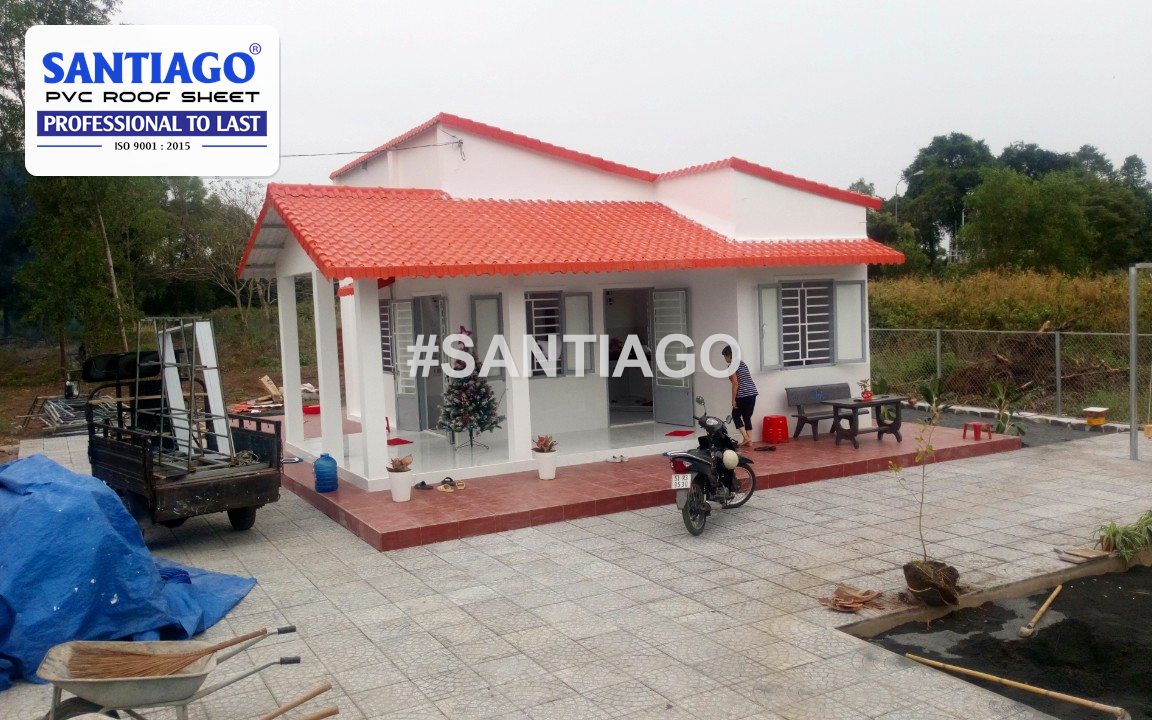
Casa térrea branca com telhado de telha laranja e quintal pavimentado, Ba Ria – Vung Tau, Vietnã
Perguntas frequentes
Telha de PVC é boa para cobrir casa?
É, quando tem pelo menos 2,5 mm, camada ASA, PVC virgem e garantia por escrito, e é instalada sobre terças a menos de 700 mm com inclinação entre 20% e 45%.
Telhado de PVC esquenta muito?
Menos que telha metálica: nos testes da Santiago, o ambiente sob a telha ASA/PVC fica 6 a 8 °C mais fresco do que sob telha metálica sem isolamento.
Telha de PVC aguenta granizo?
A Santiago não tem teste de granizo e não promete resistência a granizo. A telha tem 2,5 ou 3,0 mm e resistência à flexão acima de 1.000 N; peça amostra e consulte o seu construtor.
Dá para andar em cima do telhado de PVC?
Só sobre as terças, em cima de uma tábua apoiada em pelo menos duas delas. Nunca pise no meio do vão, no canal ou com o telhado molhado.
Sources for the figures in this article
- Profiles, 2.5–3.0 mm thickness and 10-year warranty: Santiago ASA/PVC product specification.
- About 6–8 °C cooler than bare metal sheet and about 80% less rain noise: Santiago's own comparisons on finished roofs in Vietnam.
- HS code 3925.90.00: Harmonized System Chapter 39 (builders' ware of plastics), as applied in Vietnam's export tariff.
- Certificates of origin (Form D, AI, AK/VK, AJ/VJ, VC, CPTPP): issued by Vietnam's Ministry of Industry and Trade under the country's free trade agreements.
- Minimum order of one 40 ft container (about 5,000 m) and about 5 days for production and loading: Santiago export desk, October 2026.
Updated 03/11/2026. Santiago Import Export Co., Ltd, Vietnam. WhatsApp +84 935 391 495 (Mr. Quyen), hotline +84 965 437 316 (Mrs. Ly), email salessantiagoroofing@gmail.com.


