


Mr Quyen - Santiago. Posted 03/11/2026
Santiago does not make greenhouse film or clear greenhouse covers. It makes the solid ASA/PVC roof for the buildings around the greenhouses on flower and vegetable farms: post-harvest packing sheds, nursery work sheds, fertiliser and agrochemical stores, canteens and changing rooms. Skylight sheets on 5 – 10% of the roof let through 80 – 90% of the light where they sit. A 16 × 30 m packing shed takes 62 sheets of 8.76 m, 6 of them skylight sheets.
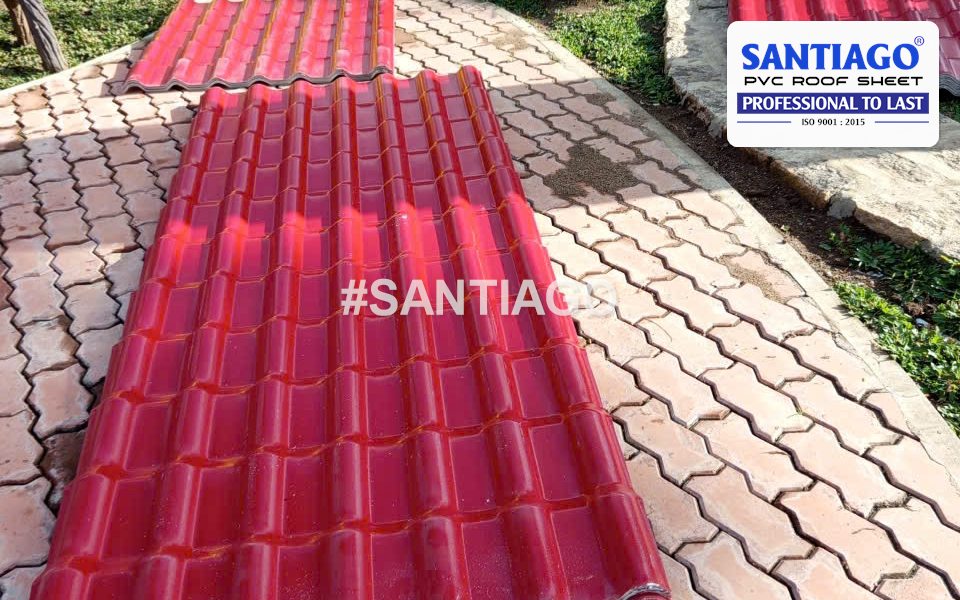
Red tile sheets laid out on a brick garden path, Vietnam
Does Santiago make a greenhouse roof (techo para invernadero)?
No, and it is better to say so at the start. Growers in Colombia, Ecuador and Peru who search for "techo para invernadero" or "mejor techo para invernadero" usually want the clear plastic film or transparent panels that roses, carnations and vegetables grow under. Santiago makes none of that. Its sheets are opaque ASA/PVC roofing in a Spanish tile profile and in 5, 6 and 11-wave corrugated profiles, plus translucent skylight sheets meant for a small share of a roof.
A flower farm is more than its greenhouses, though. Around the high plain near Bogotá and in eastern Antioquia around Rionegro, around Cayambe and Tabacundo in Pichincha and Latacunga in Cotopaxi, and in the coastal valleys of Peru where vegetables and fruit are packed, every farm has buildings where people work and goods are stored. Those are the roofs this article is about.
| Building on the farm | Roof that fits | Daylight |
|---|---|---|
| Greenhouse (growing area) | Greenhouse film or clear panels; not a Santiago product | Full light for the crop |
| Post-harvest packing shed (poscosecha) | ASA/PVC corrugated sheet, 6 or 11-wave | Skylight sheets of the same profile on 5 – 10% of the roof |
| Nursery work shed: tray filling, potting, tool and cart store | ASA/PVC corrugated sheet | Skylight sheets for working light; young plants that need full light stay in the greenhouse |
| Fertiliser and agrochemical store | ASA/PVC corrugated sheet | Little or none; the store is kept shaded |
| Canteen, offices, changing rooms, workers' houses | ASA/PVC tile sheet | Windows in the walls |
The skylight sheet gives working light, not growing light. A roof that is 90% opaque is the wrong place to raise seedlings, and we would rather lose the order than sell it for that.
Why should a packing shed or agrochemical store have a roof without metal?
The rooms on a flower farm stay damp. Packing sheds are washed down, stems come in wet, and the high Andean plains have cold nights that leave condensation under a roof by morning. Fertiliser sacks and agrochemicals add to what the air carries in a store. A metal roof sheet over that kind of room rusts from the underside, starting at the laps and the screw holes, and the rust drops onto the packing tables or the stock below.
A Santiago sheet has no metal in it, so there is nothing in the sheet to rust. It is four co-extruded layers with no glue: an ASA top layer, virgin PVC, a PVC core and a milky-white PVC base, all from virgin material, not recycled. The screws are the one metal part left on the roof. Ask your installer for corrosion-resistant screws, and fit the ASA cap that Santiago supplies over every screw head. The same reasoning for fertiliser stores in a very different climate is in our article on a fertiliser and rice store roof.
How much skylight does a post-harvest packing shed need?
Santiago's figure is skylight sheets on 5 – 10% of the roof area. Each skylight sheet lets through 80 – 90% of the light that falls on it. Santiago's skylight sheets include the 6-wave and 11-wave profiles, so a shed roofed in 11-wave sheet takes 11-wave skylight sheets, laid in the roof like any other sheet with a one-wave side lap.
Spread the skylight sheets along both roof faces rather than putting them side by side. Three strips per face over a long shed light the packing tables more evenly than one wide strip. If your packing line needs a set light level for grading, plan the electric lighting with your electrician; the skylight is there to cut daytime lighting, not to replace it.
How many sheets does a 16 × 30 m packing shed need? A worked example
Take a packing shed 16 m wide and 30 m long with a gable roof. The ridge runs along the 30 m side, the slope is 25% (the ridge stands 2.0 m above the eaves), and the roof overhangs 0.5 m at the eaves and at both gables. The roof is laid in 11-wave sheet, which covers 1.00 m per sheet after the side lap.
| Step | Working | Result |
|---|---|---|
| Roof length | 30 m + 2 × 0.5 m | 31.0 m |
| Sheets per face | 31.0 m ÷ 1.00 m | 31 sheets |
| Face length along the slope | (8.0 m + 0.5 m) × 1.031 for a 25% slope | about 8.76 m |
| Sheets for the roof | 31 × 2 faces | 62 sheets of 8.76 m |
| Roof area | 31.0 m × 8.76 m × 2 | about 543 m² |
| Skylight sheets | 3 per face × 2 | 6 sheets, about 53 m², 9.7% of the roof |
| ASA/PVC sheets | 62 − 6 | 56 sheets, about 491 running metres |
| Purlin rows | 8.76 m at under 700 mm | about 14 rows per face |
| Screw sets with ASA caps | 543 m² × 4 – 5 per m² | about 2,170 – 2,720 |
| Ridge cap | Along the ridge | 31.0 m |
| Weight of the ASA/PVC sheets | 491 m × 5.2 kg per m (2.5 mm) | about 2.55 t; about 46 kg per sheet |
Two points from the numbers. First, an 8.76 m sheet weighs about 46 kg, so plan four people to carry each one and lift it to the roof flat. Second, the whole shed uses about 543 running metres, roughly 11% of the 5,000 m that a 40 ft container holds. A farm that also needs a store, a canteen and staff housing, or a group of farms ordering together, can fill one container with mixed profiles, colours and accessories.
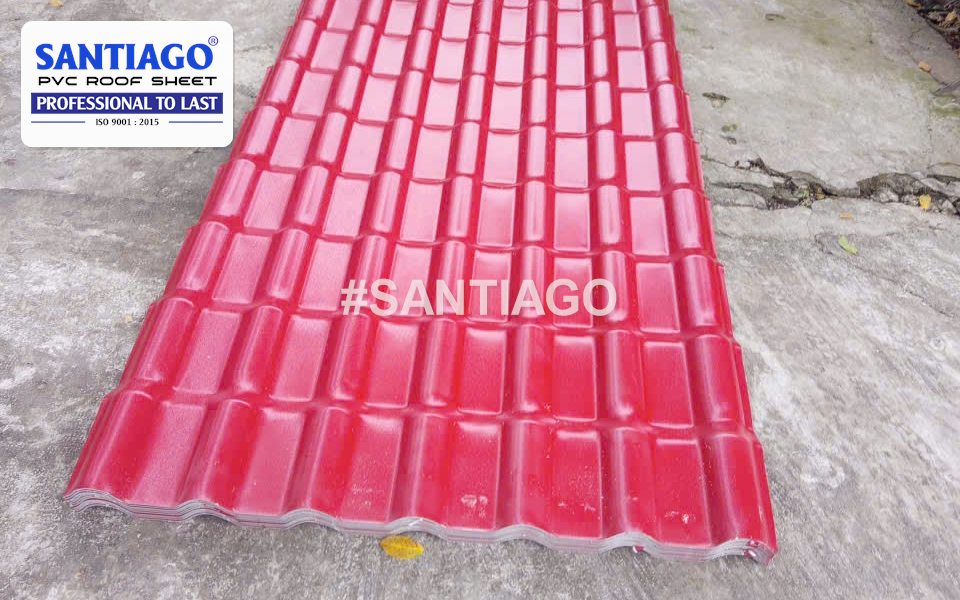
Red tile sheet laid out in a yard, Vietnam
What about the canteen, offices and workers' rooms?
These are the buildings where Santiago's tile sheet earns its place. The tile sheet is 1.05 m wide, covers 0.96 m and is cut to length in 219 mm tile steps, so from the yard it reads as rows of curved tiles. In Santiago tests the space under ASA/PVC sheet stays 6 – 8 °C cooler than under bare metal sheet, and rain noise is about 80% lower. In a canteen at lunchtime during an afternoon downpour, the second number is the one people notice.
Example: a canteen 7 × 14 m with a gable roof at 25% and 0.5 m overhangs all round. Each face is about 4.12 m along the slope, so each sheet is 19 tile steps, 4.161 m. The roof takes 16 sheets per face, 32 in total (about 133 running metres), covering about 128 m². Add about 510 – 640 screw sets with ASA caps, 15.36 m of ridge cap, 2 ridge terminals and 2 × 15.36 m of eave sealing tile. The sheet weighs about 5.4 kg per m², about 690 kg for this roof. The photos in this article show the tile sheet; the corrugated sheet for the sheds is the same ASA/PVC material in a wave profile.
Strong highland sun, cold nights and hail: what do we know?
Sun near the equator and at altitude is hard on a coloured roof. The ASA top layer showed no colour change after 2,000 hours of artificial UV; the colour is rated for 30 years and real roofs last 25 – 30 years. The bending strength of the sheet is above 1,000 N.
Santiago does not publish a hail-impact figure. Hail falls in short storms on the Sabana and in the Ecuadorian highlands, so if hail is your main concern, discuss it with your builder before choosing any roof. For farms near Ecuador's active volcanoes, our article on volcanic ash and PVC tile roofs covers clearing ash from a light roof.
How should the shed roof be fixed?
Purlins go less than 700 mm apart; for the tile sheet that means 440 or 660 mm, one under the foot of each tile step. The top purlin sits 15 – 18 cm below the ridge, and the roof slope stays between 20% and 45%. Pre-drill 6 mm holes, drive 70 mm screws through the top of the wave over a purlin, use 4 – 5 screw sets per m² and cap each one. Never screw in the valley, where the water runs. Each sheet laps the next by one wave. Santiago supplies the sheets and accessories and sends installation videos for your contractor; it does not install.
How do the sheets reach Buenaventura, Guayaquil or Callao?
The minimum export order is one 40 ft container, about 5,000 m of sheet, with colours, profiles, skylight sheets and accessories mixed. Production takes about 5 days. The goods ship under HS code 3925.90.00 with a commercial invoice, packing list, bill of lading and a quality certificate (CQ) for every lot. The factory works under ISO 9001:2015 certificate ICI-23087.D and the sheet has Quatest test results.
For Peru, Santiago issues a CPTPP proof of origin for shipments into Callao. For Colombia (Buenaventura) and Ecuador (Guayaquil), check the duty rate and the papers customs will want with your customs broker before the first order. The price is quoted per order in writing, by profile, thickness, colour, sheet lengths, accessories and quantity. Samples are free; the buyer pays the courier.
What does a red tile-sheet roof look like on a finished building?
Mr Quyen presents, in English, a restaurant in Da Nang, Vietnam, roofed with red Santiago ASA/PVC tile sheets and filmed from a drone. The video also shows red, blue and navy tile samples on a wooden shelf and a house with a blue tile roof.
A restaurant roof in Da Nang with Santiago ASA/PVC tile sheets (Santiago video on YouTube).
Short videos for farms in Colombia, Ecuador and Peru
Two more English shorts from the Santiago YouTube channel. Each one is about a minute or less.
How do tile sheets cope with sun and heavy rain?
This one-minute short moves from red tile sheets going up onto a house to a flame test on a stack of sheets, then a blue warehouse roof under installation. A flame test is a demonstration, not a fire rating.
Santiago PVC roofing tiles in real conditions (Santiago video on YouTube).
What does a tile sheet look like up close at the factory?
Filmed inside the Santiago factory: a worker steps onto a white tile sheet, red and blue sheets get a torch test, and the last scene is the team beside an export container.
Santiago tile sheets at the factory (Santiago video on YouTube).
Santiago – a leading exporter of ASA/PVC roofing from Vietnam
Santiago roofing is produced and loaded into containers at our factory in Vietnam. It has been exported to India since 2023, Thailand since 2024 and the USA since 2025. Every export shipment comes with a commercial invoice, packing list, bill of lading and a certificate of origin (C/O) issued by Vietnam's Ministry of Industry and Trade, which importers use to claim the duty preference of their trade agreement.
| Item | Details |
|---|---|
| HS code | 3925.90.00 (ASA/PVC roofing sheets) |
| Certificate of origin | Form D (ASEAN), Form AI (India), Form AK / VK (Korea), Form AJ / VJ (Japan), Form VC (Chile), CPTPP proof of origin |
| Shipped from | Vietnam, by container |
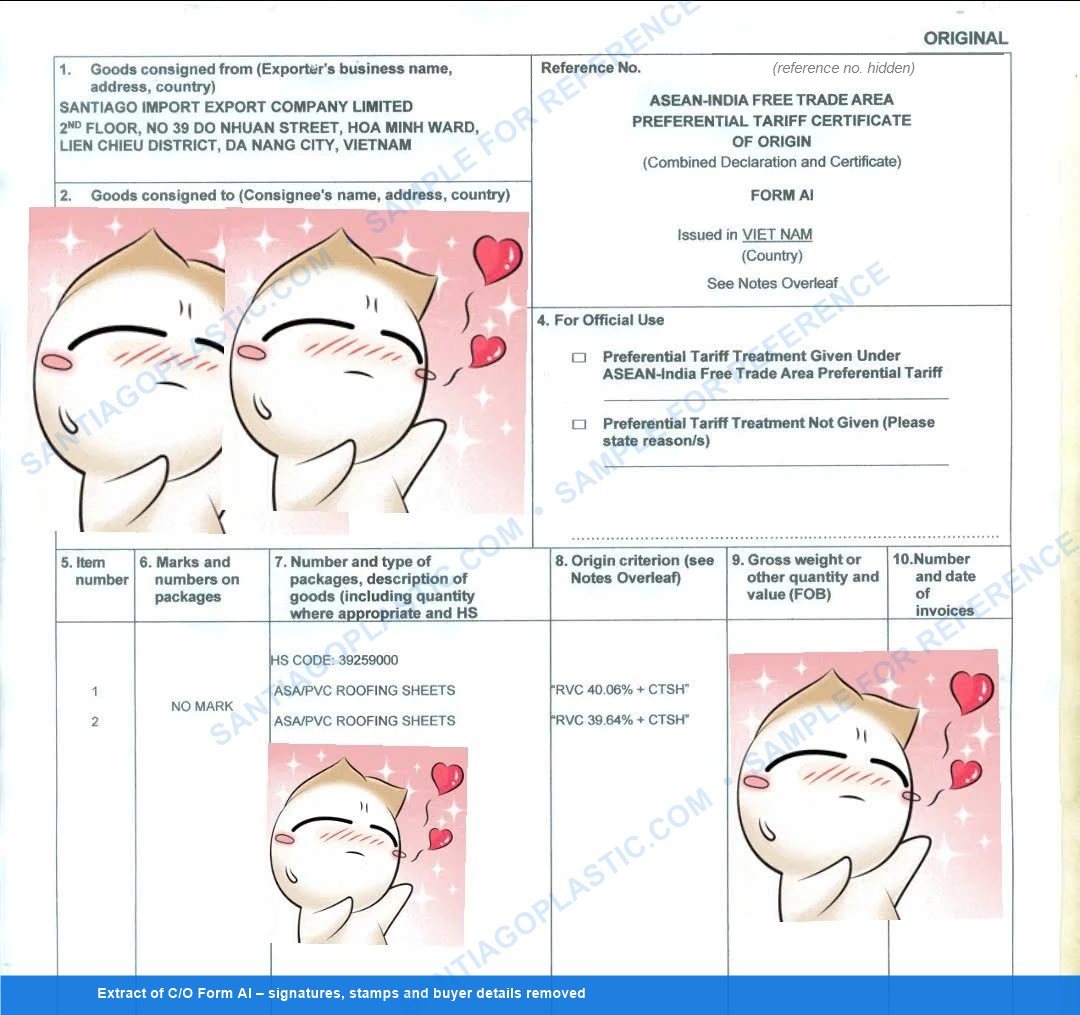
Certificate of origin Form AI (ASEAN–India) for Santiago ASA/PVC roofing sheets, HS 39259000, certified on 24 September 2026. Buyer details are hidden.
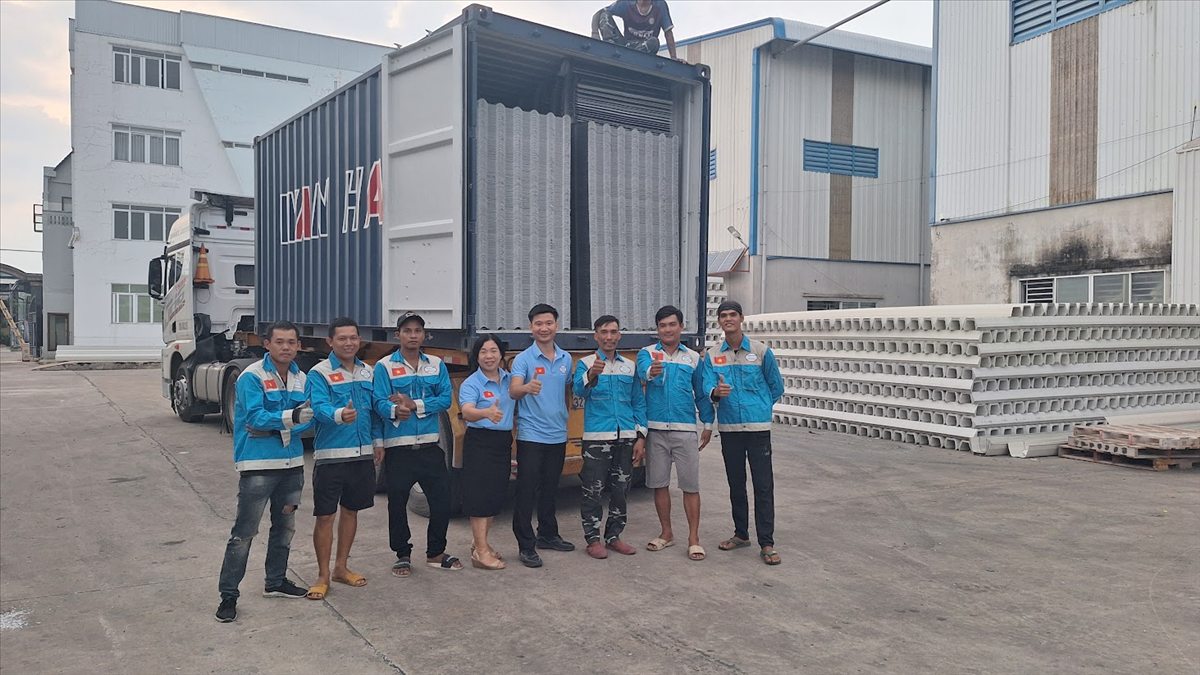
The Santiago team beside a loaded export container at the factory, November 2024
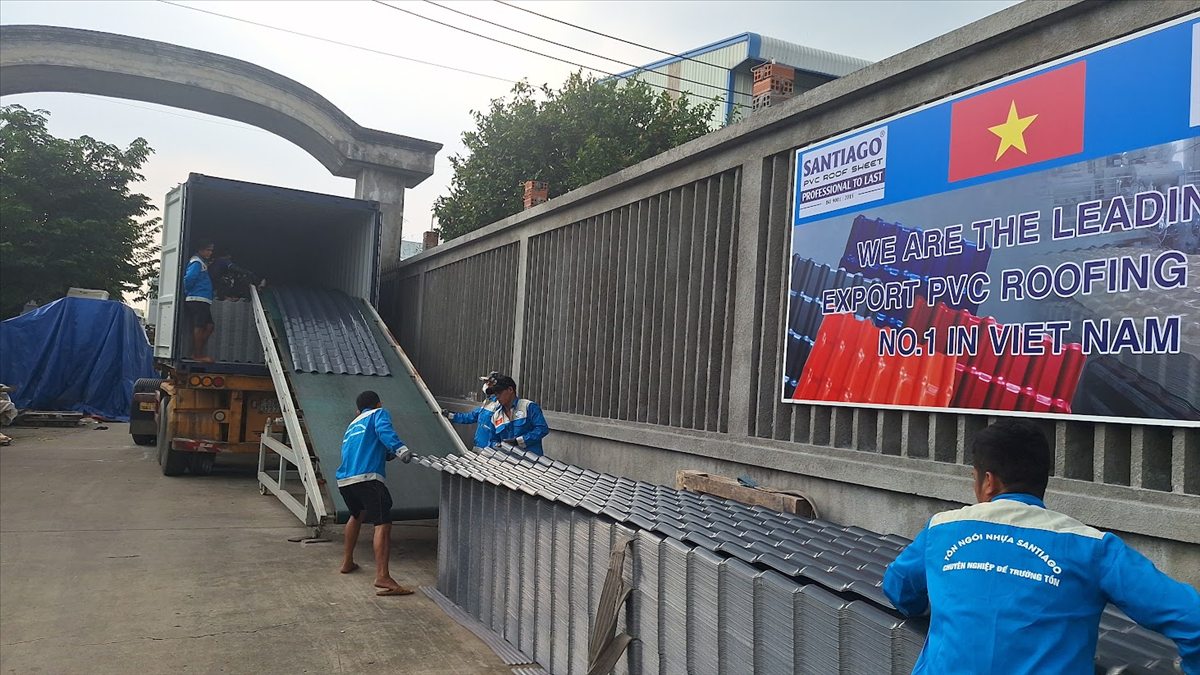
Loading Santiago roof tiles into an export container
Frequently asked questions
Does Santiago make greenhouse roofing film or clear greenhouse panels?
No. Santiago makes opaque ASA/PVC roof sheets in tile and corrugated profiles, and translucent skylight sheets for 5 – 10% of a roof. They are for packing sheds, stores and workers' buildings around the greenhouses, not for the growing area.
How much skylight should a packing shed roof have?
About 5 – 10% of the roof area in skylight sheets, which let through 80 – 90% of the light. A 16 × 30 m shed with three skylight strips per face comes to 6 sheets, about 9.7% of the roof.
How many sheets does a 16 × 30 m packing shed need?
With 0.5 m overhangs and a 25% slope, 62 sheets of 11-wave profile at 8.76 m: 56 ASA/PVC and 6 skylight sheets, about 543 m² of roof and 2,170 – 2,720 screw sets.
Will a metal-free roof rust over a fertiliser store?
The sheet has no metal, so it cannot rust. The screws are metal: ask your installer for corrosion-resistant screws and fit an ASA cap on each one.
Can Santiago ship to Colombia, Ecuador and Peru?
Yes, by the 40 ft container (about 5,000 m, mixed) to Buenaventura, Guayaquil or Callao. Peru shipments carry a CPTPP proof of origin; for Colombia and Ecuador, your customs broker confirms the duty rate.
Read more
- Skylight roofing sheets: which profile and how many
- PVC tile or polycarbonate: which to use where (Spanish)
- Importing PVC roof tiles from Vietnam to Peru (Spanish)
- Roofs for fertiliser and rice stores
- Skylight roofing sheet, 11 waves
Versión en español
Santiago no fabrica plástico para invernadero ni cubiertas transparentes para cultivo. Fabrica el techo sólido de ASA/PVC para los edificios que rodean los invernaderos en fincas de flores y hortalizas: galpones de poscosecha, cuartos de agroquímicos y fertilizantes, bodegas, comedores y vestieres. Las tejas traslúcidas se ponen en el 5 – 10% del techo y dejan pasar el 80 – 90% de la luz. Un galpón de poscosecha de 16 × 30 m lleva 62 láminas de 8,76 m, 6 de ellas traslúcidas.
¿Santiago fabrica techo para invernadero?
No. Quien busca "techo para invernadero", "techo plástico para invernadero" o "techo transparente para invernadero" suele necesitar el plástico o los paneles claros bajo los que crecen las rosas, los claveles o las hortalizas, y eso Santiago no lo fabrica. Lo que sí fabrica es teja española de ASA/PVC, láminas trapezoidales de 5, 6 y 11 ondas y tejas traslúcidas para una parte pequeña del techo. En una finca de la Sabana de Bogotá, del oriente antioqueño, de Cayambe, Tabacundo o Latacunga, o en un valle de la costa peruana, esos productos sirven para los edificios donde se trabaja y se guarda la carga.
| Edificio de la finca | Techo recomendado | Luz natural |
|---|---|---|
| Invernadero (zona de cultivo) | Plástico o panel transparente; no es producto de Santiago | Luz total para el cultivo |
| Galpón de poscosecha | Lámina trapezoidal ASA/PVC de 6 u 11 ondas | Tejas traslúcidas del mismo perfil en el 5 – 10% del techo |
| Galpón de trabajo del vivero (llenado de bandejas, herramientas) | Lámina trapezoidal ASA/PVC | Luz para trabajar; las plántulas que necesitan sol pleno siguen en el invernadero |
| Bodega de fertilizantes y agroquímicos | Lámina trapezoidal ASA/PVC | Poca o ninguna |
| Comedor, oficinas, vestieres, vivienda | Teja española ASA/PVC | Ventanas en los muros |
¿Cuánta teja traslúcida lleva un galpón de poscosecha?
La cifra de Santiago es el 5 – 10% del área del techo. En un galpón de 16 × 30 m con techo a dos aguas, pendiente del 25% y aleros de 0,5 m, el techo mide 31,0 m de largo y cada agua 8,76 m. Con lámina de 11 ondas (1,00 m útil) salen 31 láminas por agua, 62 en total y unos 543 m² de techo. Tres franjas traslúcidas por agua dan 6 tejas traslúcidas, cerca del 9,7% del techo. Se necesitan unos 2.170 – 2.720 juegos de tornillo con capuchón ASA y 31,0 m de caballete. Cada lámina de 8,76 m pesa unos 46 kg: cuatro personas para cargarla.
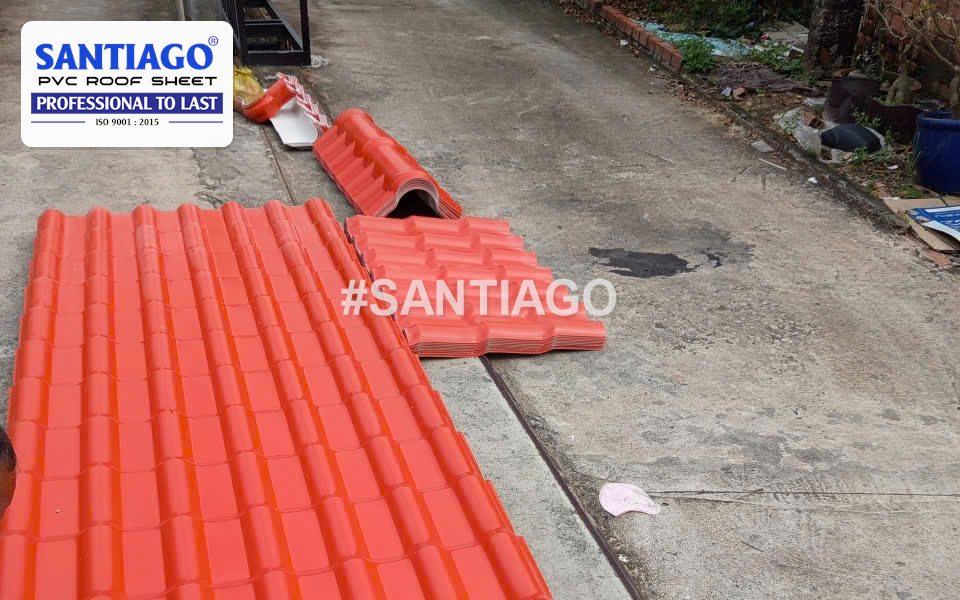
Tejas de PVC naranjas entregadas en un callejón, Vietnam
¿Por qué no usar lámina metálica en la bodega de agroquímicos y en el comedor?
Los galpones de poscosecha se lavan, los tallos entran mojados y las noches frías de la sierra dejan condensación bajo el techo. Sobre una bodega de fertilizantes, la lámina metálica se oxida por debajo, empezando por los traslapos y los huecos de los tornillos. La lámina de Santiago no tiene metal, así que no se oxida. Los tornillos sí son metálicos: pida a su instalador tornillos resistentes a la corrosión y ponga un capuchón ASA en cada uno. En el comedor y la vivienda conviene la teja española: según pruebas de Santiago, bajo la lámina ASA/PVC hace 6 – 8 °C menos que bajo la lámina metálica sin aislamiento, y el ruido de la lluvia baja cerca de un 80%. Santiago no publica una cifra de resistencia al granizo; si el granizo es su principal preocupación, revíselo con su constructor.
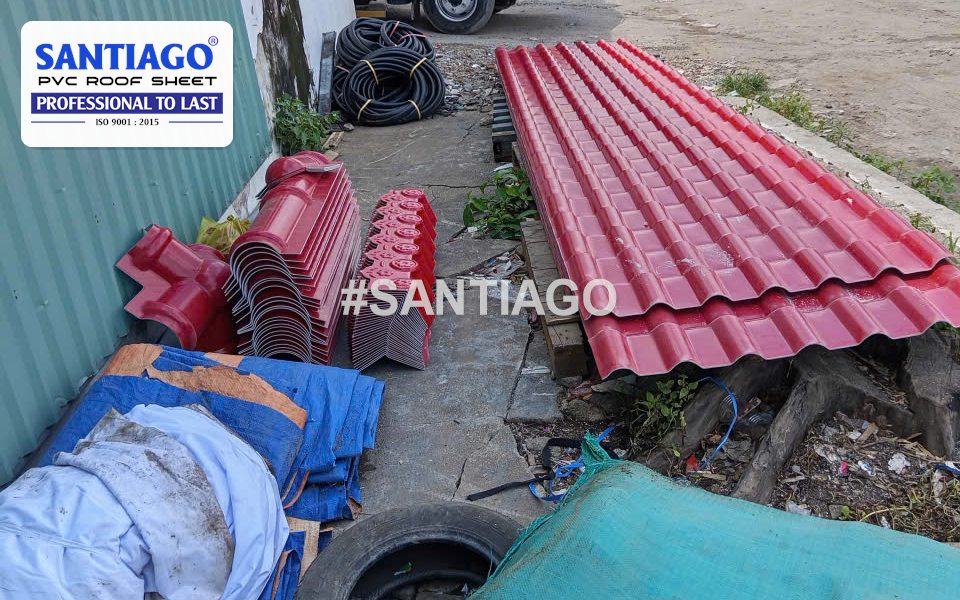
Tejas rojas y piezas de caballete junto a un camión, Vietnam
¿Cómo llega el pedido a Buenaventura, Guayaquil o Callao?
El pedido mínimo es un contenedor de 40 pies, unos 5.000 m de lámina, con perfiles, colores, tejas traslúcidas y accesorios mezclados. La producción tarda unos 5 días y la mercancía viaja con la partida arancelaria 3925.90.00, factura comercial, lista de empaque, conocimiento de embarque y certificado de calidad (CQ) por lote, bajo el certificado ISO 9001:2015 ICI-23087.D. Para Perú, Santiago emite la prueba de origen CPTPP. Para Colombia y Ecuador, consulte la tasa de arancel con su agente de aduanas antes del primer pedido. El precio se cotiza por escrito en cada pedido. Las muestras son gratis; el comprador paga el courier. Santiago no instala: entrega láminas, accesorios y videos de instalación.
Preguntas frecuentes
¿Santiago vende techo para invernadero?
No fabrica plástico ni paneles transparentes para cultivo. Fabrica techos ASA/PVC para galpones de poscosecha, bodegas y comedores de la finca, con tejas traslúcidas en el 5 – 10% del techo.
¿Sirve para un techo tipo invernadero para ganado?
Para un establo o corral cubierto, la lámina ASA/PVC con tejas traslúcidas en el 5 – 10% del techo da sombra y algo de luz natural. No es un techo transparente: el 90 – 95% del techo queda opaco.
¿Cuántas láminas lleva un galpón de poscosecha de 16 × 30 m?
Con pendiente del 25% y aleros de 0,5 m, 62 láminas de 11 ondas de 8,76 m: 56 de ASA/PVC y 6 traslúcidas, unos 543 m² de techo.
Sources for the figures in this article
- Profiles, 2.5–3.0 mm thickness and 10-year warranty: Santiago ASA/PVC product specification.
- About 6–8 °C cooler than bare metal sheet and about 80% less rain noise: Santiago's own comparisons on finished roofs in Vietnam.
- HS code 3925.90.00: Harmonized System Chapter 39 (builders' ware of plastics), as applied in Vietnam's export tariff.
- Certificates of origin (Form D, AI, AK/VK, AJ/VJ, VC, CPTPP): issued by Vietnam's Ministry of Industry and Trade under the country's free trade agreements.
- Minimum order of one 40 ft container (about 5,000 m) and about 5 days for production and loading: Santiago export desk, October 2026.
Updated 03/11/2026. Santiago Import Export Co., Ltd, Vietnam. WhatsApp +84 935 391 495 (Mr. Quyen), hotline +84 965 437 316 (Mrs. Ly), email salessantiagoroofing@gmail.com.


