


Mr Quyền - Santiago. Posted 25/11/2026
A broken skylight sheet in a corrugated roof is replaced, not patched: measure the old sheet's waves, rib height, width and length, unscrew it, lift the lap of the sheet above, slide it out and fit a new sheet of the same profile. On a Santiago roof the new sheet laps one full rib at the sides and is screwed at every purlin through pre-drilled 6 mm holes with 70 mm screws and ASA caps. Nobody stands on the skylight while doing it.
Santiago Import Export Co., Ltd (Vietnam) makes ASA/PVC roof tile sheets and corrugated roofing sheets and exports them by the container. WhatsApp +84 935 391 495 (Mr. Quyen), hotline +84 965 437 316 (Mrs. Ly).
This guide follows the job in order: deciding the sheet has to go, measuring it so the new one fits, setting up to work safely, taking the old sheet out, fixing the new one, deciding whether to replace one sheet or the whole run, and ordering replacements with roof sheets.
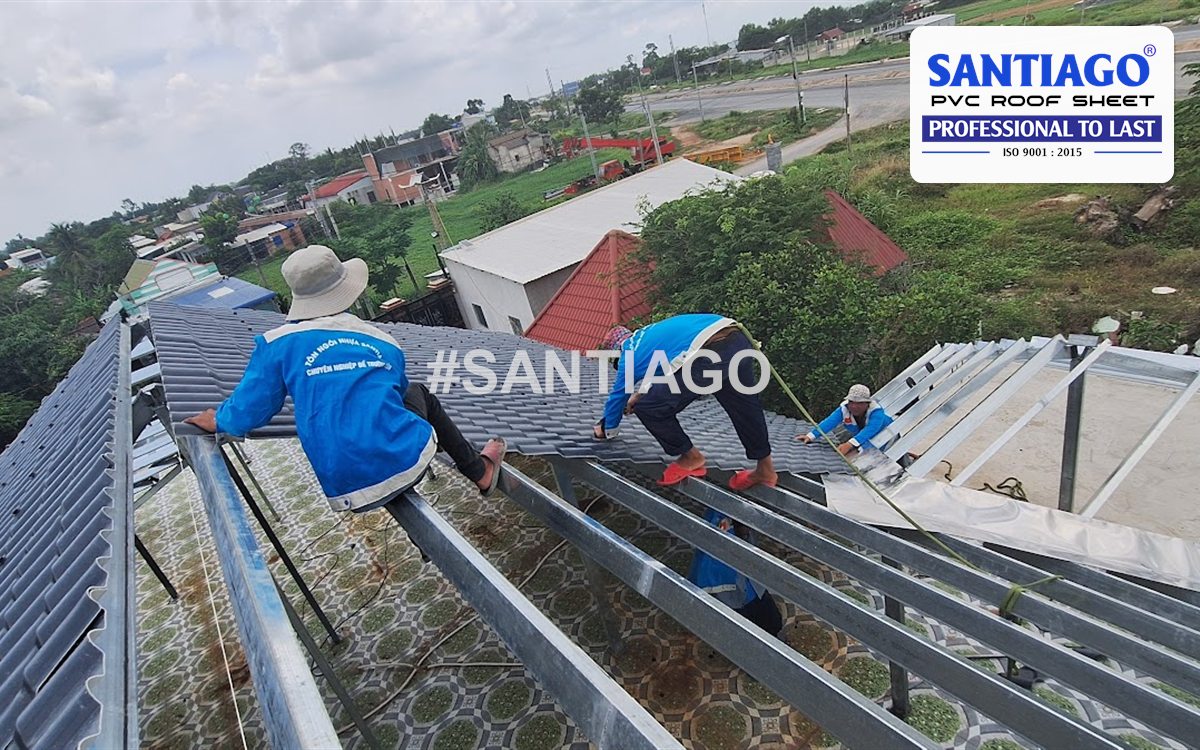
Two installers fixing grey tile-profile sheets on steel purlins next to a section of translucent roofing, Vietnam
When does a skylight sheet need replacing?
A skylight sheet needs replacing when it is cracked, holed, brittle or so cloudy that it no longer lights the floor. Tape and sealant can hold out rain for a few days on a small crack, but a crack in a translucent sheet keeps growing with heat and wind, so treat any patch as a stopgap until the new sheet arrives.
- A crack or hole, often around a screw or along a rib
- A sheet that has gone brittle: it chips at the edge when pressed lightly with a tool from a safe position
- Heavy yellowing or clouding that has cut the daylight inside
- Water marks on the floor under a lap, after the screws and laps have been checked
- Damage after a storm, a fallen branch or someone stepping on it
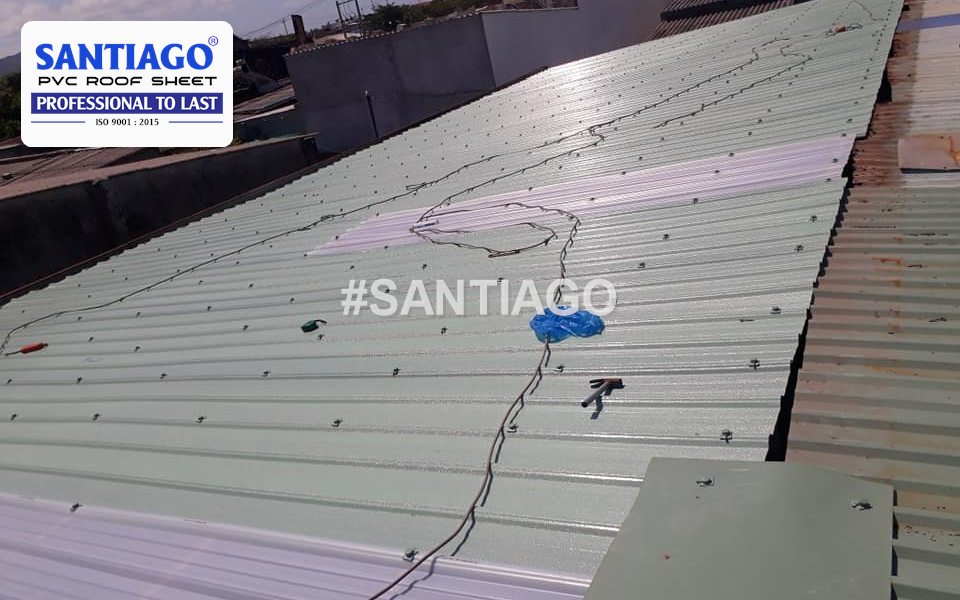
White skylight sheet set into a green 6-wave corrugated roof, seen from above, Vietnam
What do you measure before ordering a replacement skylight sheet?
Measure the profile first, then the size. The new skylight has to nest rib on rib with the roof sheets on both sides, so the number of waves and the rib height matter more than the colour. Take the measurements on a sheet next to the broken one, from a board or ladder, not by standing on the roof.
| What to measure | How | Why |
|---|---|---|
| Number of waves | Count the ribs across one sheet: 5, 6 or 11 on Santiago corrugated roofs | The replacement must have the same profile |
| Rib height and spacing | Measure from valley to top of rib, and from rib to rib | Santiago's 11-wave skylight has the same 20 mm ribs as its 11-wave ASA/PVC sheet; a 6-wave match is checked before production |
| Sheet width | Overall width, and the width it covers once lapped | Sets the side laps |
| Length | Along the slope, from end lap to end lap | Sheets are cut to length at the factory |
| Screw positions | Distance of each purlin from the eave | The new sheet is drilled at the same purlins |
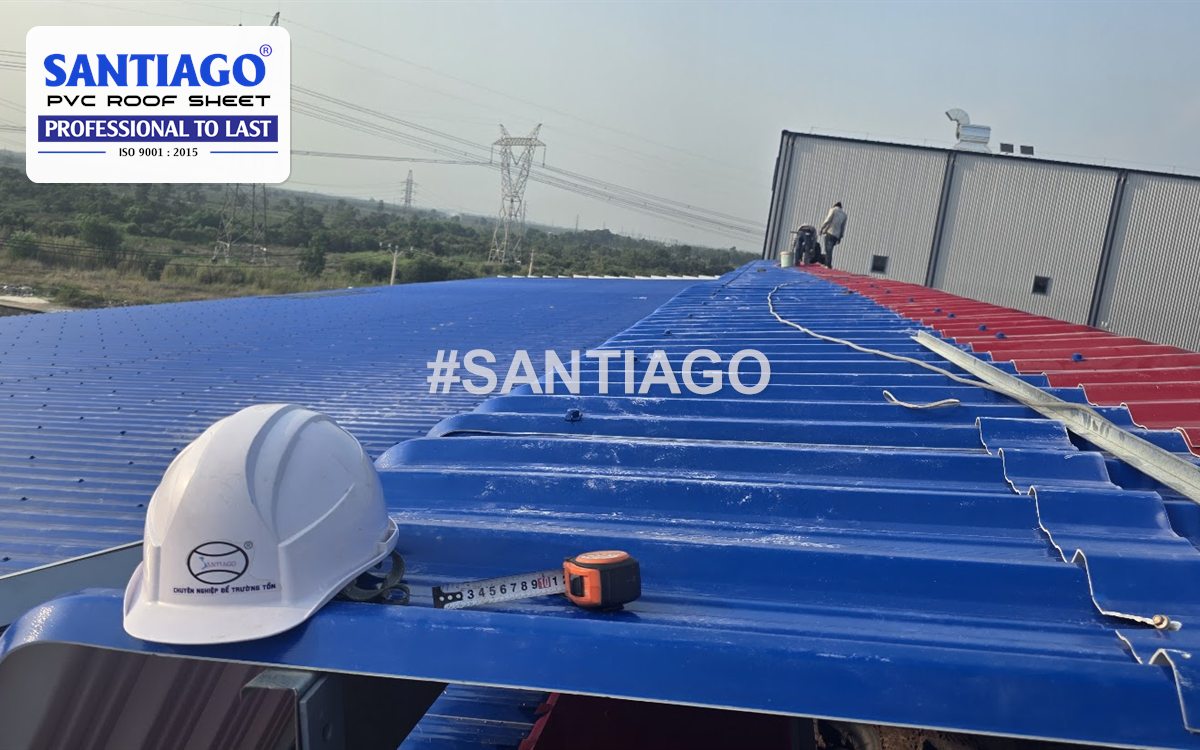
Safety helmet and tape measure on a blue corrugated roof during work on a factory roof, Vietnam
If the roof sheets came from another maker, send Santiago the profile drawing or a photo of a cut end with the rib height and spacing marked. More on matching profiles and how many skylights a roof needs is in our guide to choosing the skylight profile and number of sheets.
How do you work safely when replacing a skylight sheet?
Treat every skylight on the roof, broken or not, as a surface that will not hold a person. The UK Health and Safety Executive (HSE) lists rooflights as fragile roofing and a common cause of serious and fatal falls through roofs; its guidance asks for crawling boards, covers, guard rails or nets wherever people work near them.
- Work from boards that span at least three purlins, or from a platform or lift below the roof
- Cover or net the opening as soon as the old sheet is out
- Never kneel or lean on the neighbouring skylight sheets
- Pick a dry morning with little wind; a sheet lifted in a gust acts like a sail
- Keep people out of the floor area under the opening
How do you take out a broken skylight sheet?
The broken sheet comes out from under the sheet above it, so the job starts by freeing the laps. Work from the top end of the sheet down.
- Remove every screw along the broken sheet, including the screws through its side laps with the sheets on both sides
- Loosen the screws at the bottom of the sheet above, so its end lap can be lifted a few centimetres
- Lift that lap with a flat bar on a piece of timber, so the upper sheet does not crack
- Slide the broken sheet down and out, and lower it off the roof by hand or rope, not by throwing
- Scrape off old sealant tape and wipe the lap areas dry
- Check the purlins under the opening: they should be less than 700 mm apart, straight and free of loose rust
If a purlin under the skylight has rusted through or sagged, fix it before the new sheet goes in. Our guide on checking an old roof frame before re-roofing lists what to look for.
How do you fix the new skylight sheet so it does not leak?
The new skylight goes in exactly as the old one should have: under the sheet above, over the sheet below, nested one full rib over its neighbours, and screwed at every purlin through the top of the wave. Pre-drilled holes slightly wider than the screw let the sheet move with heat without cracking.
- Side laps of one full rib, with sealant tape along the rib on low slopes or exposed roofs
- End laps of at least 150 mm, upper sheet over lower sheet, with a line of sealant tape across
- Pre-drill 6 mm holes through the top of the wave, never in the valley
- 70 mm screws with sealing washer and ASA cap, tightened until the washer seals and no further
- If an old hole in a neighbouring sheet has worn oval, seal it and drill a new hole on the next wave top instead of reusing it
- Re-tighten the loosened screws on the sheet above last
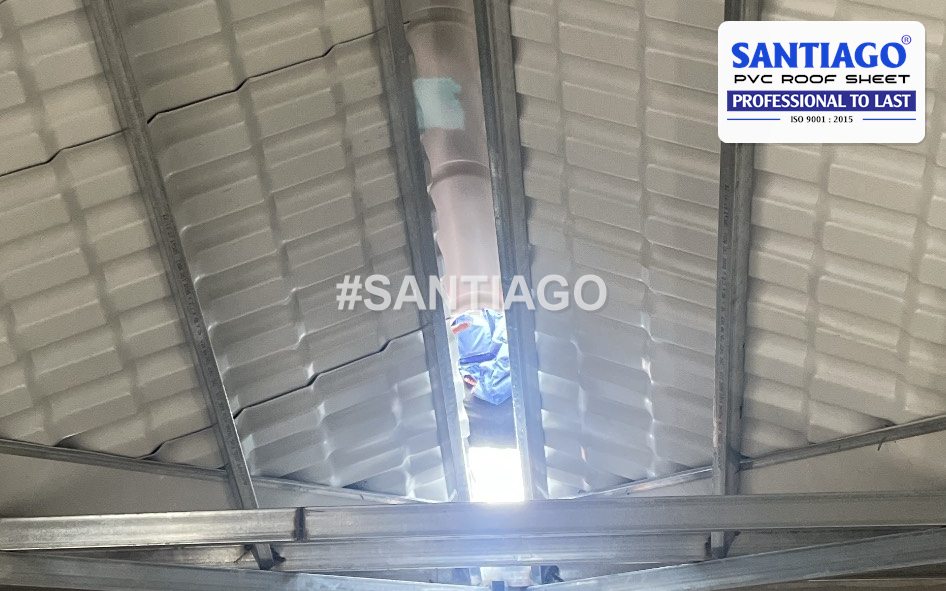
Daylight coming through a skylight strip between tile-profile sheets, seen from under the roof on steel purlins, Vietnam
The same lap and screw rules for a new roof are set out step by step in our guide on installing skylight sheets in a corrugated roof without leaks.
How are sheets screwed down at every purlin on site?
In under a minute the short goes from the Santiago factory floor to a grey tile-profile roof on site: some sheets already fixed, installers screwing down the rest through the top of the wave, and a finished run next to the gutter. A replacement skylight sheet is fixed the same way, at every purlin.
Santiago sheets being screwed down on site (Santiago video on YouTube).
More short videos for carport roofs
Both clips below come from Santiago's own YouTube channel and were filmed at the factory in Vietnam or on Santiago roofs.
How are sheets fixed to the frame?
Installers screw grey Santiago tile sheets down on a roof while Mr Quyen and a colleague walk along the finished section near the gutter. The short opens in the factory with a green sheet.
Santiago uPVC tile roofs on site (Santiago video on YouTube).
Can a worker stand on a 2.5 mm sheet on the floor?
A short factory clip: a white tile sheet takes a worker's weight on the floor, a torch is aimed at red and blue sheets, and the Santiago team lines up in front of a container.
Santiago tile sheets at the factory (Santiago video on YouTube).
Should you replace one skylight sheet or the whole run?
Replace the whole run when the other skylights are the same age and already brittle or cloudy. A single new sheet in an old run lets in noticeably more light than its neighbours, and the next old sheet to crack means another trip onto the roof with the same safety set-up. A single replacement makes sense when only one sheet was damaged by an impact and the rest are sound.
A yearly look along the skylight runs from a safe position, as in our roof maintenance checklist before the rainy season, finds brittle sheets before they break.
Can replacement skylight sheets be ordered with corrugated roof sheets?
Yes. Skylight sheets, ASA/PVC corrugated sheets in 5-wave, 6-wave and 11-wave profiles, ridge pieces and screw sets with ASA caps can share one 40 ft container, which holds about 5,000 m of sheet. Ordering spare skylights with a roof or a re-roof keeps the profile identical when one has to be changed later.
- Give the roof sheet profile and colour, then the skylight profile and rib measurements
- Give the length of each skylight along the slope
- Say how many sheets are replacements and how many are spares
- Add screw sets and sealant tape to the same order
For skylights that match a factory, warehouse or farm roof, start from the ASA/PVC corrugated roofing sheets in 5, 6 and 11 waves and send the measurements through the Santiago quotation form.
Santiago – a leading exporter of ASA/PVC roofing from Vietnam
Santiago roofing is produced and loaded into containers at our factory in Vietnam. It has been exported to India since 2023, Thailand since 2024 and the USA since 2025. Every export shipment comes with a commercial invoice, packing list, bill of lading and a certificate of origin (C/O) issued by Vietnam's Ministry of Industry and Trade, which importers use to claim the duty preference of their trade agreement.
| Item | Details |
|---|---|
| HS code | 3925.90.00 (ASA/PVC roofing sheets) |
| Certificate of origin | Form D (ASEAN), Form AI (India), Form AK / VK (Korea), Form AJ / VJ (Japan), Form VC (Chile), CPTPP proof of origin |
| Shipped from | Vietnam, by container |
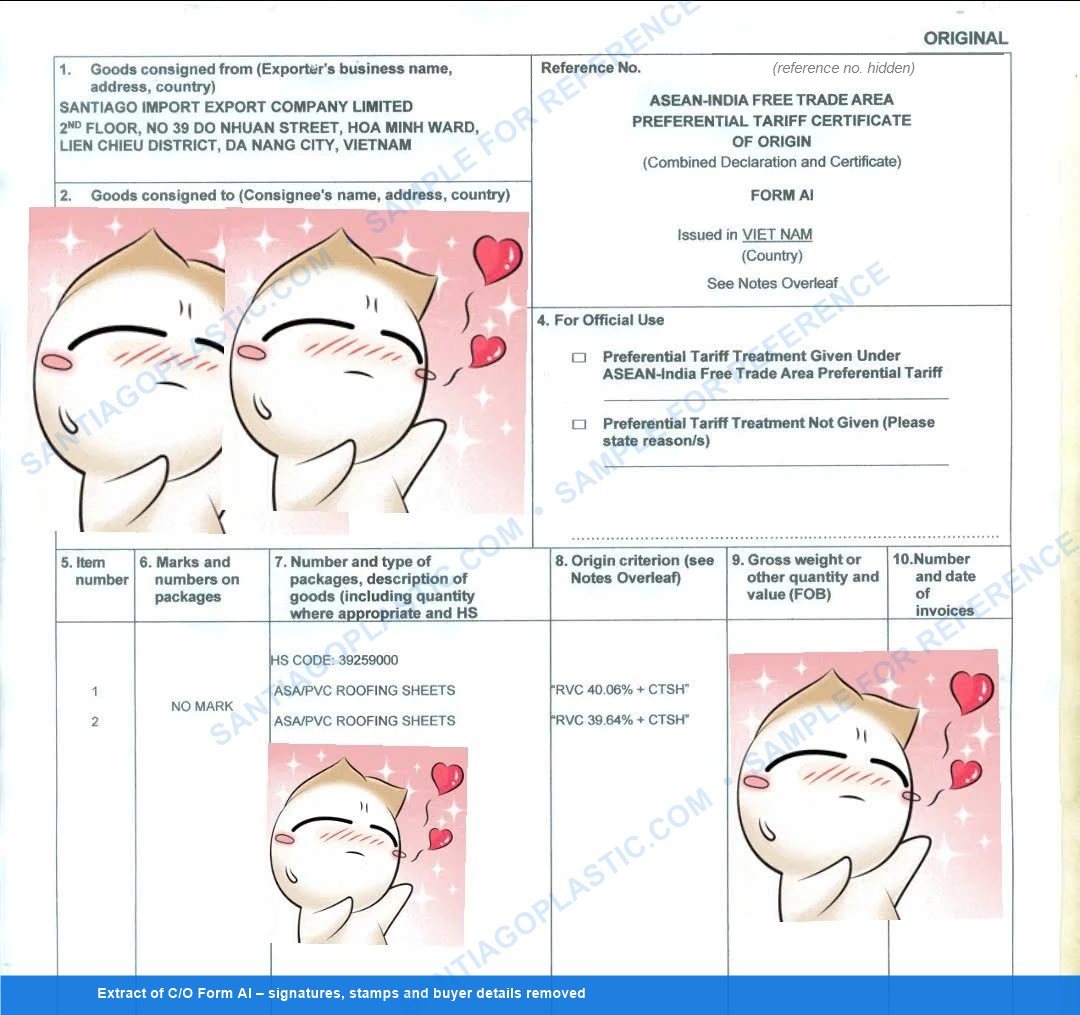
Certificate of origin Form AI (ASEAN–India) for Santiago ASA/PVC roofing sheets, HS 39259000, certified on 24 September 2026. Buyer details are hidden.
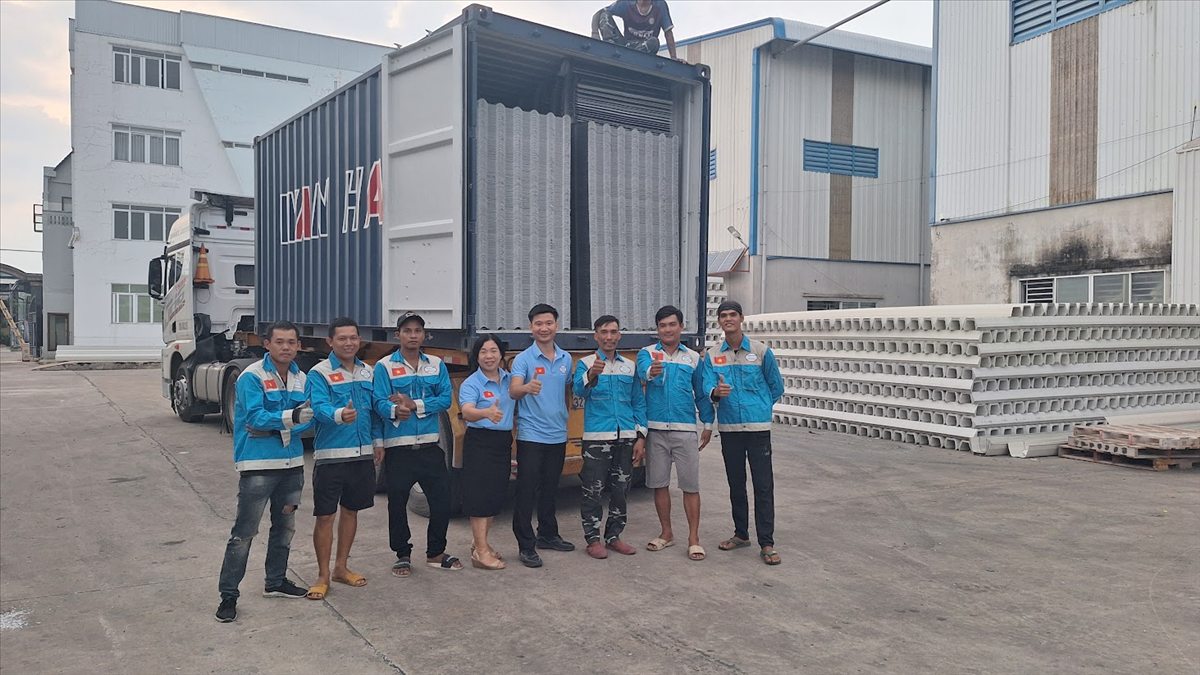
The Santiago team beside a loaded export container at the factory, November 2024
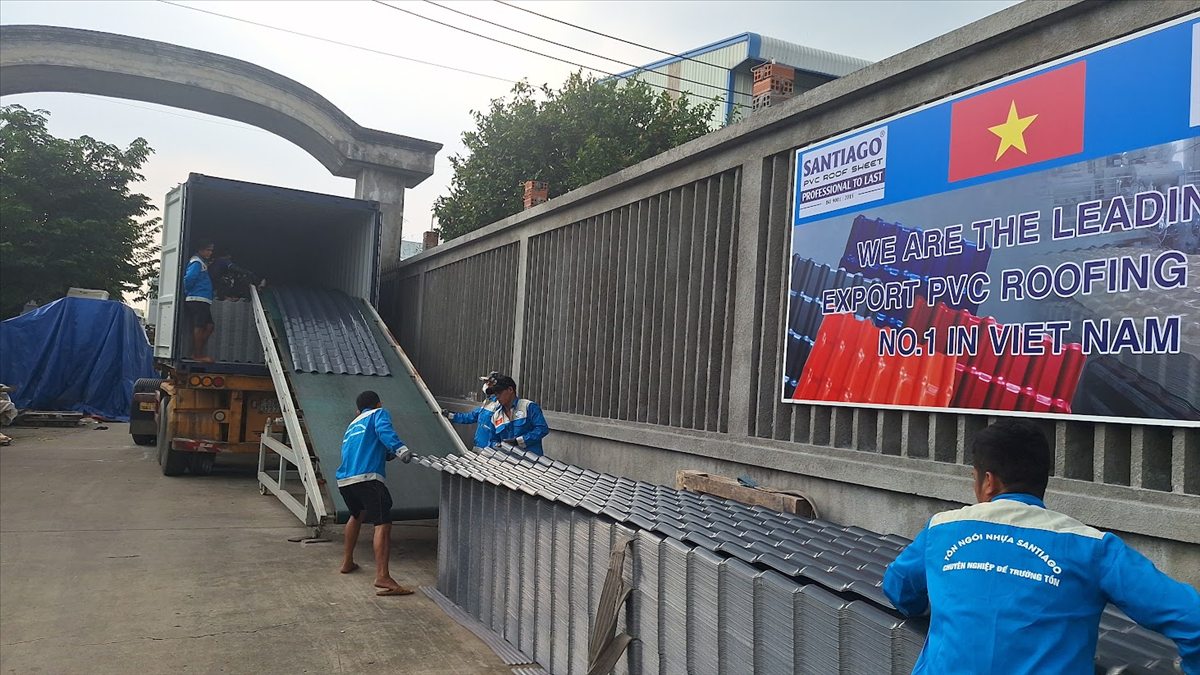
Loading Santiago roof tiles into an export container
Frequently asked questions
Can I repair a cracked skylight sheet instead of replacing it?
Only as a stopgap. Tape or sealant can keep rain out for a few days, but cracks in translucent sheets keep growing with heat and wind, so the sheet should be replaced.
What do I need to measure to order a replacement skylight sheet?
The number of waves, the rib height and spacing, the width, the length along the slope, and where the purlins are. Santiago's 11-wave skylight has 20 mm ribs, the same as its 11-wave ASA/PVC sheet.
Can I stand on a skylight sheet while replacing it?
No. Skylight sheets are fragile. Work from boards spanning at least three purlins or from below, and cover or net the opening once the old sheet is out.
Can I reuse the old screw holes?
Use the old holes only if they are still round and sealed. A hole worn oval should be sealed, with a new 6 mm hole drilled on the next wave top.
Should all skylights be replaced at the same time?
If they are the same age and already brittle or cloudy, yes. If only one sheet was damaged by an impact, replacing that one is enough.
Read more
- Skylight roofing sheets: which profile and how many
- How to install skylight sheets in a corrugated roof
- How to seal a corrugated roof and stop leaks
- Skylight sheets for warehouses in Vientiane
- Roof maintenance checklist before the rainy season
Read next on this topic
Main guide: Skylight Roofing Sheets: Which Profile and How Many
Sources for the figures in this article
- Profiles, 2.5–3.0 mm thickness and 10-year warranty: Santiago ASA/PVC product specification.
- HS code 3925.90.00: Harmonized System Chapter 39 (builders' ware of plastics), as applied in Vietnam's export tariff.
- Certificates of origin (Form D, AI, AK/VK, AJ/VJ, VC, CPTPP): issued by Vietnam's Ministry of Industry and Trade under the country's free trade agreements.
- Minimum order of one 40 ft container (about 5,000 m) and about 5 days for production and loading: Santiago export desk, October 2026.
Updated 03/11/2026. Santiago Import Export Co., Ltd, Vietnam. WhatsApp +84 935 391 495 (Mr. Quyen), hotline +84 965 437 316 (Mrs. Ly), email salessantiagoroofing@gmail.com.


