


Mr Quyen - Santiago. Posted 03/11/2026
An ASA/PVC tile sheet gives a clay-tile look at about 5.4 kg per m² of roof, which is about 1.1 lb per sq ft or 110 lb per 100 sq ft roofing square. Clay and concrete tile are much heavier, so the dead load and the frame change with the choice. Use the tile sheet on light frames, porches, pavilions and outbuildings; keep clay or concrete where the code, the HOA or the owner calls for it, and have an engineer check the dead load either way.

Large open pavilion under construction with a grey tile-sheet roof, Long An, Vietnam
How heavy is a PVC tile sheet roof compared with a clay tile roof?
A Santiago ASA/PVC tile sheet 2.5 mm thick weighs about 5.4 kg per m² of roof, or about 1.1 lb per sq ft. That is the sheet alone. Purlins, screws and ridge pieces come on top, and so does any deck or insulation you add.
Santiago does not publish weights for clay or concrete tile; they vary with the profile and the maker, and both are much heavier than a plastic sheet. Get the installed weight per square from the tile supplier, give both figures to your engineer, and let the engineer compare the dead loads for your roof.
| Roof area | Area in m² | ASA/PVC tile sheet weight, 2.5 mm |
|---|---|---|
| 400 sq ft (porch or casita) | 37.2 | about 200 kg (440 lb) |
| 1,000 sq ft | 92.9 | about 500 kg (1,110 lb) |
| 2,000 sq ft | 185.8 | about 1,000 kg (2,210 lb) |
What does a lighter roof change in the frame?
Less dead load means less weight for rafters, beams, posts and footings to carry. How much of that can be saved in the structure is your engineer's call; Santiago does not size structural members.
A light roof also has less weight holding it down in wind, so uplift depends on the fixings. For the tile sheet that means 70 mm (2¾ in) screws with ASA caps through the top of the wave into each purlin, 4 – 5 sets per m² (about 37 – 46 per 100 sq ft), and purlins tied down to the rafters. Snow load, where it applies, comes from your local code and is carried by the frame whatever the covering weighs.
The tile sheet needs its own support grid as well: purlins at 440 mm (17.3 in) or 660 mm (26 in), one under the foot of a tile step, never more than 700 mm (27.5 in) apart, on a slope of 20 – 45% (about 2.4:12 to 5.4:12). Santiago gives the sheet a bending strength of more than 1,000 N (about 225 lbf).
Replacing an old clay tile roof with tile sheets
A frame built for clay tile has capacity to spare for a sheet roof, but the old battens will not match the sheet unless they happen to sit at 440 or 660 mm. Plan new purlins to meet the 219 mm (8.6 in) tile step, and ask the engineer to check the uplift connections, because the weight that used to hold the roof down is gone.
Going the other way
Never put clay or concrete tile on a frame that was designed for a sheet roof without a new structural check.

Gazebo with a blue tile-sheet roof, Binh Phuoc, Vietnam
Clay tile roof vs metal: where does a PVC tile sheet fit?
Owners who compare a clay tile roof with metal are usually weighing looks and load against heat and noise. Metal is light, but without insulation it is hot under the roof and loud in rain, and in coastal air it rusts at the fasteners. Against bare metal sheet, Santiago's figures for the ASA/PVC tile sheet are about 6 – 8 °C (11 – 14 °F) cooler under the roof and about 80% less rain noise, with no rust because the sheet contains no metal. Against clay, the tile sheet gives up the mass and the fired-clay surface you see up close, and gains a much lighter roof that goes on as sheets.
Clay tile roofing pros and cons
- Pro: the look of fired clay, with the color through the body of the tile
- Pro: a long-established roof covering that building departments know well
- Con: heavy, so the rafters, beams and footings must be designed for it
- Con: laid tile by tile, and single tiles can crack if someone walks on them
ASA/PVC tile sheet pros and cons
- Pro: about 1.1 lb per sq ft of roof
- Pro: no rust, and cooler and quieter than bare metal sheet
- Pro: sheets 41.3 in wide cut to length, with ridge cap, hip ridge, three-way, four-way, ridge terminal and eave sealing pieces in the same color
- Con: needs purlins at 17.3 or 26 in and a slope of 20 – 45%
- Con: on a house, local code and the HOA decide whether a plastic tile sheet is accepted
When is clay or concrete tile still the right choice?
- The HOA or a historic district requires real clay or concrete tile
- The site is in a wildfire area where the code asks for a fire-rated roof covering: use a covering that carries the rating required
- The roof is steeper than 45% (5.4:12), outside the range for Santiago tile sheets
- The house frame is already built for tile and the owner wants fired clay
For porches, pavilions, gazebos, carports and outbuildings where the frame is light and nobody requires fired tile, the tile sheet gets the look with a much smaller load on the structure.
Corrugated plastic roof panels vs shingles on an outbuilding?
Asphalt shingles are nailed over a solid roof deck with underlayment. ASA/PVC sheets, corrugated or tile-effect, screw straight onto purlins, so an open-purlin frame needs no deck. Santiago's corrugated sheets come in 5, 6 and 11 square waves, 2.5 mm thick weighing about 5.2 kg per running metre (about 3.5 lb per running foot).
Santiago has not tested its sheets against shingles, so the heat and noise figures in this article compare with bare metal only. Choose by frame and by look. If the outbuilding already has a deck and the house has shingles, shingles may match better. If you want an open-purlin frame or a tile look to match a tile house, use the tile sheet.
What should your engineer check before you choose?
- The dead load of the covering, from the supplier's figure (about 5.4 kg/m² or 1.1 lb/sq ft for the ASA/PVC tile sheet), plus purlins and fixings
- Live, snow and wind loads under your local code
- Uplift connections from sheet to purlin and from purlin to rafter
- Purlin spacing that fits the covering: 17.3 or 26 in for the tile sheet
- A slope within the range the covering allows
- On a re-roof, the condition of the existing frame
Can I import ASA/PVC tile sheets to the US?
Santiago has shipped roofing to the US since 2025. The minimum order is one 40 ft container, about 5,000 m of sheet, roughly 51,700 sq ft of tile-sheet roof, and colors, profiles and accessories can be mixed in it. Production takes about 5 days. The documents use HS code 3925.90.00; Vietnam has no free trade agreement preference with the US, so check the duty rate with your customs broker. Prices are quoted per order in writing, and free samples are sent with the buyer paying the courier.
How much load can a PVC tile sheet take? Watch the truck test
Mr Quyen lays a blue ASA/PVC tile sheet and a blue corrugated sheet on the yard at the Santiago factory in Vietnam, and a Santiago delivery truck drives over them. The short shows the test from start to finish. It is a demonstration only: on a roof, the sheet still needs purlins less than 700 mm apart.
Truck test on Santiago ASA/PVC sheets (Santiago video on YouTube).
How are PVC roof tiles shipped to the USA?
Mr Quyen explains in English how Santiago loads orange tile sheets for export. The sheets slide down a ramp from the stack into the container, and workers in Santiago uniforms stack them inside.
Loading PVC roof tiles into an export container (Santiago video on YouTube).
More shorts for US buyers
Three more English shorts from the Santiago YouTube channel. Each one is about a minute or less.
How do PVC tile sheets look on a house roof?
Red ASA/PVC tile sheets are carried up to a house, a flame is put to a stack of sheets, and the short ends on a blue warehouse roof being fitted and grey sheets on the factory roller line.
Santiago PVC roofing tiles in real conditions (Santiago video on YouTube).
What happens when a flame is put to PVC tile sheets?
A flame is put to a stack of grey and red tile sheets, Mr Quyen crouches on grey sheets in the factory, and the short ends on a blue warehouse roof where installers lay new sheets. A flame test is a demonstration, not a fire rating.
Heat test and a warehouse re-roof with uPVC sheets (Santiago video on YouTube).
How does a PVC tile sheet handle bending and cutting?
A 45-second factory short: beige and orange ASA/PVC sheets are flexed by hand and cut with shears to show how the material behaves. On a roof, purlins still go less than 700 mm apart.
Bending and cutting test on Santiago ASA/PVC sheets (Santiago video on YouTube).
Santiago – a leading exporter of ASA/PVC roofing from Vietnam
Santiago roofing is produced and loaded into containers at our factory in Vietnam. It has been exported to India since 2023, Thailand since 2024 and the USA since 2025. Every export shipment comes with a commercial invoice, packing list, bill of lading and a certificate of origin (C/O) issued by Vietnam's Ministry of Industry and Trade, which importers use to claim the duty preference of their trade agreement.
| Item | Details |
|---|---|
| HS code | 3925.90.00 (ASA/PVC roofing sheets) |
| Certificate of origin | Form D (ASEAN), Form AI (India), Form AK / VK (Korea), Form AJ / VJ (Japan), Form VC (Chile), CPTPP proof of origin |
| Shipped from | Vietnam, by container |

Certificate of origin Form AI (ASEAN–India) for Santiago ASA/PVC roofing sheets, HS 39259000, certified on 24 September 2026. Buyer details are hidden.
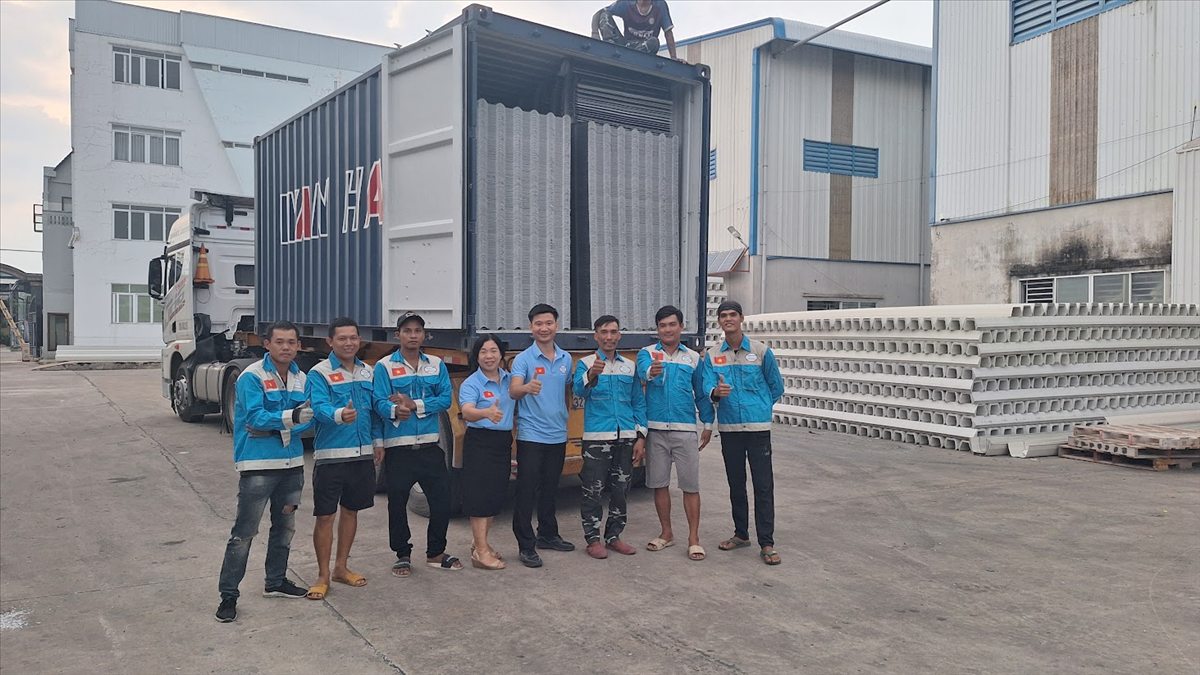
The Santiago team beside a loaded export container at the factory, November 2024
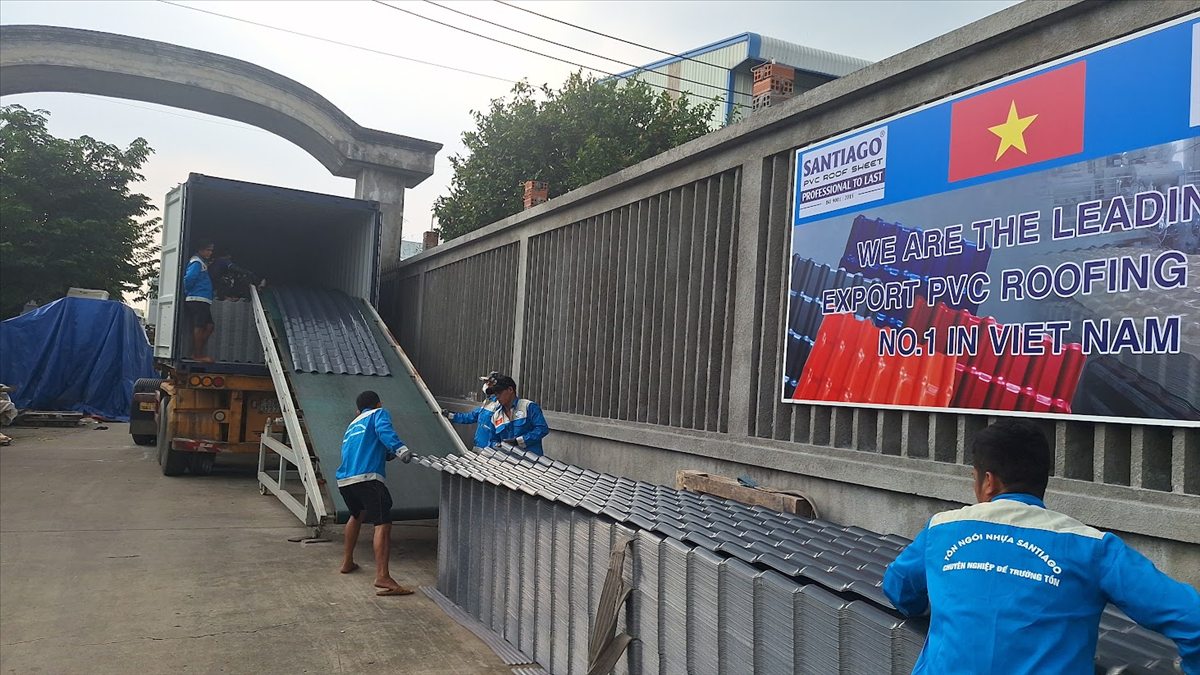
Loading Santiago roof tiles into an export container
Frequently asked questions
What is the dead load of a PVC tile sheet roof?
A 2.5 mm Santiago ASA/PVC tile sheet weighs about 5.4 kg per m², about 1.1 lb per sq ft or 110 lb per 100 sq ft. Purlins, screws and ridge pieces are extra.
Is a clay tile roof heavier than a PVC tile sheet roof?
Yes, clay and concrete tile are much heavier. Get the installed weight from the tile maker and have an engineer check the dead load before you choose.
Is a PVC tile sheet cooler than a metal roof?
By Santiago's figures, the space under an ASA/PVC tile sheet is about 6 – 8 °C (11 – 14 °F) cooler than under bare metal sheet, and rain noise is about 80% lower.
Can I replace a clay tile roof with PVC tile sheets?
A frame built for clay tile can carry the lighter sheets, but it needs new purlins at 17.3 or 26 in to match the tile step, and an engineer should check the uplift connections.
Corrugated plastic roof panels or shingles for a shed?
Shingles need a solid deck; ASA/PVC corrugated or tile sheets screw straight onto purlins at a slope of 20 – 45%. Choose by the frame you have and the look you want to match.
Read more
- Synthetic Spanish tile roofing with ASA PVC tile sheets
- ASA PVC vs metal corrugated roofing
- PVC roofing sheet thickness and weight
- Plastic roof tiles for sheds and cabins
- ASA/PVC roof tile sheet
Versión en español
La lámina tipo teja de ASA/PVC da el aspecto de teja de barro con un peso de unos 5.4 kg por m² de techo, alrededor de 1.1 libras por pie cuadrado o 110 libras por cada 100 pies cuadrados. La teja de barro y la de concreto pesan mucho más, así que la carga muerta y la estructura cambian. En cualquier caso, pida a su ingeniero que revise la carga muerta.
¿Cuánto pesa un techo de teja de PVC frente a uno de teja de barro?
La lámina tipo teja de Santiago de 2.5 mm pesa unos 5.4 kg/m², solo la lámina; los largueros, tornillos y caballetes van aparte. Santiago no publica pesos de teja de barro ni de concreto, porque cambian según el modelo y el fabricante. Pida el peso instalado al proveedor de la teja y entregue las dos cifras a su ingeniero.
| Área del techo | m² | Peso de la lámina tipo teja, 2.5 mm |
|---|---|---|
| 400 pies² (porche o casita) | 37.2 | unas 440 libras (200 kg) |
| 1,000 pies² | 92.9 | unas 1,110 libras (500 kg) |
| 2,000 pies² | 185.8 | unas 2,210 libras (1,000 kg) |
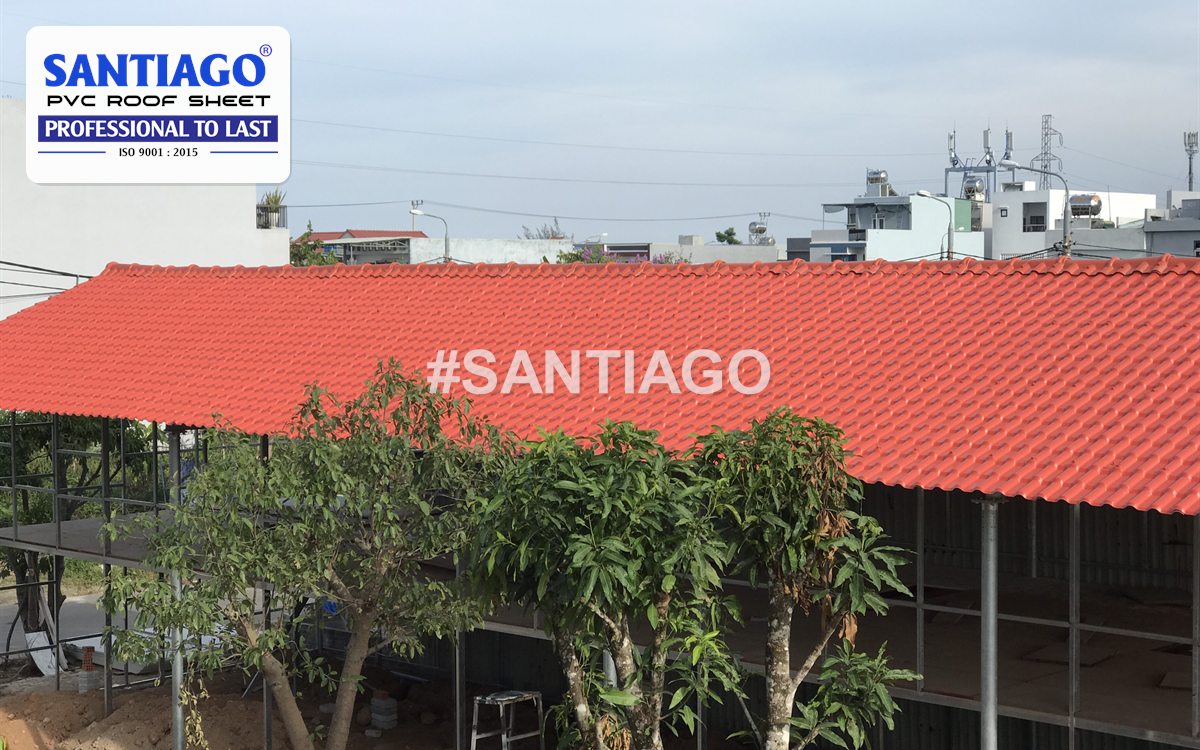
Galera larga con techo de lámina tipo teja roja, Da Nang, Vietnam
¿Qué cambia en la estructura con un techo más liviano?
Con menos carga muerta, vigas, postes y zapatas cargan menos peso; cuánto se puede ahorrar lo decide el ingeniero. Pero un techo liviano tiene menos peso que lo sujete contra el viento, así que todo depende de la fijación: tornillos de 2¾ pulgadas (70 mm) con tapa de ASA en la cresta de la onda, 4 – 5 juegos por m², y largueros bien amarrados a las vigas. La lámina necesita largueros a 17.3 o 26 pulgadas (440 o 660 mm) y una pendiente de 20 – 45% (de 2.4:12 a 5.4:12).
Si cambia un techo viejo de teja de barro por lámina, los listones de la teja casi nunca coinciden con el paso de 8.6 pulgadas (219 mm): ponga largueros nuevos y pida que revisen el anclaje contra el viento. Y nunca ponga teja de barro sobre una estructura diseñada para lámina sin un nuevo cálculo.
¿Cuándo conviene seguir con teja de barro o de concreto?
- Cuando la HOA o un distrito histórico exige teja de barro o de concreto
- En zonas de incendios forestales donde el código pide una cubierta con clasificación contra fuego: use una cubierta que tenga esa clasificación
- Cuando el techo tiene más de 45% de pendiente (5.4:12)
- Cuando la estructura ya está hecha para teja y el dueño quiere barro cocido
Para porches, pérgolas, kioscos, cocheras y casitas con estructura liviana, la lámina tipo teja da el mismo aspecto con mucho menos peso. Comparada con lámina metálica sin aislar, deja el espacio unos 6 – 8 °C (11 – 14 °F) más fresco y reduce el ruido de la lluvia cerca de un 80%.

Techo de lámina tipo teja verde, Binh Dinh, Vietnam
¿Lámina de PVC o teja asfáltica (shingle) en un cobertizo?
La teja asfáltica se clava sobre una cubierta sólida de madera; la lámina de ASA/PVC, ondulada o tipo teja, se atornilla directo a los largueros. Santiago no ha comparado sus láminas con shingles, así que sus cifras de calor y ruido son frente a lámina metálica. Elija según la estructura que ya tiene y el aspecto de la casa.
Preguntas frecuentes
¿Cuánto pesa la lámina tipo teja de PVC?
Unos 5.4 kg por m² en 2.5 mm, alrededor de 1.1 libras por pie cuadrado o 110 libras por cada 100 pies cuadrados, sin contar largueros ni tornillos.
¿La teja de barro pesa más que la lámina de PVC?
Sí, la teja de barro y la de concreto pesan mucho más. Pida el peso al fabricante y que un ingeniero revise la carga muerta.
¿Puedo cambiar un techo de teja de barro por lámina tipo teja de PVC?
Sí, la estructura aguanta la lámina más liviana, pero necesita largueros nuevos a 17.3 o 26 pulgadas y una revisión del anclaje contra el viento.
Sources for the figures in this article
- Profiles, 2.5–3.0 mm thickness and 10-year warranty: Santiago ASA/PVC product specification.
- About 6–8 °C cooler than bare metal sheet and about 80% less rain noise: Santiago's own comparisons on finished roofs in Vietnam.
- HS code 3925.90.00: Harmonized System Chapter 39 (builders' ware of plastics), as applied in Vietnam's export tariff.
- Certificates of origin (Form D, AI, AK/VK, AJ/VJ, VC, CPTPP): issued by Vietnam's Ministry of Industry and Trade under the country's free trade agreements.
- Minimum order of one 40 ft container (about 5,000 m) and about 5 days for production and loading: Santiago export desk, October 2026.
Updated 03/11/2026. Santiago Import Export Co., Ltd, Vietnam. WhatsApp +84 935 391 495 (Mr. Quyen), hotline +84 965 437 316 (Mrs. Ly), email salessantiagoroofing@gmail.com.


