


Mr Quyen - Santiago. Posted 13/11/2026
Santiago ASA/PVC roofing sheets (tile profile or 5-, 6- and 11-wave corrugated) contain no metal, so they cannot rust in coastal air or around fertiliser, and in Santiago's tests the space under them stays 6 – 8 °C cooler than under bare metal sheet. They need purlins less than 700 mm apart and a slope of 20 – 45%. An 18 × 10 m gable shed takes 38 tile sheets of 5.475 m; the sheet has no cyclone or BAL rating, and it can be imported under CPTPP through any Australian port.
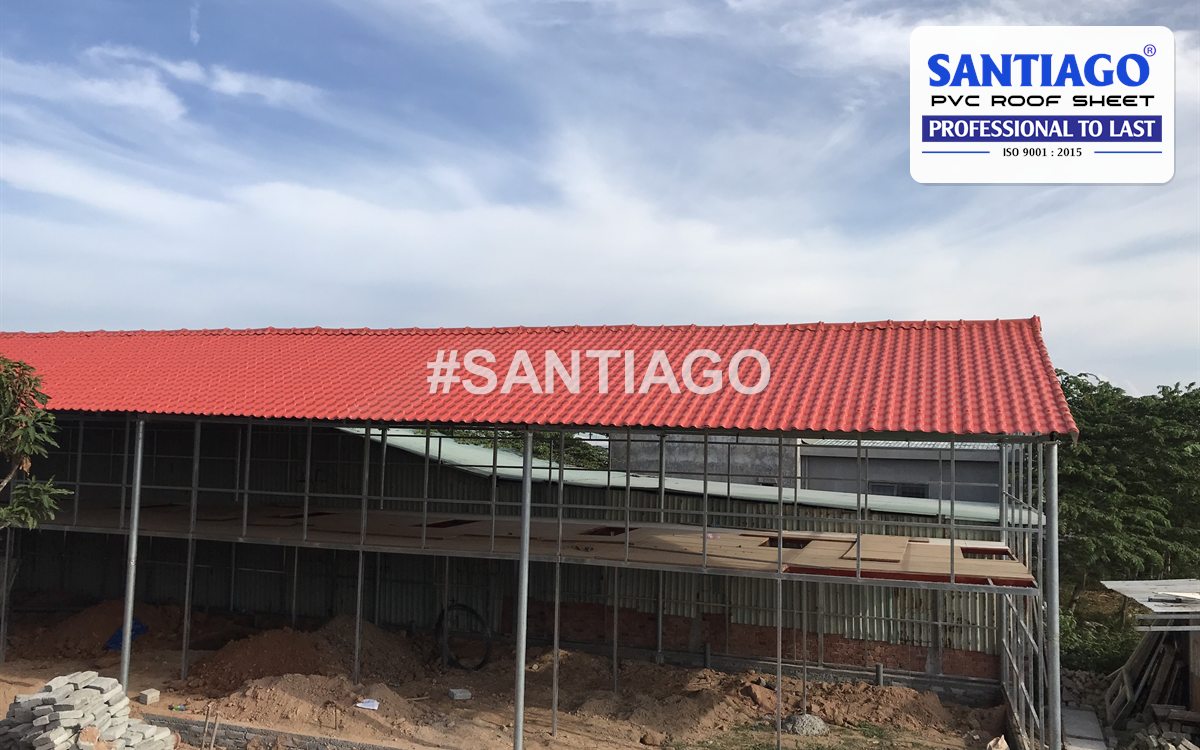
Long open shed with red tile roof, Vietnam
Why do metal shed roofs on Australian farms rust and run hot?
A shed roof on a farm has a hard life. Near the coast, salt in the air settles on the sheet and starts working at the laps and around the fixings. Inland, fertiliser dust, damp hay and animal sheds do the same job more slowly. Once the coating is through, rust spreads from the edges, and the first sign is often a stain on the hay or the machine parked underneath.
Then there is the heat. A bare metal roof in a January afternoon turns the shed into an oven. A tractor does not mind; stock, poultry and anyone repairing a machine inside do. Santiago's sheets attack both: there is no metal in them to rust, and the space under them stays 6 – 8 °C cooler than under bare metal sheet in Santiago's tests. Rain noise is about 80% lower as well.
Tile sheet or corrugated sheet for a shed?
Both are made the same way: four co-extruded layers with no glue (an ASA top layer, virgin PVC, a PVC core and a milky-white PVC base), from virgin material. The ASA layer showed no colour change after 2,000 hours of artificial UV, the colour is rated for 30 years, and real service life is 25 – 30 years. Most working sheds go with a corrugated profile; the tile profile is for sheds near the homestead, farm-stay buildings and shop fronts where the look counts.
| Profile | Full / cover width | Wave or step | Weight at 2.5 mm |
|---|---|---|---|
| Tile sheet (Spanish style) | 1.05 / 0.96 m | 219 mm tile step | about 5.4 kg per m² of roof |
| 5-wave corrugated | 1.08 / 1.00 m | 32 mm wave | about 5.2 kg per running metre |
| 6-wave corrugated | 1.06 / 0.95 m | 34 mm wave | about 5.2 kg per running metre |
| 11-wave corrugated | 1.05 / 1.00 m | 20 mm wave | about 5.2 kg per running metre |
Thickness is 2.5 or 3.0 mm, with 2.5 mm the minimum for a roof. The warranty is 10 years for 2.5 mm and thicker sheet installed as Santiago recommends. Bending strength is above 1,000 N.
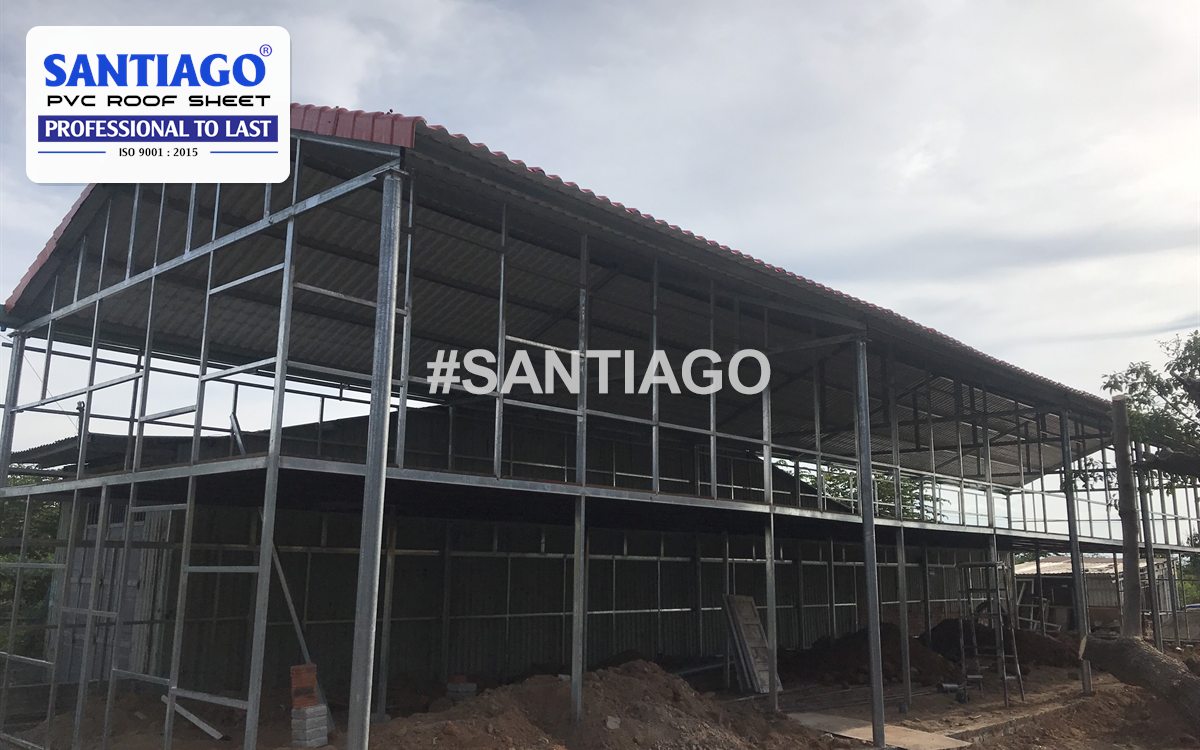
Steel-frame shed under construction, Vietnam
What purlin spacing does a long-span shed need?
This is where a plastic roof differs most from a metal one. Metal roofing on farm sheds is often laid over much wider purlin spacing. Santiago sheets need purlins less than 700 mm apart: 440 or 660 mm for the tile sheet, with one purlin under the foot of each tile step. That means more purlin rows than a metal-roofed shed of the same size, so plan the frame for the sheet from the start rather than re-roofing an old frame as it stands.
The span between portal frames, the purlin size and the bracing are for your shed builder or engineer to design. What Santiago specifies is the fixing: slope between 20% and 45%, top purlin 15 – 18 cm below the ridge, 6 mm pre-drilled holes, 70 mm screws through the top of the wave over a purlin, 4 – 5 screw sets per m² with ASA caps, never a screw in the valley, and a one-wave side lap.
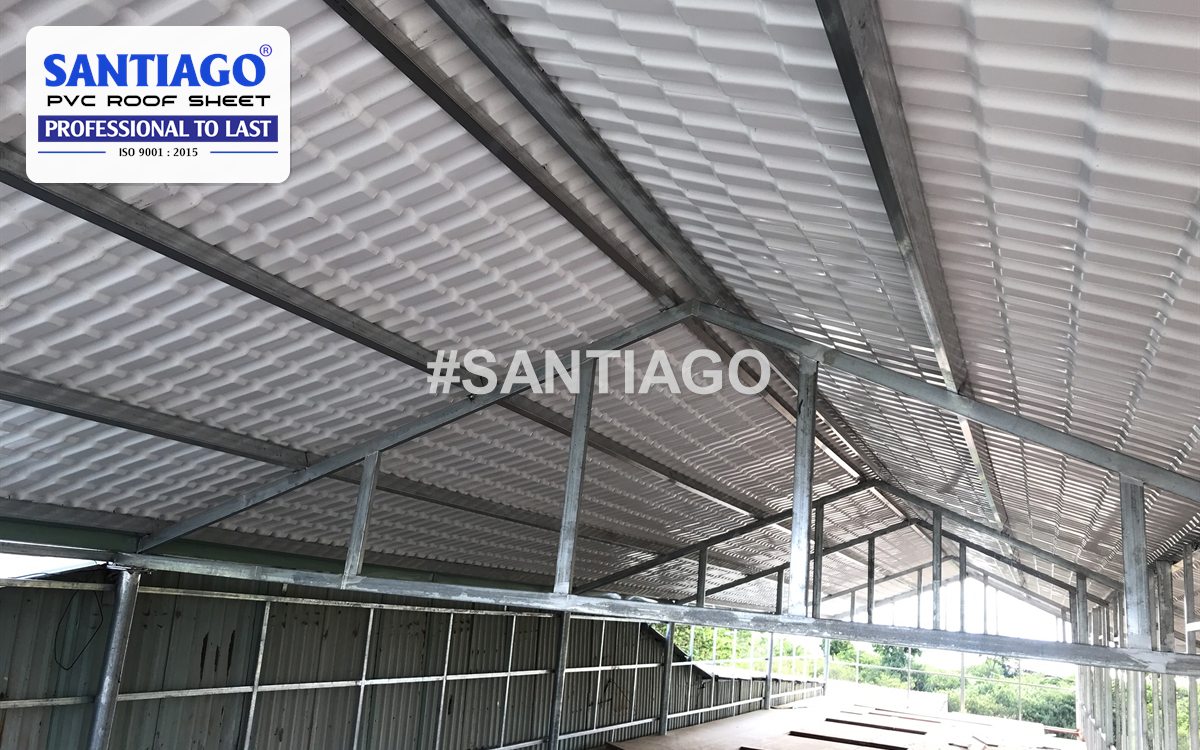
Underside of a shed roof of tile sheets on steel purlins, Vietnam
How many sheets for an 18 × 10 m machinery shed? A worked example
Take a gable machinery and hay shed 18 m long and 10 m wide, ridge along the length, roof slope 25%, with a 0.3 m overhang at each eave.
| Step | Working | Result |
|---|---|---|
| Ridge height above the eaves | 5.0 m half-width × 25% | 1.25 m |
| Length along the slope | (5.0 m + 0.3 m) × 1.031 = 5.46 m; 5.46 ÷ 0.219 = 24.95, round up to 25 steps | 25 × 219 mm = 5.475 m |
| Sheets per face | 18 m ÷ 0.96 m = 18.75, round up | 19 sheets, covering 18.24 m |
| Sheets for the roof | 19 × 2 faces | 38 sheets, about 208 running metres |
| Roof area | 18.24 m × 5.475 m × 2 | about 200 m² |
| Purlin rows per face | One every 3 tile steps (660 mm) or every 2 steps (440 mm) | 10 rows, or 14 at 440 mm |
| Screw sets with ASA caps | 200 m² × 4 – 5 per m² | about 800 – 1,000 |
| Ridge | Length of the ridge | 18.24 m of ridge cap and 2 ridge terminals |
| Eave sealing tile | Both eaves | 2 × 18.24 m |
| Skylight sheets | 5 – 10% of the roof | about 10 – 20 m² |
| Sheet weight | 200 m² × 5.4 kg | about 1,080 kg |
About 208 m is roughly a 24th of a 40 ft container (about 5,000 m). A rural merchant ordering a container can mix tile and corrugated profiles, colours and accessories in the same load, and production takes about 5 days.
What about poultry sheds?
For a poultry shed the two Santiago figures that count are heat and noise: 6 – 8 °C cooler under the roof than bare metal sheet and about 80% less rain noise, both from Santiago tests. Skylight sheets let through 80 – 90% of the light and are used on 5 – 10% of the roof area if the shed needs daylight. Santiago has no published data on ventilation or ammonia, so the shed's air flow stays with the shed designer. Our poultry house roofing article covers smaller coops.
Cyclone regions and bushfire-prone land
Say it plainly to buyers: Santiago publishes no cyclone, wind, hail, fire or BAL rating for these sheets and holds no AS/NZS certification for them. Sheds in cyclone wind regions and on bushfire-prone land need roofing with those tested ratings, so this sheet is for sheds outside those zones, and only where your builder or certifier accepts it. Approval for farm buildings is a question for your council.
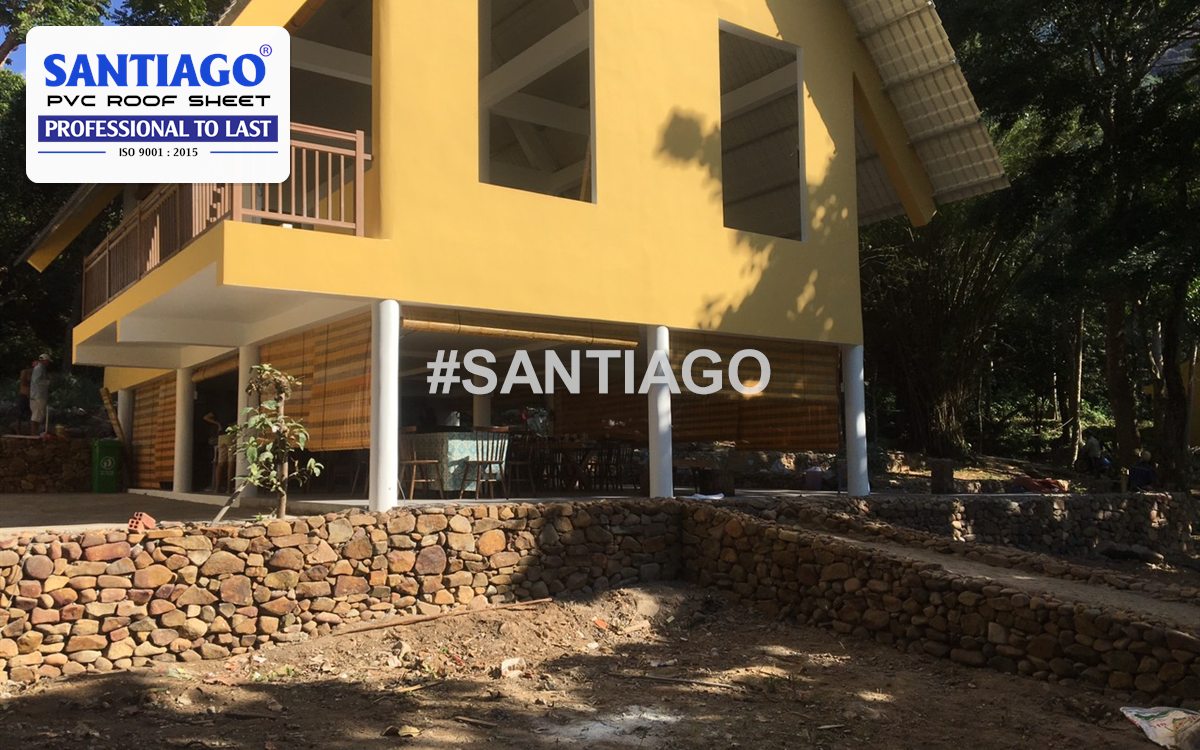
Raised yellow building with grey tile roof, Vietnam
Importing through Brisbane, Sydney, Melbourne or Fremantle under CPTPP
Australia and Vietnam are both in CPTPP, so the sheets (HS 3925.90.00) can enter at a lower or zero duty under Australia's CPTPP schedule, with proof of origin from Santiago for each container. Your customs broker confirms the rate for your port of entry, and you can ask customs for an advance ruling on classification and origin before the first container. CPTPP members commit to publishing customs rules and releasing goods within 48 hours where possible.
What comes with each order?
Santiago supplies sheets and accessories (ridge cap, hip ridge, three-way and four-way pieces, ridge terminals, eave sealing tile, vertical wall flashing and ASA screw caps, all in the sheet colours) and sends installation videos to your installer; it does not install. Every lot ships with a quality certificate (CQ) and Quatest test results are available; the factory works under ISO 9001:2015 certificate ICI-23087.D. Free samples are sent on request, with the buyer paying the courier, and the quotation is given per order in writing.
How do uPVC tile sheets react to heat?
A flame is put to a stack of grey and red tile sheets, Mr Quyen crouches on grey sheets in the factory, and the short ends on a blue warehouse roof where installers lay new sheets. A flame test is a demonstration, not a fire rating.
Heat test and a warehouse re-roof with uPVC sheets (Santiago video on YouTube).
More shorts for sheds and rural buildings in Australia
Two more English shorts from the Santiago YouTube channel. Each one is about a minute or less.
How does a tile sheet compare with metal for heat and noise?
Mr Quyen holds a white tile sheet in the Santiago factory and explains in English, with captions, why bare metal roofs are hot, noisy in rain and costly to repair. The short then shows a red tile roof on a house and a finished grey tile roof beside the gutter.
Heat and rain noise: Santiago ASA/uPVC roofing explained (Santiago video on YouTube).
What happens when a truck drives over the sheet?
The 26-second short shows a Santiago truck rolling across two blue sheets on the yard, one tile-profile and one corrugated. Treat it as a demonstration: on a roof, purlins still go less than 700 mm apart.
Truck test on Santiago ASA/PVC sheets (Santiago video on YouTube).
CPTPP: lower import duty on roofing sheets made in Vietnam
Vietnam is one of the 12 member countries of the Comprehensive and Progressive Agreement for Trans-Pacific Partnership (CPTPP), together with Australia, Brunei, Canada, Chile, Japan, Malaysia, Mexico, New Zealand, Peru, Singapore and the United Kingdom. Santiago ASA/PVC roofing sheets and accessories are made in Vietnam (HS 3925.90.00), so buyers in these countries can claim the CPTPP preference when they import them.
- Lower or zero import duty. Each member cuts its tariffs on goods of Vietnamese origin under its own CPTPP schedule, and many tariff lines are already at 0%. Your customs broker confirms the rate that applies to HS 3925.90.00 on the day of import.
- Proof of origin with every container. Santiago prepares the CPTPP origin documents for each shipment, so the importer can claim the preferential rate at clearance.
- Advance rulings. Under CPTPP, an importer can ask its customs authority for a written ruling on tariff classification and origin before the goods ship, so the duty is known before the order is confirmed.
- Faster, more predictable clearance. CPTPP members commit to publish their customs rules and, where possible, to release goods within 48 hours of arrival.
- The same preference on every repeat order. As long as the sheets are made in Vietnam and the origin documents are in order, each new container qualifies again.
Duty rates and paperwork change by country and over time: check the current rate and the proof-of-origin form with your customs broker before you order.
Santiago – a leading exporter of ASA/PVC roofing from Vietnam
Santiago roofing is produced and loaded into containers at our factory in Vietnam. It has been exported to India since 2023, Thailand since 2024 and the USA since 2025. Every export shipment comes with a commercial invoice, packing list, bill of lading and a certificate of origin (C/O) issued by Vietnam's Ministry of Industry and Trade, which importers use to claim the duty preference of their trade agreement.
| Item | Details |
|---|---|
| HS code | 3925.90.00 (ASA/PVC roofing sheets) |
| Certificate of origin | Form D (ASEAN), Form AI (India), Form AK / VK (Korea), Form AJ / VJ (Japan), Form VC (Chile), CPTPP proof of origin |
| Shipped from | Vietnam, by container |
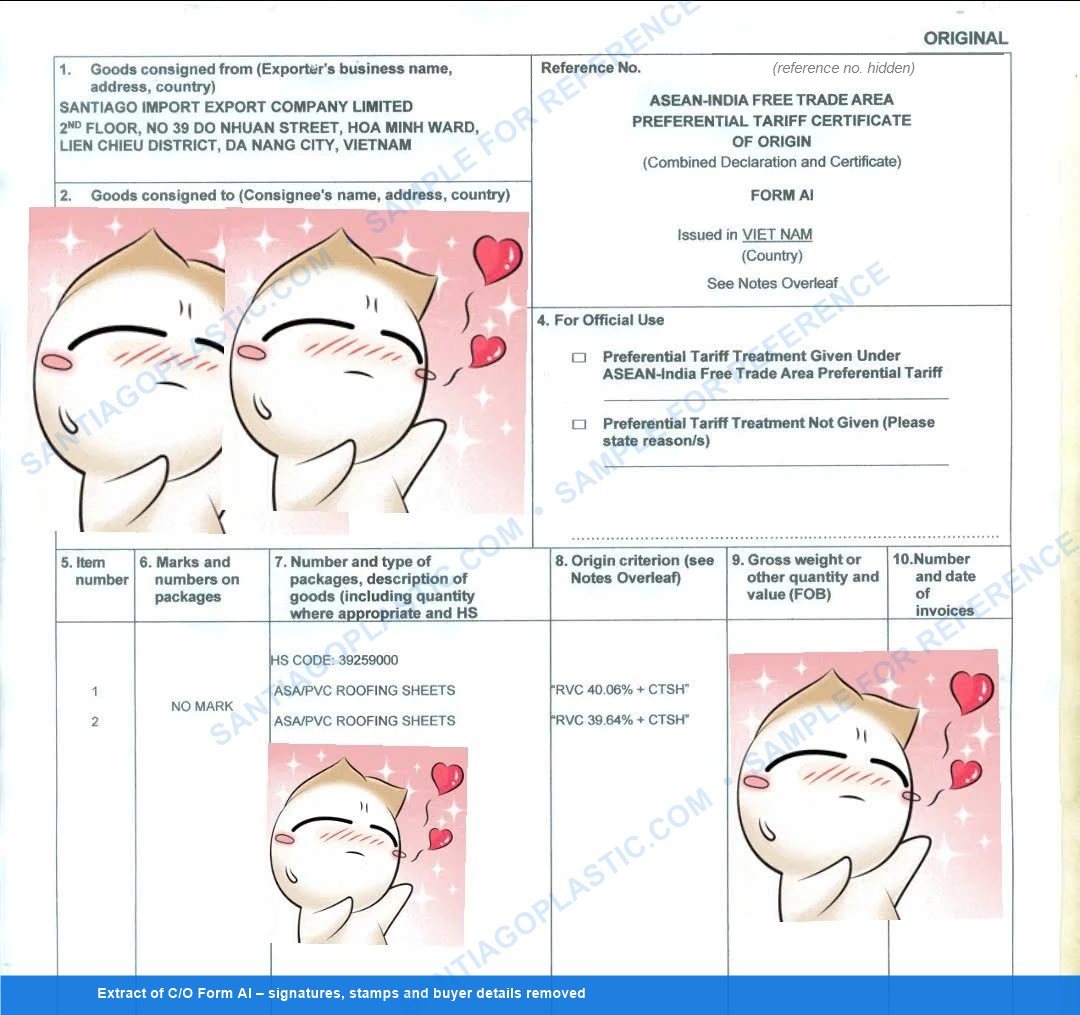
Certificate of origin Form AI (ASEAN–India) for Santiago ASA/PVC roofing sheets, HS 39259000, certified on 24 September 2026. Buyer details are hidden.
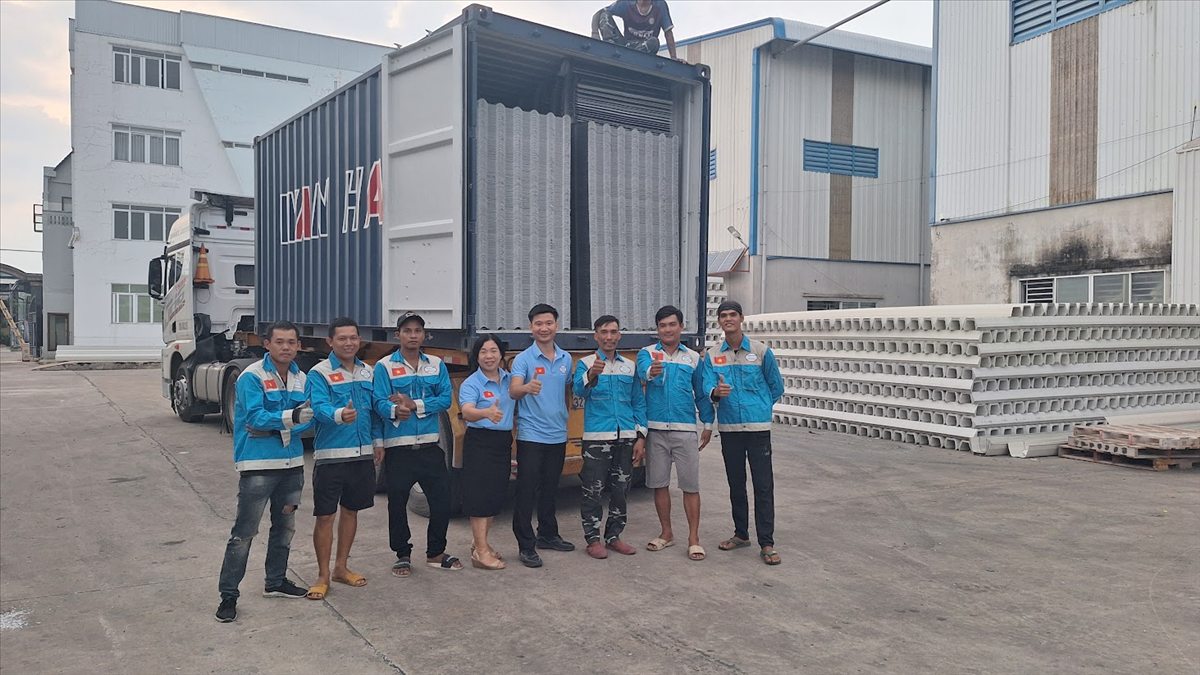
The Santiago team beside a loaded export container at the factory, November 2024
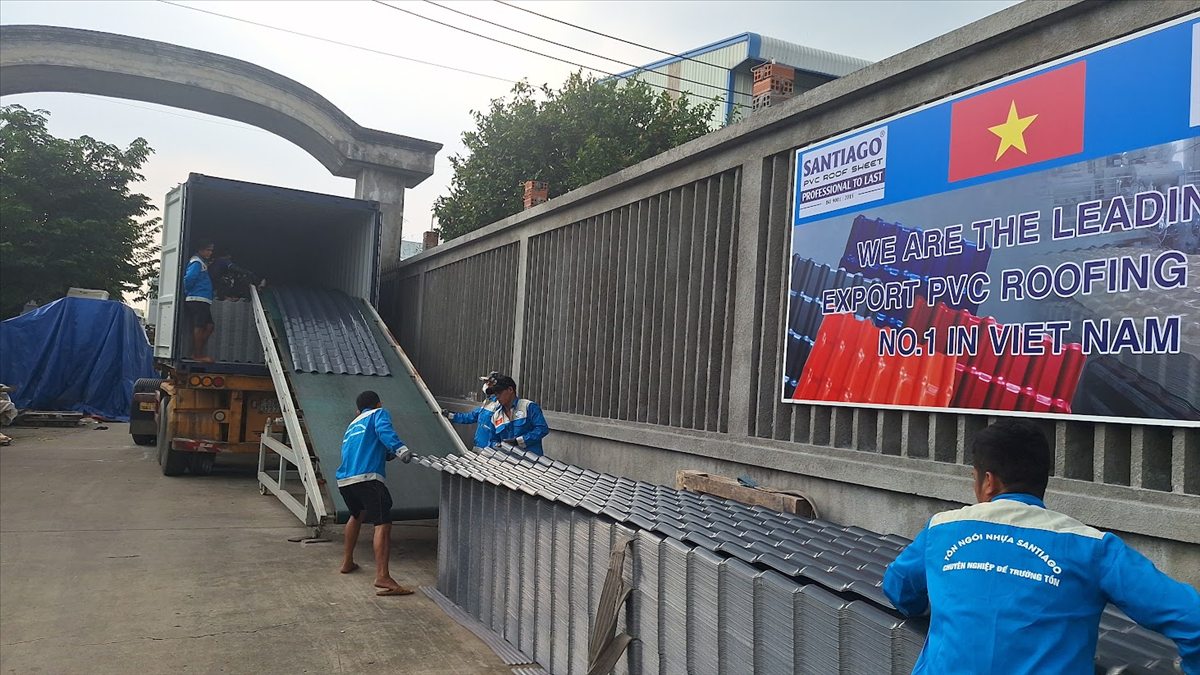
Loading Santiago roof tiles into an export container
Frequently asked questions
Do PVC roofing sheets rust on a coastal farm shed?
No. Santiago ASA/PVC sheets contain no metal, so there is nothing to rust in salt air or around fertiliser. The steel frame and purlins under them still need their own protection.
What purlin spacing do PVC shed roofing sheets need?
Less than 700 mm: 440 or 660 mm for the tile sheet, one purlin under the foot of each tile step, with a roof slope of 20 – 45%.
How many sheets does an 18 × 10 m shed need?
A gable shed 18 m long and 10 m wide at 25% slope takes 38 tile sheets of 5.475 m, about 208 running metres or 200 m² of roof, with 800 – 1,000 screw sets and 18.24 m of ridge cap.
Are the sheets rated for cyclones or bushfire zones?
No. Santiago publishes no cyclone, wind, fire or BAL rating and holds no AS/NZS certification for them, so they are for sheds outside those zones where your builder or certifier accepts them.
Can I import shed roofing sheets from Vietnam under CPTPP?
Yes. With proof of origin from Santiago for each container, the sheets (HS 3925.90.00) can get a lower or zero duty under Australia's CPTPP schedule. Your customs broker confirms the rate.
Read more
- Rust-free roof with ASA/PVC sheets
- PVC roofing sheet types for dealer stock
- How Santiago loads an export container
- Santiago export markets and certificates of origin
- ASA/PVC roofing sheet, 5 square waves
Sources for the figures in this article
- Profiles, 2.5–3.0 mm thickness and 10-year warranty: Santiago ASA/PVC product specification.
- About 6–8 °C cooler than bare metal sheet and about 80% less rain noise: Santiago's own comparisons on finished roofs in Vietnam.
- HS code 3925.90.00: Harmonized System Chapter 39 (builders' ware of plastics), as applied in Vietnam's export tariff.
- Certificates of origin (Form D, AI, AK/VK, AJ/VJ, VC, CPTPP): issued by Vietnam's Ministry of Industry and Trade under the country's free trade agreements.
- Minimum order of one 40 ft container (about 5,000 m) and about 5 days for production and loading: Santiago export desk, October 2026.
Updated 03/11/2026. Santiago Import Export Co., Ltd, Vietnam. WhatsApp +84 935 391 495 (Mr. Quyen), hotline +84 965 437 316 (Mrs. Ly), email salessantiagoroofing@gmail.com.


