


Mr Quyen - Santiago. Posted 13/11/2026
A Santiago ASA/PVC tile sheet gives a cabin, bunkie, garden shed or gazebo in Canada the look of a tiled roof at about 5.4 kg per m² (about 1.1 lb per sq ft), with no metal in it to rust. A 10 × 12 ft (3.05 × 3.66 m) shed with a single-slope roof at 4/12 pitch takes 4 sheets of 3.723 m. Santiago publishes no snow-load or cold-weather rating, so the builder or engineer designs the frame for local snow; the sheet ships from Vietnam with CPTPP proof of origin.
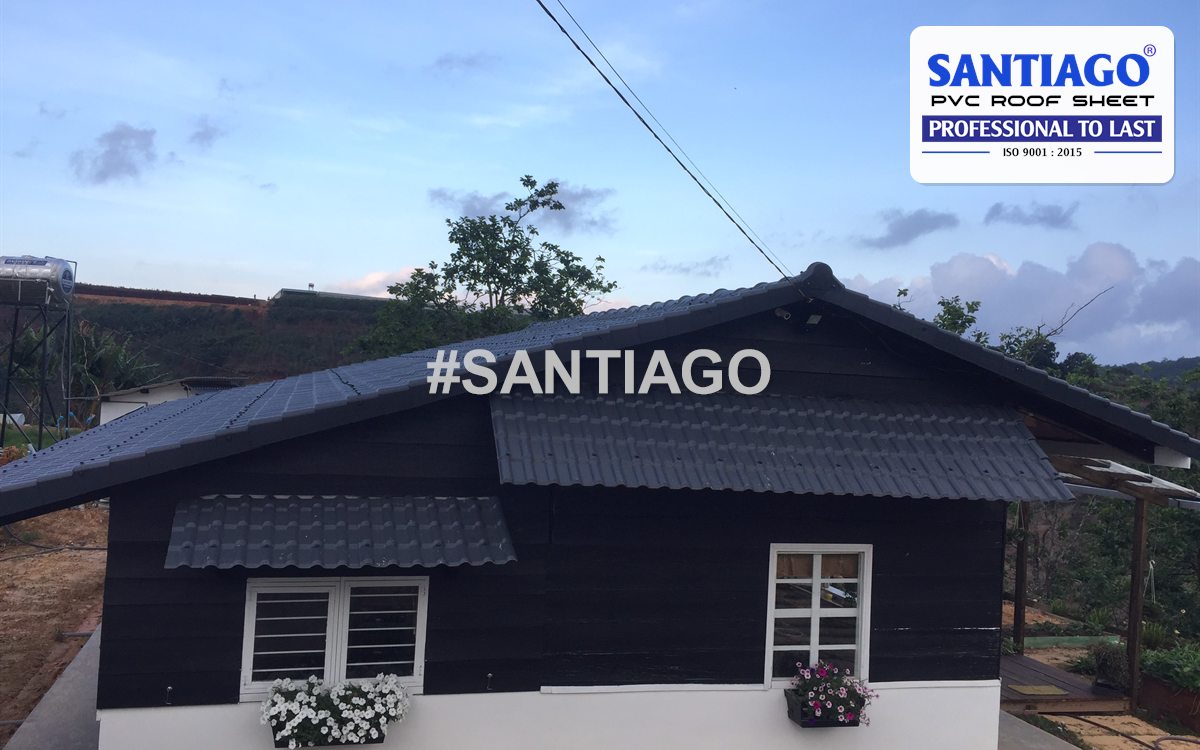
Dark timber cabin with a grey tile-sheet roof and window boxes, Da Lat, Vietnam
Where does a tile-sheet roof make sense on a Canadian property?
On the small buildings around the main house. A bunkie by the lake in Ontario cottage country, a cabanon at the back of a lot in Quebec, a garden shed or a gazebo on the BC coast: these are buildings where owners want the roof to match a tiled or dark house roof, without asking a small timber frame to carry heavy tile.
The ASA/PVC tile sheet is made for that job. From the yard it reads as rows of curved tiles, one row every 219 mm. Each sheet runs in one piece from the top of the roof to the eave, so there are no loose tiles to slip, and there is no metal to rust where the shed sits near salt water or under dripping trees.
What is the sheet, in metric and imperial?
Santiago makes the sheet in Vietnam from four co-extruded layers without glue: an ASA top layer that holds the colour and blocks UV, a virgin PVC layer, a PVC core and a milky-white PVC base that faces inside. The material is virgin, not recycled. Most Canadian builders and lumber yards think in feet and inches, so here are both.
| Item | Metric | Imperial (approx.) |
|---|---|---|
| Full width | 1.05 m | 3 ft 5 in |
| Cover width after the side lap | 0.96 m | 3 ft 1.8 in |
| Tile step | 219 mm | 8.6 in |
| Length | Cut to order in 219 mm steps | Cut to order in 8.6 in steps |
| Thickness | 2.5 or 3.0 mm (2.5 mm minimum for a roof) | about 0.1 in |
| Weight at 2.5 mm | about 5.4 kg per m² of roof | about 1.1 lb per sq ft |
| Roof slope | 20 – 45% | about 2.4/12 to 5.4/12 pitch |
The slope row matters more than it looks. A 3/12, 4/12 or 5/12 pitch sits inside Santiago's range. A 2/12 roof (about 17%) is too flat for this sheet, and a 6/12 roof (50%) is steeper than the range, so ask Santiago before you order for either.
What about snow on a cabin roof?
Santiago does not publish a snow-load rating, a cold-impact rating or a wind rating for this sheet, and it has no certification under Canadian building codes. That is the plain answer. In a heavy-snow region, the rafters, purlins and their spacing have to be designed by the builder or an engineer for the local snow load, and the builder decides whether the sheet suits that building.
Santiago's own fixing rule, purlins less than 700 mm apart, is the minimum for holding the sheet down. It is not a snow design. If the builder wants the purlins closer for snow, the 440 mm spacing (two tile steps) is one of the two standard options. Your municipality may also need a permit for a cabin or a larger shed, so check with them before you build.
There is no published data on how the sheet behaves in deep cold. If that is your concern, ask for a free sample (the buyer pays the courier) and let your builder judge it on site.
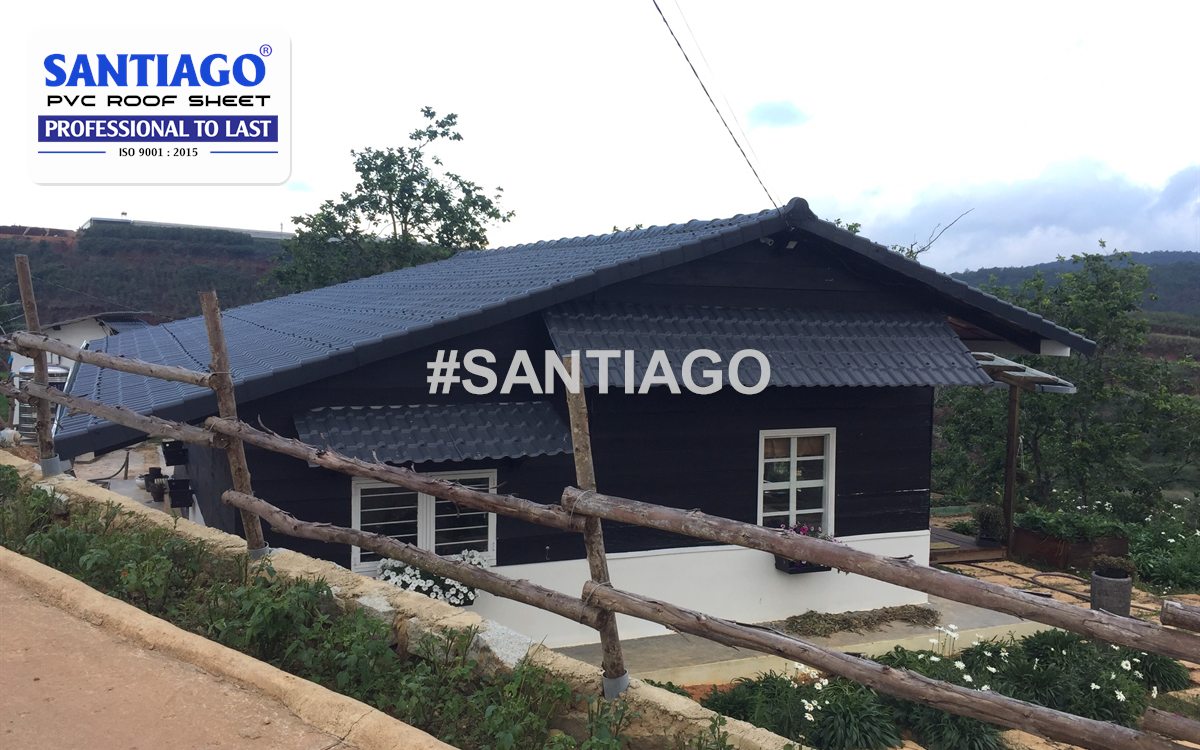
Dark timber cabin with a tile-sheet roof behind a wooden rail fence, Da Lat, Vietnam
How many sheets does a 10 × 12 ft shed take? A worked example
Take a 10 × 12 ft shed (3.05 × 3.66 m) with a single-slope roof, the style many new bunkies and garden studios use. The roof falls across the 10 ft depth at 4/12 pitch (33%), with a 30 cm overhang at the low front edge, 15 cm at the high back edge and 9 cm at each side.
| Step | Working | Result |
|---|---|---|
| Sloped length of the roof | (3.05 + 0.30 + 0.15 m) × 1.054 for a 4/12 pitch | 3.689 m |
| Sheet length | 3.689 ÷ 0.219 = 16.8, round up to 17 steps; 17 × 219 mm | 3.723 m (12 ft 2.6 in) |
| Sheets across the width | 3.66 m + 2 × 0.09 m = 3.84 m; 3.84 ÷ 0.96 | 4 sheets |
| Running metres to order | 4 × 3.723 m | about 14.9 m |
| Roof area | 3.84 × 3.723 m | about 14.3 m² (154 sq ft) |
| Screw sets with ASA caps | 14.3 m² × 4 – 5 per m² | about 57 – 72 |
| Eave sealing tile | Along the low front edge | 3.84 m |
| Sheet weight | 14.3 m² × 5.4 kg | about 77 kg (170 lb) |
The high back edge rises about 1.17 m above the low front edge, which is worth knowing before you set the wall heights. If that high edge meets a wall, the vertical wall flashing closes it; if it ends in open air, send Santiago your drawing and ask which piece finishes it. A gable version of the same shed is worked through in our article on plastic roof tiles for sheds and cabins.
How is the sheet fixed on a small timber frame?
Purlins run less than 700 mm apart: 440 or 660 mm for the tile sheet, with one purlin under the foot of a tile step. On a gable roof the top purlin sits 15 – 18 cm below the ridge so the ridge cap has something to screw into. Pre-drill 6 mm holes and drive 70 mm screws through the top of the wave over a purlin, 4 – 5 sets per m², each with an ASA cap. Never screw in the valley, where the water runs. Lap each sheet over the next by one wave.
Santiago supplies the sheets and accessories and sends installation videos; it does not install. The 10-year warranty covers sheets 2.5 mm and thicker installed as Santiago recommends, so keep to these spacings. The full sequence is in how to install PVC roof tile sheets.
Which colour suits a dark timber cabin?
The five standard colours are dark grey, red, blue, orange and chocolate; green, white and purple are made to order. Against stained or dark timber, owners usually pick dark grey or chocolate. Red and orange stand out against a white or cream shed. The ASA top layer showed no colour change after 2,000 hours of artificial UV, the colour is rated for 30 years, and real roofs last 25 – 30 years. Ridge cap, ridge terminal, eave sealing tile and wall flashing come in the same colours.
Importing into Canada under CPTPP
Canada and Vietnam are both CPTPP members, so a container of these sheets (HS 3925.90.00) can qualify for lower or zero duty under Canada's CPTPP schedule. Santiago issues proof of origin for each container, and your customs broker confirms the rate.
How does a cabin owner buy it?
Santiago's minimum export order is one 40 ft container, about 5,000 m of sheet, with colours, profiles and accessories mixed in it. The shed above uses about 15 m of that, so a single owner usually buys through a Canadian dealer or builder who imports by the container. Every lot comes with a quality certificate (CQ), and the factory works under ISO 9001:2015 certificate ICI-23087.D.
What does a grey tile-sheet roof look like while installers fix it?
Mr Quyen shows a green ASA/PVC sheet in the Santiago factory, then climbs onto a grey tile-profile roof that installers are still screwing down. Near the end he and a colleague walk along a finished grey tile roof next to the gutter.
Santiago uPVC tile roofs on site (Santiago video on YouTube).
Short videos for cabin and shed builders in Canada
Two more English shorts from the Santiago YouTube channel. Each one is about a minute or less.
What do the top and underside of a tile sheet look like?
A Santiago worker stands on a white tile sheet on the factory floor and a gas torch is pointed at red and blue sheets beside it. The short ends with the team in front of an export container.
Santiago tile sheets at the factory (Santiago video on YouTube).
Which ridge pieces finish a cabin roof?
A 19-second short from the Santiago warehouse: red ridge caps and fittings on pallets, then stacks of red tile sheets ready for export and OEM orders.
Red ridge caps and tile sheets in the Santiago warehouse (Santiago video on YouTube).
CPTPP: lower import duty on roofing sheets made in Vietnam
Vietnam is one of the 12 member countries of the Comprehensive and Progressive Agreement for Trans-Pacific Partnership (CPTPP), together with Australia, Brunei, Canada, Chile, Japan, Malaysia, Mexico, New Zealand, Peru, Singapore and the United Kingdom. Santiago ASA/PVC roofing sheets and accessories are made in Vietnam (HS 3925.90.00), so buyers in these countries can claim the CPTPP preference when they import them.
- Lower or zero import duty. Each member cuts its tariffs on goods of Vietnamese origin under its own CPTPP schedule, and many tariff lines are already at 0%. Your customs broker confirms the rate that applies to HS 3925.90.00 on the day of import.
- Proof of origin with every container. Santiago prepares the CPTPP origin documents for each shipment, so the importer can claim the preferential rate at clearance.
- Advance rulings. Under CPTPP, an importer can ask its customs authority for a written ruling on tariff classification and origin before the goods ship, so the duty is known before the order is confirmed.
- Faster, more predictable clearance. CPTPP members commit to publish their customs rules and, where possible, to release goods within 48 hours of arrival.
- The same preference on every repeat order. As long as the sheets are made in Vietnam and the origin documents are in order, each new container qualifies again.
Duty rates and paperwork change by country and over time: check the current rate and the proof-of-origin form with your customs broker before you order.
Santiago – a leading exporter of ASA/PVC roofing from Vietnam
Santiago roofing is produced and loaded into containers at our factory in Vietnam. It has been exported to India since 2023, Thailand since 2024 and the USA since 2025. Every export shipment comes with a commercial invoice, packing list, bill of lading and a certificate of origin (C/O) issued by Vietnam's Ministry of Industry and Trade, which importers use to claim the duty preference of their trade agreement.
| Item | Details |
|---|---|
| HS code | 3925.90.00 (ASA/PVC roofing sheets) |
| Certificate of origin | Form D (ASEAN), Form AI (India), Form AK / VK (Korea), Form AJ / VJ (Japan), Form VC (Chile), CPTPP proof of origin |
| Shipped from | Vietnam, by container |

Certificate of origin Form AI (ASEAN–India) for Santiago ASA/PVC roofing sheets, HS 39259000, certified on 24 September 2026. Buyer details are hidden.
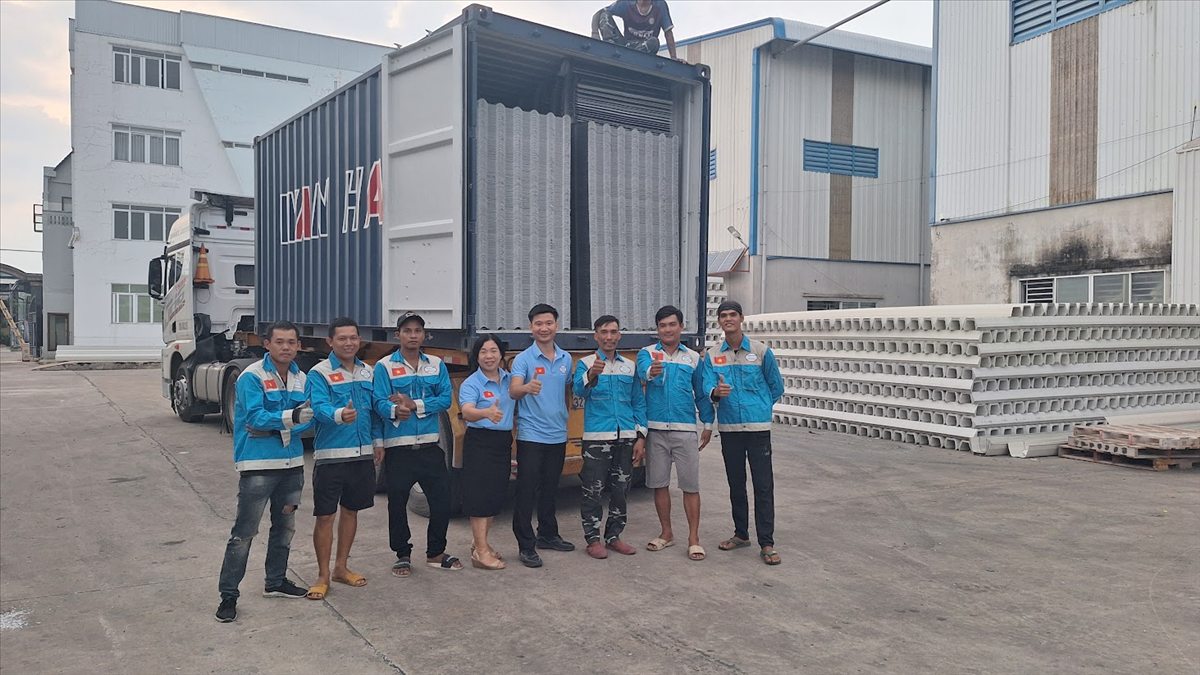
The Santiago team beside a loaded export container at the factory, November 2024
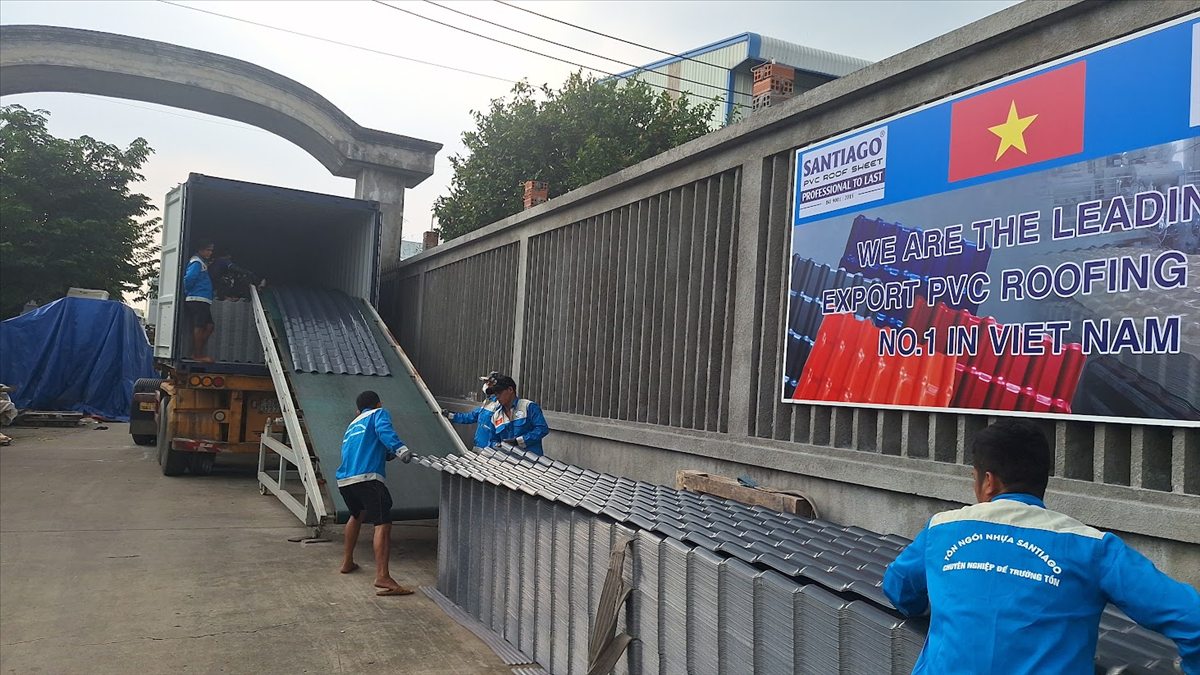
Loading Santiago roof tiles into an export container
Frequently asked questions
Can I use plastic roof tiles on a shed in Canada?
Yes, where your builder approves it for the site. Santiago's ASA/PVC tile sheet weighs about 5.4 kg per m² and has no metal to rust, but Santiago publishes no snow-load or cold rating, so the frame must be designed for local snow by the builder or an engineer.
What roof pitch does the tile sheet need?
A slope of 20 – 45%, roughly 2.4/12 to 5.4/12. A 3/12, 4/12 or 5/12 shed or cabin roof fits; a 2/12 roof is too flat and a 6/12 roof is steeper than Santiago's range.
How many sheets for a 10 × 12 ft shed roof?
A single-slope roof at 4/12 pitch with small overhangs takes 4 sheets of 3.723 m, about 14.9 running metres, 57 – 72 screw sets and 3.84 m of eave sealing tile.
Is the tile sheet covered by CPTPP for Canada?
Canada and Vietnam are both CPTPP members, so it can qualify for lower or zero duty under Canada's schedule with Santiago's proof of origin for each container. Your customs broker confirms the rate, and you can ask Canadian customs for an advance ruling on classification and origin.
Does Santiago install cabin roofs in Canada?
No. Santiago supplies the sheets and accessories from Vietnam and sends installation videos; a local builder installs them.
Read more
- Plastic roof tiles for sheds and cabins
- How to install PVC roof tile sheets
- PVC roofing sheet colours
- Roof tile accessories checklist
- ASA/PVC roof tile sheet
Version française
La tuile PVC de Santiago est une plaque ASA/PVC à profil de tuiles qui donne à un chalet, un bunkie, un cabanon ou un gazebo l'allure d'un toit en tuiles, pour environ 5,4 kg par m² de toiture et sans métal qui rouille. Un cabanon de 10 × 12 pi (3,05 × 3,66 m) à une seule pente de 4/12 demande 4 plaques de 3,723 m. Santiago ne publie aucune résistance à la charge de neige ni au froid : la charpente doit être conçue pour la neige locale par l'entrepreneur ou un ingénieur.
Pour quels bâtiments au Canada?
Les petits bâtiments autour de la maison : le bunkie au bord du lac en Ontario, le cabanon au fond du terrain au Québec, l'abri de jardin ou le gazebo sur la côte de la Colombie-Britannique. On veut un toit assorti à celui de la maison sans charger une petite charpente de bois avec de la tuile lourde. Chaque plaque va d'une seule pièce du haut du toit jusqu'à l'avant-toit, avec une rangée de tuiles tous les 219 mm.
La plaque est fabriquée au Vietnam en quatre couches coextrudées, sans colle : une couche ASA qui porte la couleur et bloque les UV, une couche de PVC vierge, un cœur en PVC et une base en PVC blanc laiteux côté intérieur. Couleurs courantes : gris foncé, rouge, bleu, orange et chocolat; vert, blanc et violet sur commande.
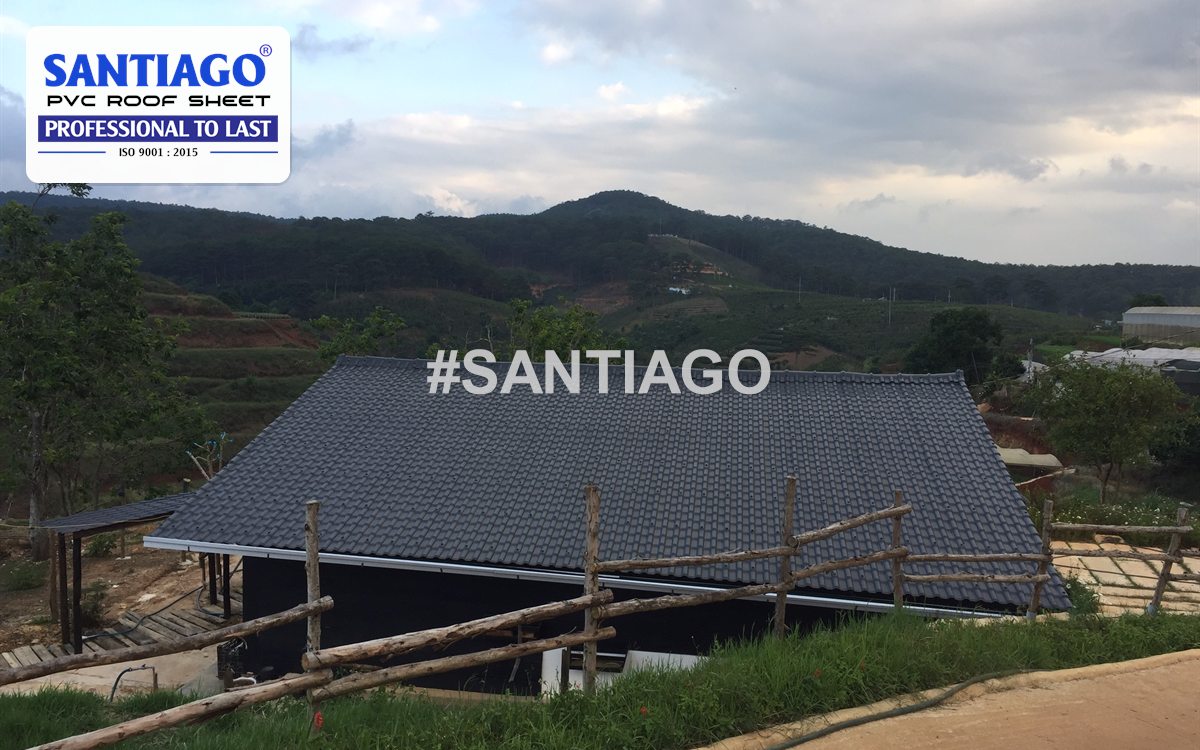
Maison en bois foncé avec toit en tuiles PVC grises, Da Lat, Vietnam
Et la neige?
Santiago ne publie pas de résistance à la charge de neige, au froid ni au vent pour cette plaque, et elle n'est certifiée selon aucun code du bâtiment canadien. Dans une région de forte neige, l'entrepreneur ou l'ingénieur conçoit les chevrons et les pannes pour la charge de neige locale et décide si la plaque convient. La règle de Santiago, des pannes à moins de 700 mm, sert à tenir la plaque; ce n'est pas un calcul de neige. Vérifiez aussi auprès de votre municipalité si un permis est nécessaire.
Combien de plaques pour un cabanon de 10 × 12 pi?
Exemple : toit à une seule pente de 4/12 (33 %) qui descend sur la profondeur de 10 pi, avec 30 cm de débord à l'avant, 15 cm à l'arrière et 9 cm de chaque côté.
| Étape | Calcul | Résultat |
|---|---|---|
| Longueur en pente | (3,05 + 0,30 + 0,15 m) × 1,054 | 3,689 m |
| Longueur de plaque | 3,689 ÷ 0,219 = 16,8, arrondi à 17 pas × 219 mm | 3,723 m |
| Plaques sur la largeur | 3,84 m ÷ 0,96 m | 4 plaques |
| Mètres linéaires à commander | 4 × 3,723 m | environ 14,9 m |
| Surface du toit | 3,84 × 3,723 m | environ 14,3 m² |
| Vis avec capuchons ASA | 14,3 m² × 4 à 5 par m² | environ 57 à 72 |
| Closoir d'avant-toit | Bord bas | 3,84 m |
| Poids des plaques | 14,3 m² × 5,4 kg | environ 77 kg |
Pannes à 440 ou 660 mm, une sous le pied de chaque pas de tuile. Prépercez des trous de 6 mm et vissez des vis de 70 mm sur le dessus de l'onde, au-dessus d'une panne, jamais dans le creux. Pente admise : 20 à 45 %, donc un toit de 3/12, 4/12 ou 5/12. Santiago fournit les plaques, les accessoires et des vidéos de pose; elle ne fait pas l'installation.
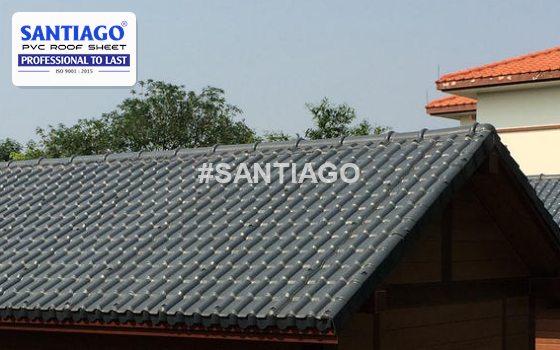
Toit en tuiles PVC grises sur un pignon en bois, Vietnam
Importer au Canada avec le PTPGP (CPTPP)
Le Canada et le Vietnam sont membres du PTPGP. Un conteneur de ces plaques (SH 3925.90.00) peut obtenir un droit réduit ou nul selon la liste du Canada, avec la preuve d'origine que Santiago fournit pour chaque conteneur; votre courtier en douane confirme le taux. La commande minimale à l'export est un conteneur de 40 pi, environ 5 000 m, couleurs et accessoires mélangés, donc un particulier achète en général chez un détaillant ou un entrepreneur canadien qui importe.
Questions fréquentes
La tuile PVC convient-elle à un toit d'abri de jardin au Canada?
Oui, si l'entrepreneur l'approuve pour le site. Elle pèse environ 5,4 kg par m² et ne rouille pas, mais Santiago ne publie aucune résistance à la neige ni au froid : la charpente doit être conçue pour la neige locale.
Quelle pente faut-il pour la tuile PVC?
De 20 à 45 %, soit environ 2,4/12 à 5,4/12. Un toit de 3/12, 4/12 ou 5/12 convient.
Peut-on recevoir un échantillon?
Oui, l'échantillon est gratuit; l'acheteur paie le messager. Comparez la couleur avec votre revêtement à la lumière du jour.
Sources for the figures in this article
- Profiles, 2.5–3.0 mm thickness and 10-year warranty: Santiago ASA/PVC product specification.
- HS code 3925.90.00: Harmonized System Chapter 39 (builders' ware of plastics), as applied in Vietnam's export tariff.
- Certificates of origin (Form D, AI, AK/VK, AJ/VJ, VC, CPTPP): issued by Vietnam's Ministry of Industry and Trade under the country's free trade agreements.
- Minimum order of one 40 ft container (about 5,000 m) and about 5 days for production and loading: Santiago export desk, October 2026.
Updated 03/11/2026. Santiago Import Export Co., Ltd, Vietnam. WhatsApp +84 935 391 495 (Mr. Quyen), hotline +84 965 437 316 (Mrs. Ly), email salessantiagoroofing@gmail.com.


