


Mr Quyen - Santiago. Posted 20/11/2026
Work out the roof area that drains to each gutter, multiply it by your local design rainfall intensity in mm per hour and divide by 3,600 to get the flow in litres per second. Then choose a gutter and outlets whose rated capacity covers that flow. A 60 m² roof slope at 150 mm/h sends about 2.5 litres per second to its gutter.
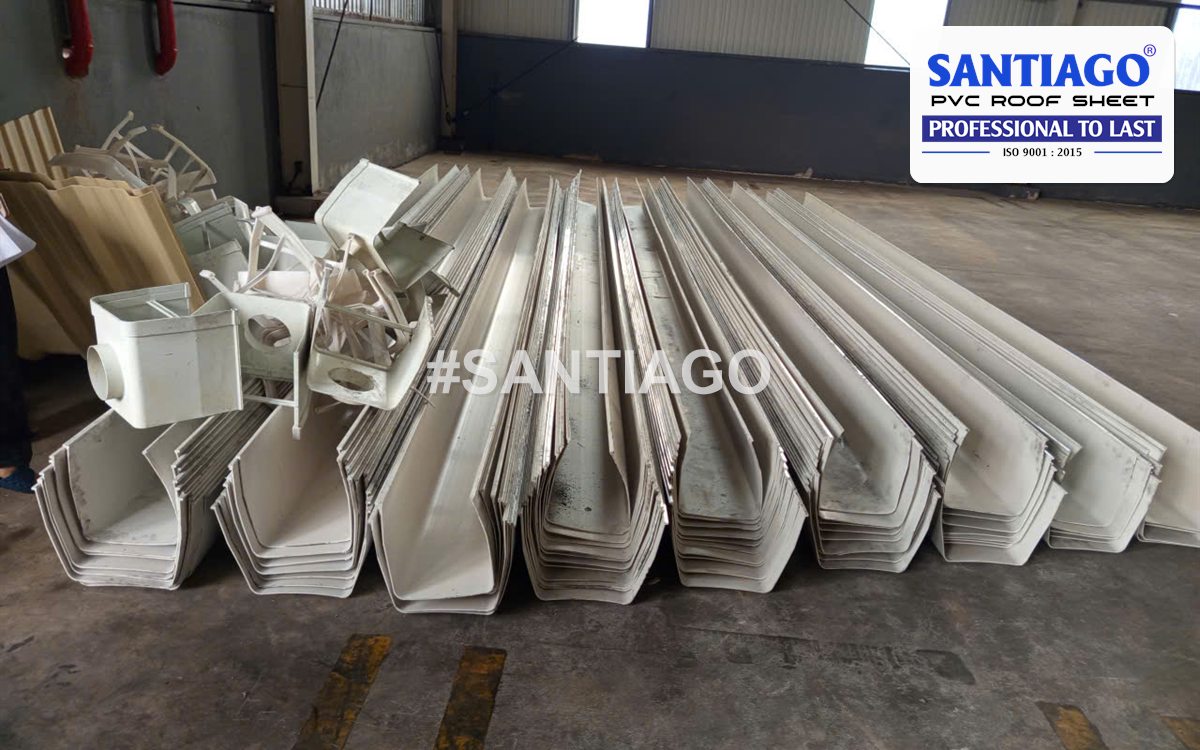
Rows of white PVC gutter lengths in a warehouse, Vietnam
What do you need to size a gutter?
Three numbers decide the size: how much roof drains into the gutter, how hard it rains in a short burst where you live, and how many outlets the water can leave by. Gutter shape and fall come next, and the gutter maker's capacity table closes the loop.
| Input | Where to get it |
|---|---|
| Roof area draining to the gutter | Your drawing: each slope, and any wall or upper roof that sheds onto it |
| Design rainfall intensity (mm/h) | Your building code or weather service; usually a short, intense storm, not daily rainfall |
| Number and position of outlets | Your layout: where downpipes can go and where water can be discharged |
| Gutter capacity | The gutter maker's data for that profile and fall |
How do I calculate the roof area for gutter sizing?
Codes do this in different ways. Many use the plan area (the footprint seen from above) with an allowance for steeper pitches, because wind drives rain onto the slope. New Zealand's building research body, BRANZ, recommends using the actual area of the roof plane. US guides multiply the plan area by a pitch factor. Use the method in your local code and stay with it through the whole calculation.
- Gable roof: two slopes, one gutter each; size each side on its own
- Hip roof: add the faces that drain to each stretch of gutter
- Lean-to against a wall: add part of the wall area above, since wind-driven rain runs down it
- Valley: the gutter or valley below takes both slopes that meet there
What rainfall intensity should I use?
Gutters are sized for short, heavy bursts, measured over about five minutes and expressed in millimetres per hour. That is very different from annual or daily rainfall. In the UK, a value of 75 mm/h is commonly used; tropical and monsoon regions design for higher values. Take the figure from your building code or weather service rather than guessing, because it changes the answer in direct proportion.
Worked example: a 12 × 10 m house
A simple gable roof covers a 12 × 10 m footprint, with the ridge along the 12 m side. Each slope drains to a 12 m gutter. Suppose the local code gives 150 mm/h; this figure is only for the example.
- Plan area per slope: 12 m × 5 m = 60 m².
- Flow per gutter: 60 × 150 ÷ 3,600 = 2.5 litres per second.
- One outlet at one end: the whole 2.5 L/s runs 12 m to that outlet.
- Two outlets, one at each end, or one in the middle: each takes about 1.25 L/s and the water travels at most 6 m.
- Pick a gutter profile and outlet whose rated capacity covers the flow at the outlet, with the fall you will build.
Adding outlets is often cheaper than going up a gutter size, and it shortens the distance water has to travel, which keeps the gutter from overflowing at the far end in a cloudburst.
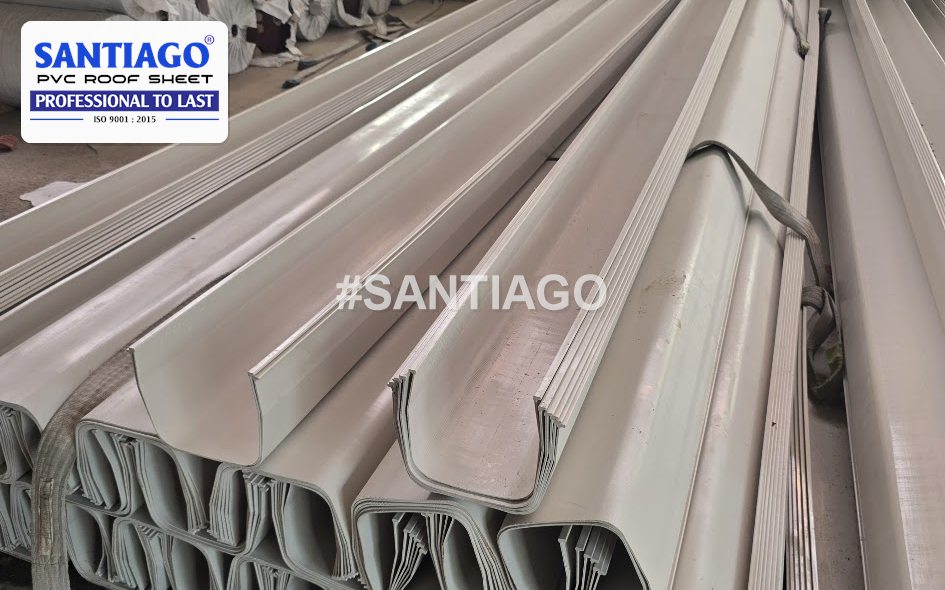
Stacked white PVC gutter profiles, Vietnam
How do I size downpipes?
The downpipe has to carry everything that reaches its outlet. US guides give two rules of thumb: about 1 square inch of downspout cross-section for every 100 sq ft of roof (roughly 0.7 cm² per m²), and figures such as about 600 sq ft (56 m²) for a 2 × 3 in downspout and 1,200 sq ft (111 m²) for a 3 × 4 in one. These assume typical US rainfall; at higher intensities you need more or larger pipes. Your code may give its own table.
Bends, long horizontal runs and leaf guards slow the water down, so leave some margin. Lead each downpipe to a drain, soakaway or tank, never onto a neighbour's land or a path.
Santiago PVC gutter sizes
Santiago makes white PVC gutters in Vietnam, in 6 m lengths, with end caps, outlets and joiners. The table gives the profile and the volume it holds when full, calculated from the cross-section. Volume is not the same as flow capacity, which also depends on fall and outlets, so use it to compare sizes, not as a flow rating.
| Size | Bottom × height × top (mm) | Wall / bottom thickness | Holds when full (calculated) | Outlet |
|---|---|---|---|---|
| Small | 135 × 135 × 205 | 2.2 / 2.5 mm | About 23 litres per metre | 114 mm |
| Medium | 185 × 185 × 255 | 2.6 / 3.0 mm | About 41 litres per metre | 114 mm |
| Step | Bottom 180, sides 150 / 185, top 270 | 2.6 / 3.0 mm | About 34 litres per metre, up to the lower side | 114 mm |
| Large | 255 × 275 × 330 | 3.3 / 4.0 mm | About 80 litres per metre | 140 mm |
There is no 90 mm outlet; a reducer connects a 114 mm outlet to a 90 mm pipe. Santiago's gutter warranty is 3 years. Santiago does not install gutters: a metalworker usually welds U-shaped steel brackets and the gutter sits in them. If you want gutters added to an export order of roofing sheets, ask with your drawing.

White PVC gutter end caps and outlet fittings in a pile, Vietnam
How should the roof edge meet the gutter?
On an ASA/PVC tile-sheet roof, fit eave drip tile along the lower edge so the water drops into the gutter rather than creeping back under the sheet. Set the gutter so the drip line falls over its middle, a little below the sheet edge, and give it a slight, even fall towards the outlets as the gutter maker specifies. Keep at least a 20% slope on the roof itself (about 11°); below that, water moves slowly and the gutter fills unevenly.
If you plan to keep the water, the same gutters feed the tank; see which roofing material works best for rainwater harvesting.
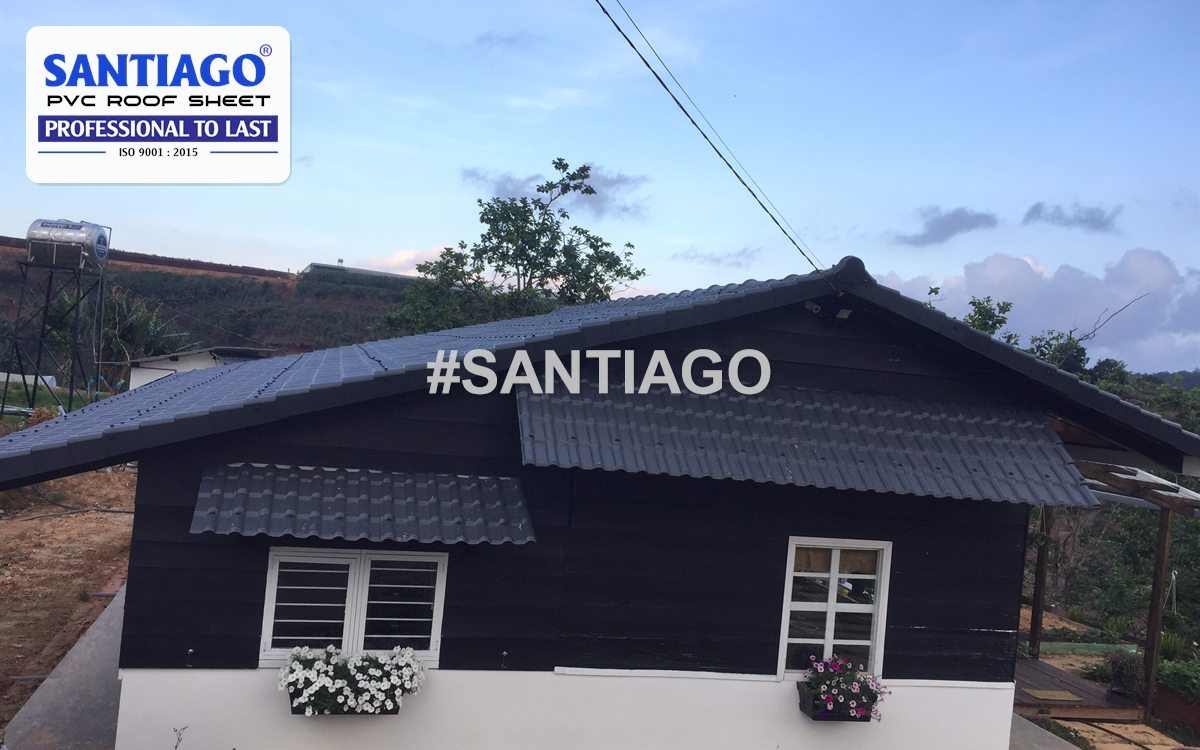
House with dark grey tile-sheet roof and a small canopy over the windows, Vietnam
Which pieces go on a finished tile-sheet roof?
Mr Quyen stands among stacks of brown tile sheets in the Santiago factory, then walks with a colleague along a finished grey tile roof with its ridge and edge pieces near the gutter. Installers carry a grey tile sheet into place.
Santiago uPVC tile sheets from the factory to the roof (Santiago video on YouTube).
More short videos on fixing
Two more English shorts from the Santiago YouTube channel. Each one is about a minute or less.
How does the sheet take a cut?
A 45-second factory short: beige and orange ASA/PVC sheets are flexed by hand and cut with shears to show how the material behaves. On a roof, purlins still go less than 700 mm apart.
Bending and cutting test on Santiago ASA/PVC sheets (Santiago video on YouTube).
What does a finished run near the gutter look like?
Mr Quyen stands among stacks of brown tile sheets in the Santiago factory, then walks with a colleague along a finished grey tile roof near the gutter while installers carry a sheet into place.
Santiago uPVC tile sheets from the factory to the roof (Santiago video on YouTube).
Santiago – a leading exporter of ASA/PVC roofing from Vietnam
Santiago roofing is produced and loaded into containers at our factory in Vietnam. It has been exported to India since 2023, Thailand since 2024 and the USA since 2025. Every export shipment comes with a commercial invoice, packing list, bill of lading and a certificate of origin (C/O) issued by Vietnam's Ministry of Industry and Trade, which importers use to claim the duty preference of their trade agreement.
| Item | Details |
|---|---|
| HS code | 3925.90.00 (ASA/PVC roofing sheets) |
| Certificate of origin | Form D (ASEAN), Form AI (India), Form AK / VK (Korea), Form AJ / VJ (Japan), Form VC (Chile), CPTPP proof of origin |
| Shipped from | Vietnam, by container |

Certificate of origin Form AI (ASEAN–India) for Santiago ASA/PVC roofing sheets, HS 39259000, certified on 24 September 2026. Buyer details are hidden.
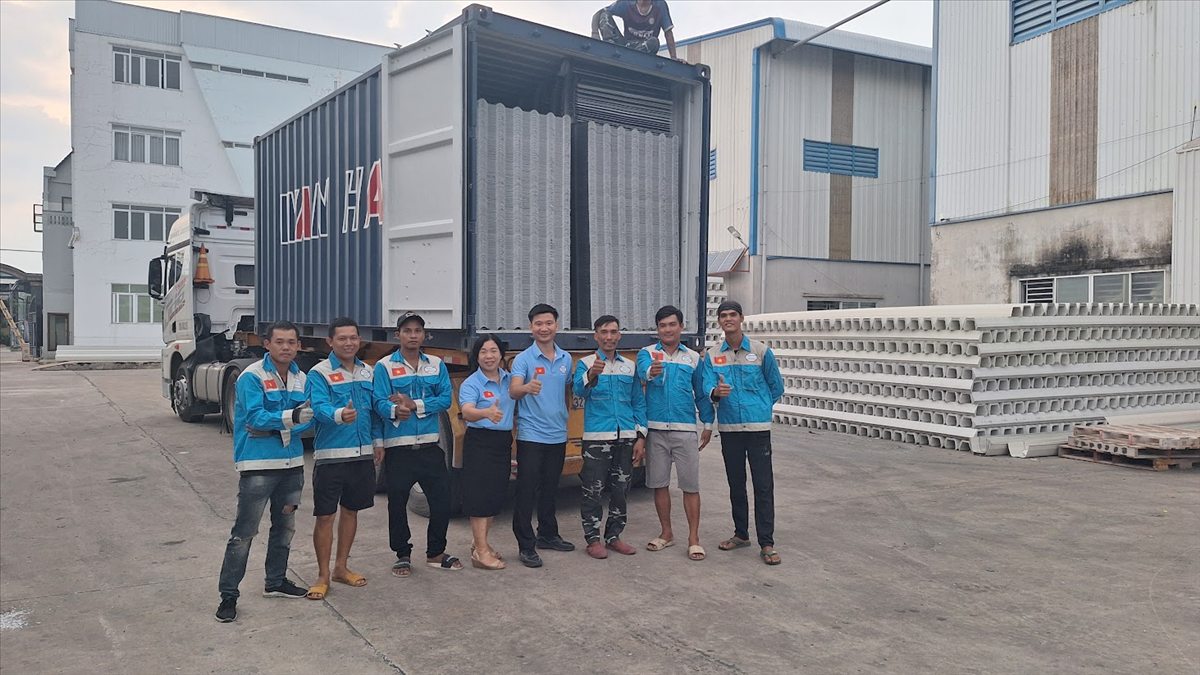
The Santiago team beside a loaded export container at the factory, November 2024

Loading Santiago roof tiles into an export container
Frequently asked questions
How do you calculate gutter size?
Multiply the roof area draining to the gutter (m²) by the design rainfall intensity (mm/h) and divide by 3,600 to get litres per second. Choose a gutter and outlets rated for at least that flow.
How many downpipes do I need?
Enough that each outlet's share of the flow is within the pipe's capacity. US rules of thumb are about 1 sq in of downspout per 100 sq ft of roof; more outlets also shorten the distance water travels in the gutter.
What size gutter do I need for a 100 m² roof?
It depends on how the roof is split between gutters, your rainfall intensity and the number of outlets. For example, 50 m² to one gutter at 150 mm/h is about 2.1 L/s; check that against the gutter maker's capacity table.
Does roof pitch affect gutter size?
It can. Steeper roofs catch more wind-driven rain and send water to the gutter faster, so some codes add an allowance for pitch or use the full roof plane area.
Is a bigger gutter always better?
Not always. A second outlet often helps more than a larger profile, and a larger gutter still needs the right fall, clean outlets and downpipes big enough to empty it.
Read more
- Eave sealing tile or vertical wall flashing
- Minimum pitch for PVC roofing
- How many roofing sheets do I need?
- ASA/PVC roof tile accessories checklist
- ASA/PVC roof tile sheet
Read next on this topic
Main guide: How to Install PVC Roof Tile Sheets: 8 Steps
Sources for the figures in this article
- Profiles, 2.5–3.0 mm thickness and 10-year warranty: Santiago ASA/PVC product specification.
- HS code 3925.90.00: Harmonized System Chapter 39 (builders' ware of plastics), as applied in Vietnam's export tariff.
- Certificates of origin (Form D, AI, AK/VK, AJ/VJ, VC, CPTPP): issued by Vietnam's Ministry of Industry and Trade under the country's free trade agreements.
- Minimum order of one 40 ft container (about 5,000 m) and about 5 days for production and loading: Santiago export desk, October 2026.
Updated 03/11/2026. Santiago Import Export Co., Ltd, Vietnam. WhatsApp +84 935 391 495 (Mr. Quyen), hotline +84 965 437 316 (Mrs. Ly), email salessantiagoroofing@gmail.com.


