


Mr Quyen - Santiago. Posted 20/11/2026
Smooth, hard roofs give the cleanest and largest harvest: in a Texas study, metal, concrete tile and cool-roof membranes gave better water quality than asphalt shingle. Every millimetre of rain on 1 m² of roof is about 1 litre of water. Whatever the roof, divert the first flush and treat the water before anyone drinks it.
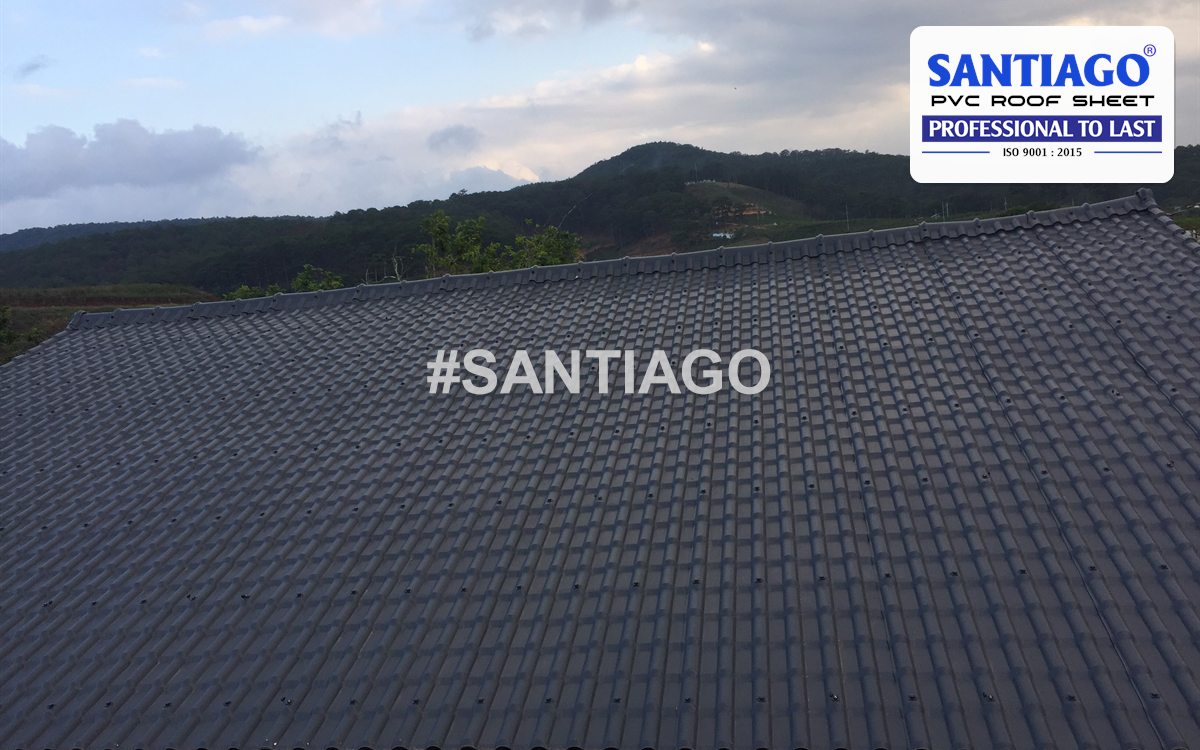
Dark grey tile-sheet roof slope above a hillside, Vietnam
How much rainwater can a roof collect?
The arithmetic is simple. One millimetre of rain falling on one square metre is one litre of water. Use the plan area of the roof, the footprint it covers seen from above, because rain falls more or less vertically and a steep roof does not catch more of it than a flat one with the same footprint.
Not all of it reaches the tank. Some wets the surface and evaporates, some splashes over the gutter in heavy storms, and the first flush is thrown away on purpose. Smooth sheet roofs lose less than rough or porous ones, which is one reason metal and plastic sheets are popular for harvesting.
| Roof plan area | Rain event | Water before losses |
|---|---|---|
| 50 m² (540 sq ft) | 10 mm (0.4 in) | About 500 litres (130 US gal) |
| 100 m² (1,080 sq ft) | 20 mm (0.8 in) | About 2,000 litres (530 US gal) |
| 150 m² (1,610 sq ft) | 25 mm (1 in) | About 3,750 litres (990 US gal) |
For a year, multiply the plan area by your local annual rainfall in millimetres and take off a share for losses. Your weather service publishes the rainfall figure; a local tank supplier will know the usual loss allowance for your climate.
Which roofing material is best for rainwater collection?
There is no single winner in the research, and the studies do not all agree. What they share is that smooth, inert, hard surfaces give cleaner water than rough or granular ones.
| Study | What it compared | What it found |
|---|---|---|
| Texas Water Development Board / University of Texas | Galvalume metal, concrete tile, cool-roof membrane, asphalt shingle, green roof | Metal, concrete tile and cool roofs gave the best water quality; the water still needed treatment to meet drinking standards |
| Shanghai, China | Several roof materials and weather patterns | Ceramic tile rated best for harvesting; asphalt ranked last |
| Korea, field study | Several roof materials | Galvanised steel judged the most suitable |
The Texas researchers were careful to say their work is not the final word. Local dust, birds, trees and how long since it last rained can matter as much as the roofing itself.
Metal sheet roofs
Metal is the material most guides recommend for harvesting: smooth, fast-draining and widely tested. Two points to check. Zinc from galvanised coatings can show up in the water, and old roofs sometimes have lead flashing or nails with lead washers. Ask for lead-free fixings and flashing if the water will be used in the house.
Tile roofs
Clay and concrete tiles performed well in the studies, but a tiled roof has many joints and a rougher surface, so more dust and organic matter sits on it between rains. Moss and lichen treatments should not be used on a collecting roof.
Asphalt shingles and treated surfaces
Shingles shed granules and ranked lowest in the studies above. Roofs treated with moss killers, or with copper flashing, are generally advised against for collection.
ASA/PVC sheet roofs
An ASA/PVC sheet has a smooth surface and no metal, so there is no rust or zinc to wash into the gutter. The studies above did not include ASA/PVC, and Santiago has no certificate for contact with drinking water. Use the water for gardens, washing, cleaning and toilet flushing, or treat it to your local health authority's rules before drinking.
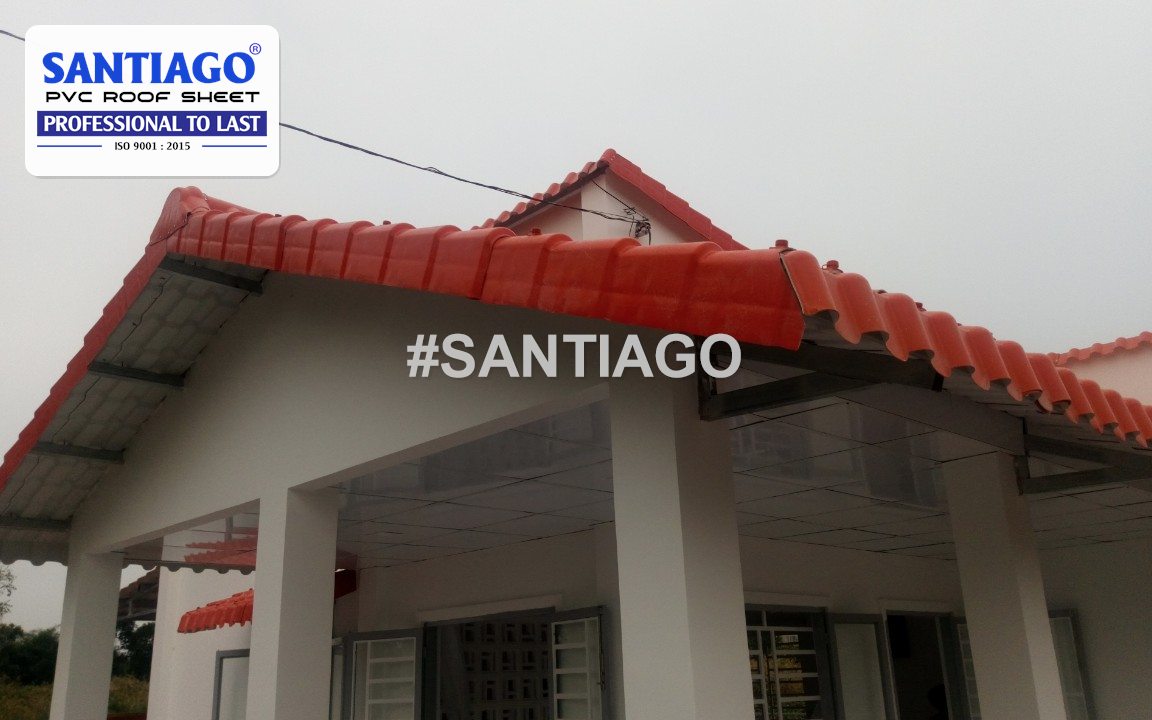
Red tile-sheet roof eaves over the porch of a white house, Vietnam
What is a first-flush diverter and do I need one?
Yes, on almost every harvesting system. The first rain after a dry spell washes off dust, leaves, pollen and bird droppings, and research on harvested water finds that most of the contamination arrives in that first portion. A first-flush diverter is a short pipe or chamber that fills with this water and sends it to waste, so only the cleaner rain that follows runs to the tank.
- Fit leaf guards or a mesh at the gutter outlets.
- Lead the downpipe into a first-flush diverter sized to the roof area, as the diverter maker advises.
- Run the overflow from the diverter to a drain or soakaway, away from the house.
- Fit a fine screen at the tank inlet and a sealed lid to keep out light, insects and animals.
- Clean gutters, screens and the diverter after storms and before the rainy season.
Can harvested rainwater be used for drinking?
Only after treatment. Even the best roof in the Texas study gave water that needed treatment to meet the US drinking-water standard. Typical steps are filtration and disinfection, chosen with a local water specialist, and many countries have their own rules for household rainwater. For gardens, laundry, cleaning, toilets and livestock washing, the bar is lower and a clean roof with a first-flush diverter is often enough.
| Use | What you usually need |
|---|---|
| Garden and lawns | Clean roof, gutter guards, first flush |
| Toilet flushing and laundry | The above plus a fine filter and a sealed tank |
| Livestock and cleaning | The above; follow farm and local rules |
| Drinking and cooking | Treatment chosen with a water specialist, under local health rules |
How should the gutters be set up for harvesting?
Gutters are the collector, so they need enough size for your heaviest rain, outlets close to the tank and no standing water. We explain the sizing method step by step in how to calculate gutter and downpipe size from roof area.
On a tile-sheet roof the lower edge needs an eave drip tile so water drops cleanly into the gutter instead of running back under the sheet. Santiago also makes white PVC gutters in Vietnam in four sizes, with outlets of 114 mm or 140 mm; if you want them in an export order, ask with your roof drawing.
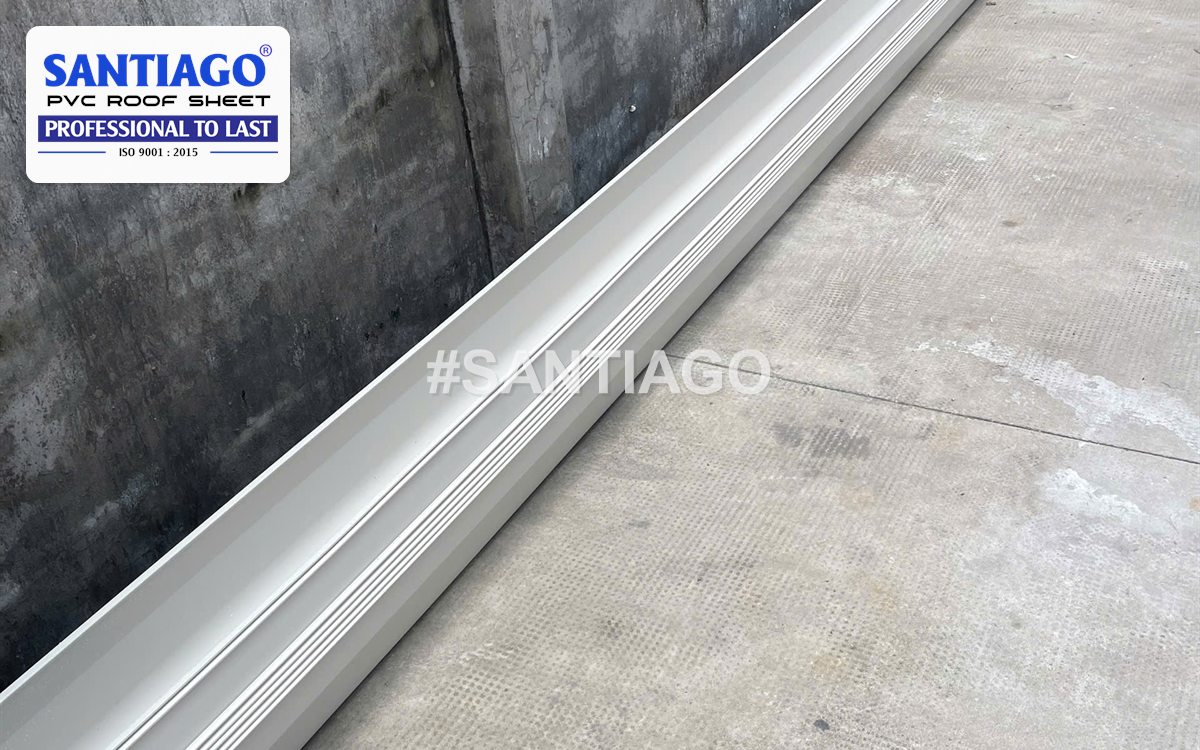
A length of white PVC gutter laid on the ground, Vietnam
What else affects rainwater quality on a roof?
- Overhanging trees: leaves and bird droppings, and roots in the downpipes
- Nearby roads, kilns and factories: soot and dust settle on the roof
- Long dry spells: more build-up before the first rain
- Old paint, sealants and flashing: ask what they contain before collecting
- Access: the roof sheet is not a walking surface, so plan how gutters will be cleaned from a ladder or a board across the purlins
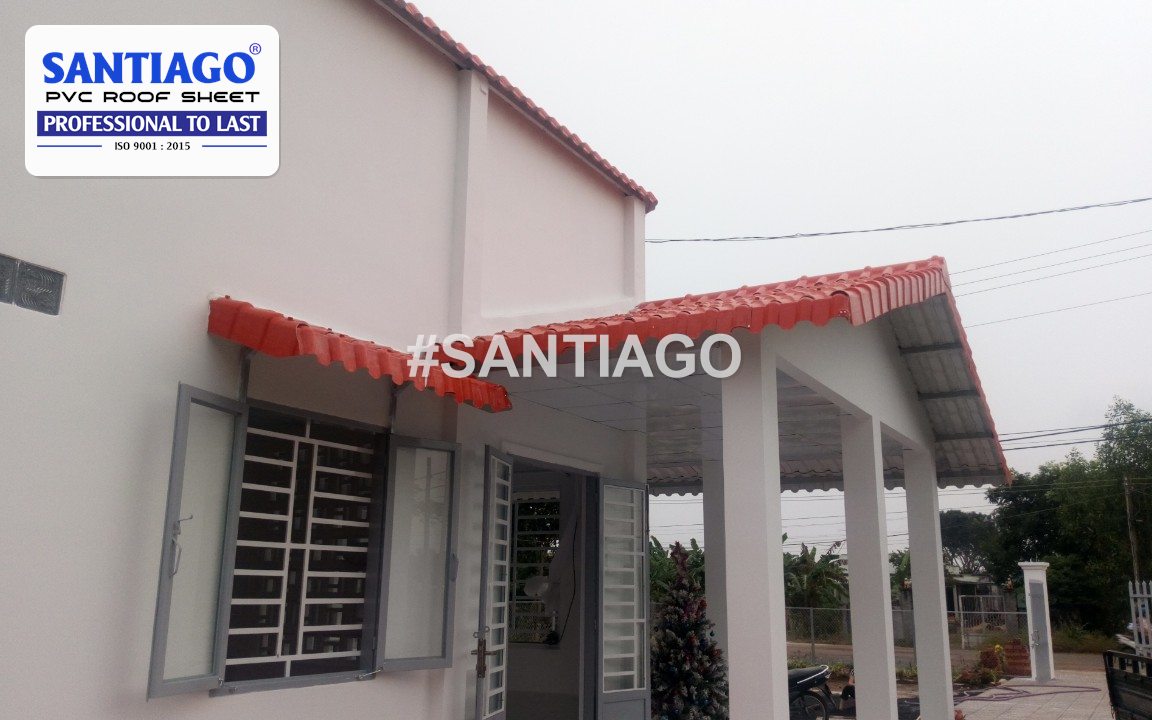
Red tile-sheet porch roof with straight edges on a white house, Vietnam
What does a finished tile-sheet roof look like up close?
Mr Quyen shows a green ASA/PVC sheet in the Santiago factory, then climbs onto a grey tile-profile roof that installers are still screwing down. Near the end he and a colleague walk along a finished grey tile roof next to the gutter.
Santiago uPVC tile roofs on site (Santiago video on YouTube).
More short videos on rain and roofs
Both clips below come from Santiago's own YouTube channel and were filmed at the factory in Vietnam or on Santiago roofs.
Why are thin metal roofs loud in rain?
Mr Quyen holds a white tile sheet in the Santiago factory and explains in English, with captions, why bare metal roofs are hot, noisy in rain and costly to repair. The short then shows a red tile roof on a house and a finished grey tile roof beside the gutter.
Heat and rain noise: Santiago ASA/uPVC roofing explained (Santiago video on YouTube).
How do tile sheets cope with sun and rain?
This one-minute short moves from red tile sheets going up onto a house to a flame test on a stack of sheets, then a blue warehouse roof under installation. A flame test is a demonstration, not a fire rating.
Santiago PVC roofing tiles in real conditions (Santiago video on YouTube).
Santiago – a leading exporter of ASA/PVC roofing from Vietnam
Santiago roofing is produced and loaded into containers at our factory in Vietnam. It has been exported to India since 2023, Thailand since 2024 and the USA since 2025. Every export shipment comes with a commercial invoice, packing list, bill of lading and a certificate of origin (C/O) issued by Vietnam's Ministry of Industry and Trade, which importers use to claim the duty preference of their trade agreement.
| Item | Details |
|---|---|
| HS code | 3925.90.00 (ASA/PVC roofing sheets) |
| Certificate of origin | Form D (ASEAN), Form AI (India), Form AK / VK (Korea), Form AJ / VJ (Japan), Form VC (Chile), CPTPP proof of origin |
| Shipped from | Vietnam, by container |

Certificate of origin Form AI (ASEAN–India) for Santiago ASA/PVC roofing sheets, HS 39259000, certified on 24 September 2026. Buyer details are hidden.
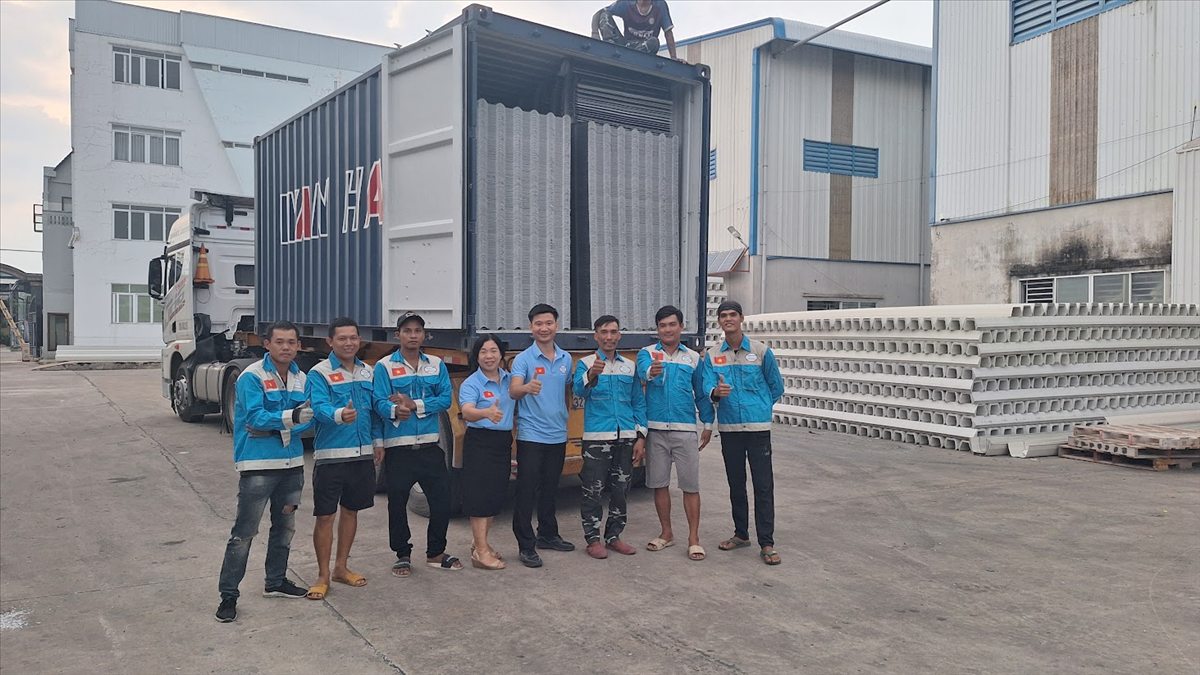
The Santiago team beside a loaded export container at the factory, November 2024
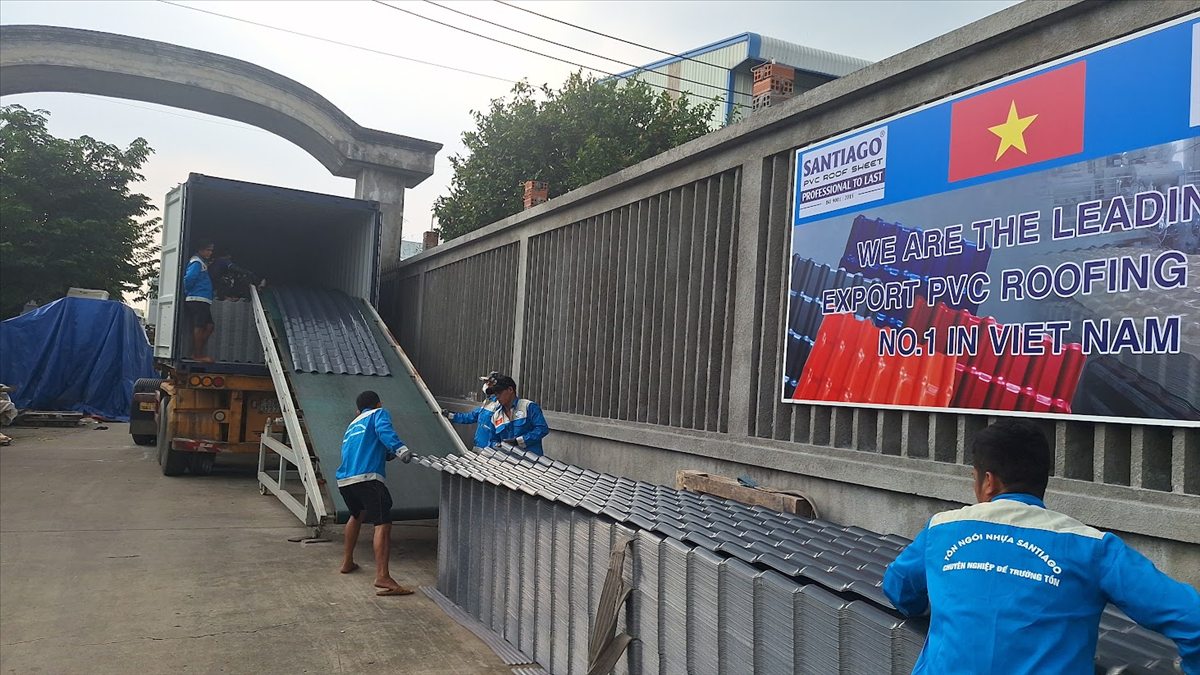
Loading Santiago roof tiles into an export container
Frequently asked questions
What is the best roof for rainwater collection?
Smooth, hard roofs: metal, concrete or clay tile and cool-roof membranes gave the best water quality in a Texas study, while asphalt shingle ranked lower. There is no single best material; keep the roof clean and fit a first-flush diverter.
How much water can I collect from my roof?
About 1 litre for every millimetre of rain on every square metre of roof plan area. A 100 m² roof in a 20 mm rain gives about 2,000 litres before losses.
Is a PVC roof safe for rainwater harvesting?
An ASA/PVC sheet has no metal, so it adds no rust or zinc to the water. Santiago has no drinking-water certificate for its sheets, so use the water for non-drinking purposes or treat it under your local health rules.
Do I need a first-flush diverter?
Yes. Most dust, droppings and debris come off in the first rain after a dry spell, and a diverter sends that portion to waste before water reaches the tank.
Can I drink rainwater from my roof?
Not without treatment. Researchers in Texas found that water from every roof type tested still needed treatment to meet drinking-water standards.
Read more
- Eave sealing tile or vertical wall flashing
- Roofing sheet types compared
- How to seal a corrugated roof and stop leaks
- Why the ASA surface layer matters
- ASA/PVC roof tile sheet
Read next on this topic
Main guide: How to Install PVC Roof Tile Sheets: 8 Steps
Sources for the figures in this article
- Profiles, 2.5–3.0 mm thickness and 10-year warranty: Santiago ASA/PVC product specification.
- HS code 3925.90.00: Harmonized System Chapter 39 (builders' ware of plastics), as applied in Vietnam's export tariff.
- Certificates of origin (Form D, AI, AK/VK, AJ/VJ, VC, CPTPP): issued by Vietnam's Ministry of Industry and Trade under the country's free trade agreements.
- Minimum order of one 40 ft container (about 5,000 m) and about 5 days for production and loading: Santiago export desk, October 2026.
Updated 03/11/2026. Santiago Import Export Co., Ltd, Vietnam. WhatsApp +84 935 391 495 (Mr. Quyen), hotline +84 965 437 316 (Mrs. Ly), email salessantiagoroofing@gmail.com.


