


Mr Quyền - Santiago. Posted 25/11/2026
Re-roofing in the rainy season works when the old roof is opened one section at a time and every opened section is framed and covered with new sheets, or tarpaulin, before the afternoon rain. With Santiago ASA/PVC tile sheets, about 5.2 kg per m² and 1.05 m wide, two people carry a 6 m sheet of about 33 kg, so a small crew can close a section in a day. Nobody works on a wet roof.
Santiago Import Export Co., Ltd (Vietnam) makes ASA/PVC roof tile sheets and corrugated roofing sheets and exports them by the container. WhatsApp +84 935 391 495 (Mr. Quyen), hotline +84 965 437 316 (Mrs. Ly).
The sections below follow the order an owner and roofer plan the job: whether to start in the rainy season at all, how much roof to open each day, what must be on site first, how to cover an open roof when rain comes, safety on wet roofs, fitting ASA/PVC sheets in damp weather, and which tile sheet suits a fast re-roof.
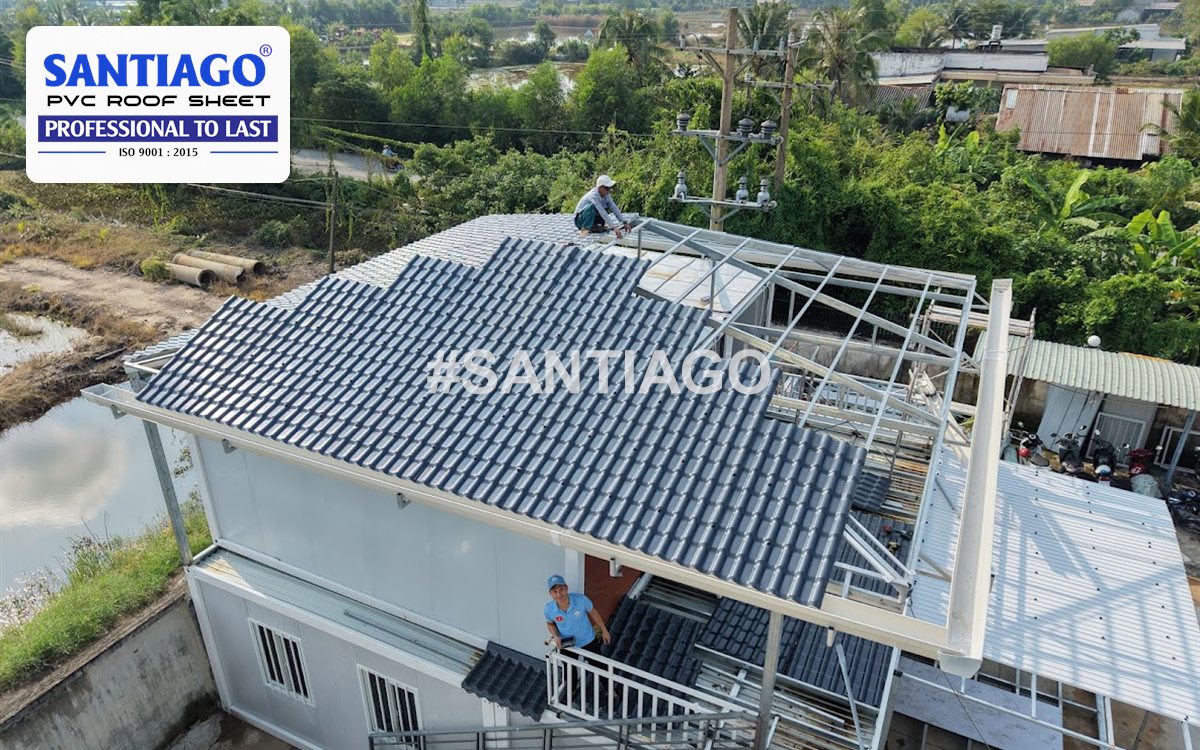
Two-storey house during re-roofing, half the roof covered with new grey tile sheets and the other half still open steel frame, Vietnam
Can you re-roof a house during the rainy season?
Yes, if the roof is never left open overnight. In tropical rainy seasons rain often comes as afternoon storms, so the working day is planned around them: strip in the early morning, frame and sheet by early afternoon, and have tarpaulins ready for anything still open. A re-roof that strips the whole roof on day one and sheets it over a week is the plan that floods rooms.
Where the frame needs major repair, or the house cannot be emptied under the roof, waiting for the dry season is still the safer choice.
How much old roof should be stripped in one day?
Strip only as much roof as the crew can close the same day, usually one slope or a few bays between rafters. The weight of the new sheets decides how fast a crew can close a section, and lightweight tile sheets are quick to carry up and fix.
| Sheet length (along the slope) | Weight of one Santiago ASA/PVC tile sheet, 2.5 mm, 1.05 m wide | Carried by |
|---|---|---|
| 2 m | about 11 kg | one person |
| 4 m | about 22 kg | two people |
| 6 m | about 33 kg | two people |
The weights follow from about 5.2 kg per m² for a 2.5 mm sheet, 1.05 m wide. Sheets are cut to the length of each slope at the factory, so there is no cutting of long runs on the roof while rain clouds build.
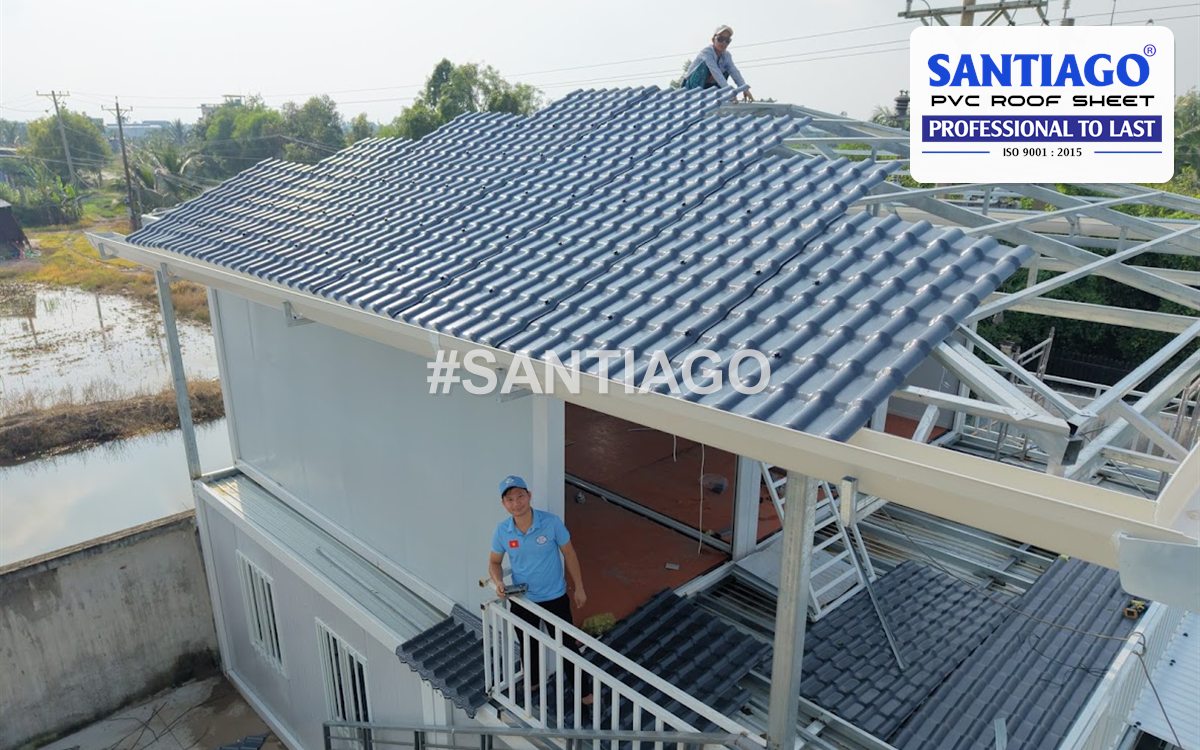
Grey tile sheets fixed on part of a new steel roof frame under a cloudy sky, with open frame still to be covered, Vietnam
What should be on site before the old roof comes off?
Everything needed to close the roof should be on site before the first old sheet is lifted. A re-roof stopped half-way because a box of screws or a ridge piece is missing is a re-roof open to the next storm.
- All tile sheets, cut to the slope lengths and counted against the roof drawing
- Ridge pieces, verge and eave pieces for the whole roof
- Screw sets at 4 – 5 per m², with sealing washers and ASA caps
- Heavy tarpaulins larger than the biggest section, with ropes
- Timber or steel for any purlins that need replacing, with purlins set less than 700 mm apart
- A dry place on site to stack the sheets flat
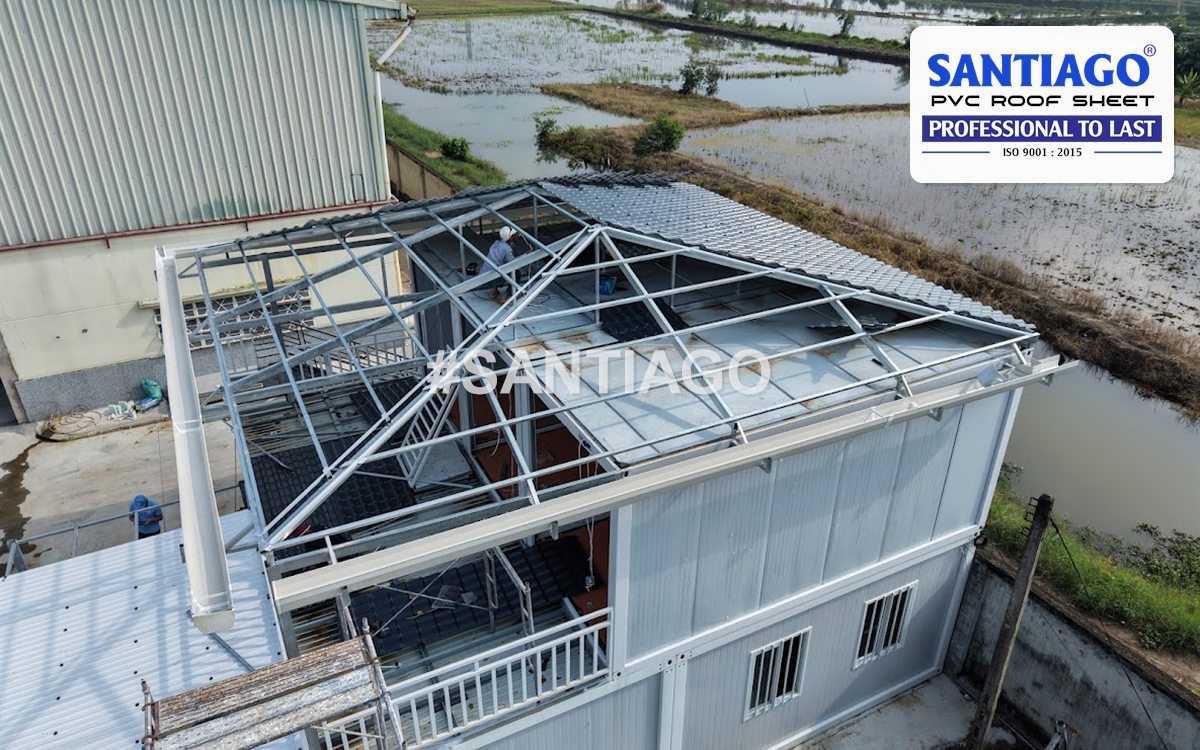
New steel roof frame on a two-storey building, ready for roof sheets, Vietnam
Before stripping, check the frame as described in our guide to checking an old roof frame before re-roofing; finding rotten rafters with the roof already open is what turns a one-day section into a week.
How do you cover an open roof when rain comes?
Cover the open section with tarpaulins laid like roof tiles, upper sheet over lower sheet, so water runs off the roof and not into it. Tie them to the frame, not to loose objects, because a storm gust lifts an unweighted tarpaulin in seconds.
- Start at the eave and work up, lapping each tarpaulin over the one below by at least 300 mm
- Run the top tarpaulin over the ridge or tuck it under the finished sheets above
- Tie the ropes to purlins or rafters, never to the edge of a new sheet
- Lead the water off the edge into the gutter or clear of the walls
- Cover furniture and floors under the open section with plastic sheet as a second layer
- Switch off power to light fittings and sockets in rooms under the open section
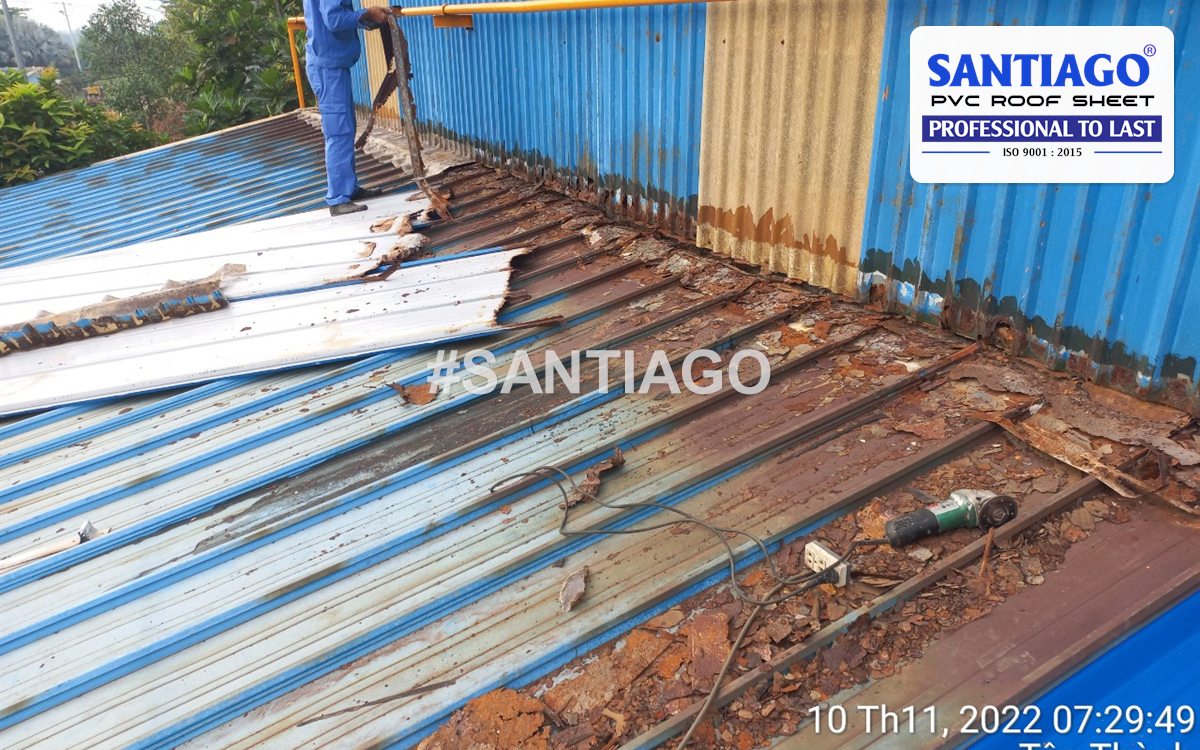
Rusted old metal roof sheets next to newly laid roofing sheets on the same building, Vietnam
Is it safe to work on a wet roof?
No. Wet sheets, wet steel purlins and wet timber are slippery, and lightning makes a roof the worst place to be in a storm. The US Occupational Safety and Health Administration (OSHA) names falls as the leading cause of death in construction, and roofers face them every day even in dry weather.
- Stop work and come down when rain starts or thunder is heard
- Wait until the surface has dried before going back up
- Use harnesses and anchor points, or guard rails at the edge
- Keep a clear, dry route for carrying sheets up
- Never stand on old fibre-cement or plastic sheets that are being removed
Can ASA/PVC tile sheets be installed in damp weather?
The sheets themselves are not harmed by rain, but the fixing work needs dry conditions. Sealant tape at laps only bonds to a dry, clean surface, and drilling and screwing on a wet roof is where installers slip. In practice, sheets are laid and screwed in the dry hours, and a sheet half-fixed when rain comes is tarpaulined with the open section.
- Dry the lap areas with a cloth before laying sealant tape
- Pre-drill 6 mm holes through the top of the wave and fix with 70 mm screws, sealing washers and ASA caps
- Lay tile sheets on a slope of 20 – 45% (about 11 – 24°) so rain clears quickly
- Check every lap from inside after the first heavy rain
The complete fixing order is covered in our guide on how to install PVC roof tile sheets in 8 steps.
What does a tile-sheet roof look like from stock to finished roof?
Mr Quyen stands among stacks of brown tile sheets in the Santiago factory, then walks with a colleague along a finished grey tile roof near the gutter. Installers carry a grey tile sheet into place, the kind of long, light sheet that lets a crew close a roof section in a day.
Santiago tile sheets from the factory to the roof (Santiago video on YouTube).
More short videos on roof shapes
Two short clips in English, filmed by Santiago. Tap a video to play it here on the page.
How are tile sheets fixed on a pitched roof?
In under a minute the short goes from the Santiago factory floor to a grey tile-profile roof on site: some sheets already fixed, installers screwing down the rest, and a finished run next to the gutter.
Santiago uPVC tile roofs on site (Santiago video on YouTube).
What does a tile sheet look like before it goes up?
Filmed inside the Santiago factory: a worker steps onto a white tile sheet, red and blue sheets get a torch test, and the last scene is the team beside an export container.
Santiago tile sheets at the factory (Santiago video on YouTube).
Which tile sheet suits a fast re-roof in the rainy season?
A light, long tile sheet that is cut to slope length and screwed straight to the purlins closes a roof faster than small heavy tiles laid one by one. The Santiago ASA/PVC roof tile sheet is 2.5 mm thick, about 5.2 kg per m², 1.05 m wide with 0.96 m of cover, and is fixed with 4 – 5 screw sets per m² to purlins less than 700 mm apart.
- About 5.2 kg per m², so the old frame carries less load than with clay or concrete tiles
- Cut to the length of each slope, from 2 m to long single runs
- ASA surface layer with a 30-year colour life and a 10-year warranty for sheets 2.5 mm or thicker
- Ridge, verge and eave pieces in the same colour
- About 5,000 m of sheet in one 40 ft container, which can be mixed with corrugated sheets
For a house re-roof, see the ASA/PVC roof tile sheet, 1.05 m wide and 2.5 mm thick, and send the slope lengths through the Santiago quotation form so every sheet arrives cut to size.
Santiago – a leading exporter of ASA/PVC roofing from Vietnam
Santiago roofing is produced and loaded into containers at our factory in Vietnam. It has been exported to India since 2023, Thailand since 2024 and the USA since 2025. Every export shipment comes with a commercial invoice, packing list, bill of lading and a certificate of origin (C/O) issued by Vietnam's Ministry of Industry and Trade, which importers use to claim the duty preference of their trade agreement.
| Item | Details |
|---|---|
| HS code | 3925.90.00 (ASA/PVC roofing sheets) |
| Certificate of origin | Form D (ASEAN), Form AI (India), Form AK / VK (Korea), Form AJ / VJ (Japan), Form VC (Chile), CPTPP proof of origin |
| Shipped from | Vietnam, by container |
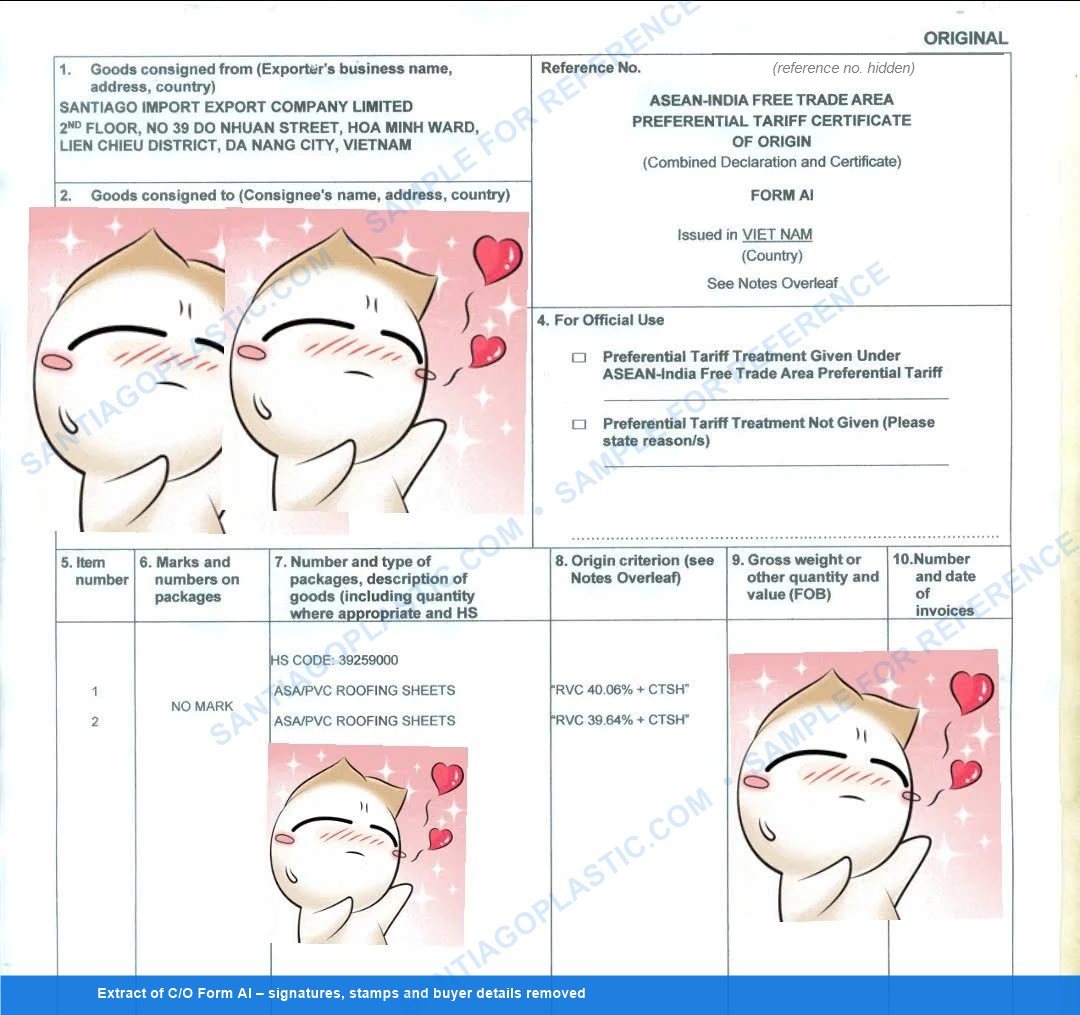
Certificate of origin Form AI (ASEAN–India) for Santiago ASA/PVC roofing sheets, HS 39259000, certified on 24 September 2026. Buyer details are hidden.
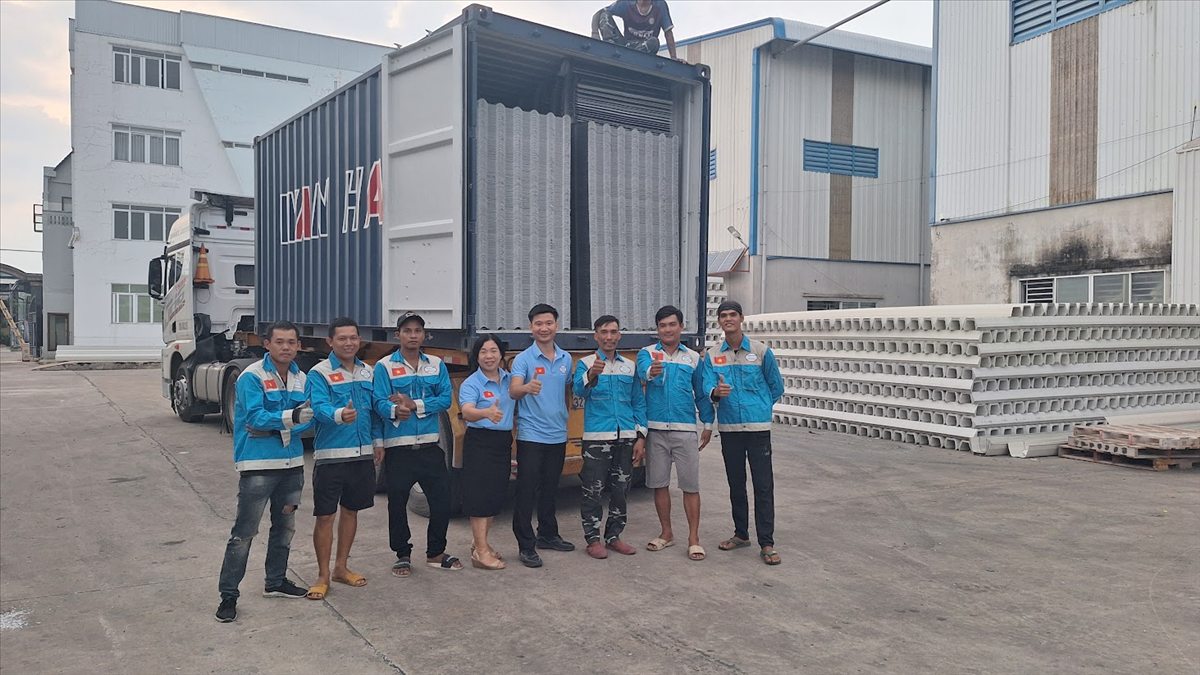
The Santiago team beside a loaded export container at the factory, November 2024
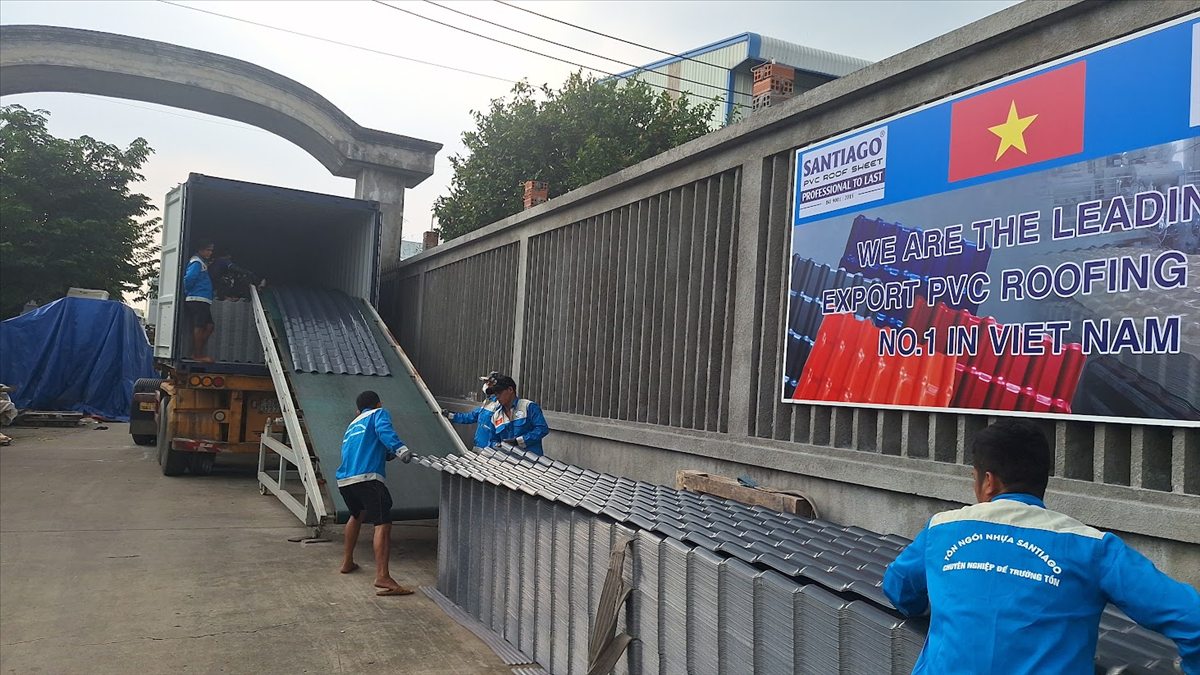
Loading Santiago roof tiles into an export container
Frequently asked questions
Can you replace a roof in the rainy season?
Yes, if the roof is opened one section at a time and each section is closed with new sheets or tarpaulin the same day. Never leave a roof open overnight.
How much roof can be stripped in a day?
Only what the crew can close the same day, usually one slope or a few bays. With 1.05 m tile sheets of about 5.2 kg per m², two people carry a 6 m sheet of about 33 kg.
How do you protect a house from rain during a re-roof?
Lay tarpaulins like tiles, upper over lower with at least 300 mm lap, tie them to the frame, lead water into the gutter, and cover furniture below with plastic sheet.
Can ASA/PVC roof sheets be installed in the rain?
The sheets are not harmed by rain, but laps, sealant tape and screws need dry conditions, and nobody should work on a wet roof.
What should be on site before the old roof comes off?
All sheets cut to length, ridge and edge pieces, screw sets at 4 – 5 per m², tarpaulins and ropes, and material for any purlins that need replacing.
Read more
- Replacing a rusted metal roof with PVC sheets
- Check an old roof frame before re-roofing
- PVC roofing sheets over an existing metal roof
- Roof maintenance checklist before the rainy season
- Lightweight roofing materials for old buildings
Read next on this topic
Main guide: Replacing a Rusted Metal Roof with PVC Sheets
Sources for the figures in this article
- Profiles, 2.5–3.0 mm thickness and 10-year warranty: Santiago ASA/PVC product specification.
- HS code 3925.90.00: Harmonized System Chapter 39 (builders' ware of plastics), as applied in Vietnam's export tariff.
- Certificates of origin (Form D, AI, AK/VK, AJ/VJ, VC, CPTPP): issued by Vietnam's Ministry of Industry and Trade under the country's free trade agreements.
- Minimum order of one 40 ft container (about 5,000 m) and about 5 days for production and loading: Santiago export desk, October 2026.
Updated 03/11/2026. Santiago Import Export Co., Ltd, Vietnam. WhatsApp +84 935 391 495 (Mr. Quyen), hotline +84 965 437 316 (Mrs. Ly), email salessantiagoroofing@gmail.com.


