


Mr Quyền - Santiago. Posted 29/11/2026
An old clay tile roof can be replaced with ASA/PVC tile sheets by stripping the tiles one section at a time, checking the rafters, fixing purlins less than 700 mm apart and screwing the sheets down through 6 mm pre-drilled holes with 70 mm screws and ASA caps. A Santiago tile sheet weighs about 5.2 kg per m² at 2.5 mm, many times lighter than laid clay tiles, so the old frame carries far less load, and the roof keeps a tile look from the street.
Santiago Import Export Co., Ltd (Vietnam) makes ASA/PVC roof tile sheets and corrugated roofing sheets and exports them by the container. WhatsApp +84 935 391 495 (Mr. Quyen), hotline +84 965 437 316 (Mrs. Ly).
This guide follows the order an owner or builder works through: when a clay roof is worth replacing, how the weights compare, whether the old frame and battens can stay, the order of work on site, ridges, valleys and wall joints, what to do with the old tiles, how the new roof looks, and what to send when ordering the sheets.
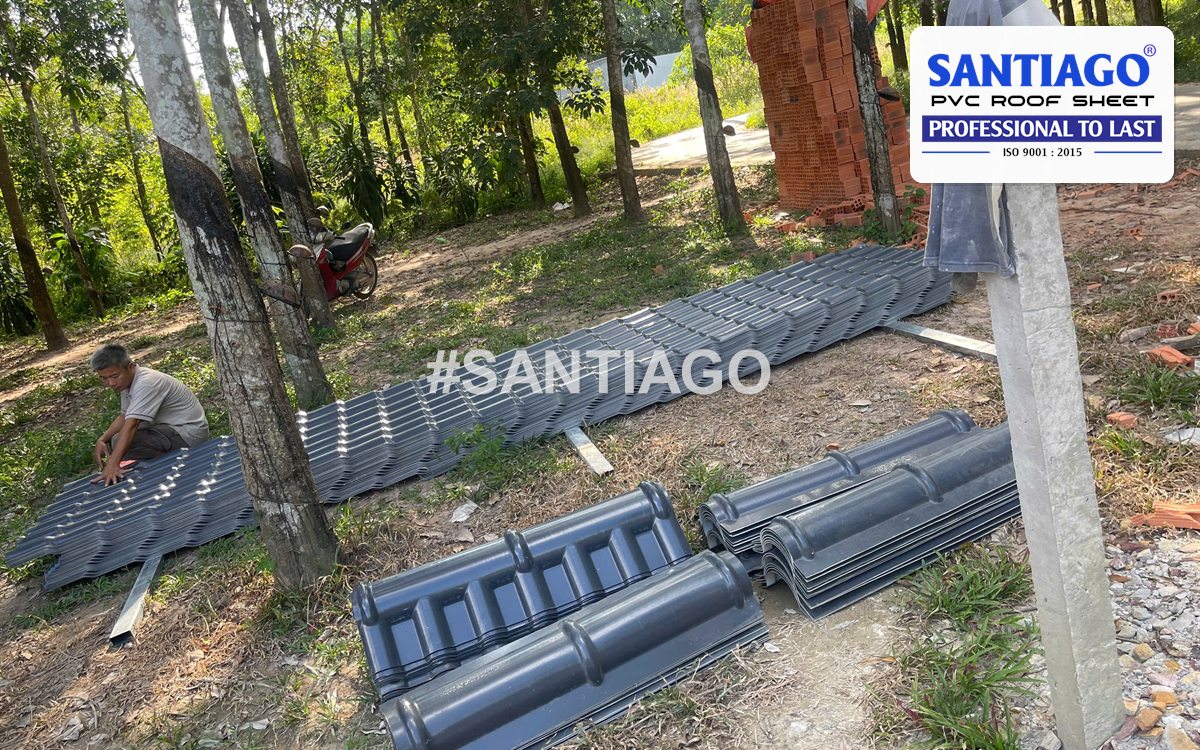
Grey ASA/PVC tile sheets and matching ridge pieces laid out on the ground beside a house before re-roofing, Vietnam
When is it time to replace a clay tile roof?
A clay roof is worth replacing when repairs no longer keep the water out, or when the frame under it is struggling with the weight. Single cracked tiles can be swapped; widespread slipping, broken tiles after every storm and leaks along many rows mean the roof covering has reached the end of its life.
- Many tiles cracked, slipped or blown off after storms
- Leaks in several places, not one spot
- Mortar on the ridge and hips breaking away
- Sagging rafters or a wavy roof line under the tile weight
- Moss and broken tiles that hold water in the valleys
- Plans to add a room or a solar array that the old frame cannot carry with clay on it
Before deciding, look at the frame as well as the tiles. Our guide on checking an old roof frame before re-roofing lists what to look for in timber and steel.
How much lighter is an ASA/PVC tile sheet than clay tiles?
Clay tiles are one of the heaviest common roof coverings. Laid weights quoted by builders are usually in the range of 40 to 60 kg per m², depending on the tile type, overlap and battens. A Santiago ASA/PVC tile sheet weighs about 5.2 kg per m² at 2.5 mm and about 6.2 kg per m² at 3.0 mm.
| Roof covering | Approximate weight per m² | Notes |
|---|---|---|
| Clay tiles, laid with battens | about 40 to 60 kg (typical range) | Varies by tile type and overlap; check your own tiles |
| Santiago ASA/PVC tile sheet, 2.5 mm | about 5.2 kg | 1.05 m total width, 0.96 m effective |
| Santiago ASA/PVC tile sheet, 3.0 mm | about 6.2 kg | Same profile, thicker sheet |
To check your own roof, weigh one clay tile and count the tiles in one square metre of roof. Ten tiles per m² at 4 kg each is already 40 kg per m² before battens and mortar. A lighter covering takes most of that load off the rafters and walls, which is why owners of older houses often choose sheets, as explained in our article on lightweight roofing materials for old buildings.
Can the old rafters and battens be reused?
Sound rafters can usually stay. The tile battens are a different question: clay tile battens are thin, closely spaced strips made to hang tiles, not to hold screws through a sheet. They can stay only where they are straight, firm and fixed at less than 700 mm between fixing lines; otherwise new steel or timber purlins are fixed across the rafters at less than 700 mm.
- Rafters: keep them if they are straight and free of rot, splits and insect damage
- Battens: replace any that are rotten, split or loose, and add purlins where the fixing lines would be 700 mm or more apart
- Steel frames: wire-brush rust spots and paint them before the sheets go on
- Eaves and fascia boards: replace soft timber now, while the roof is open
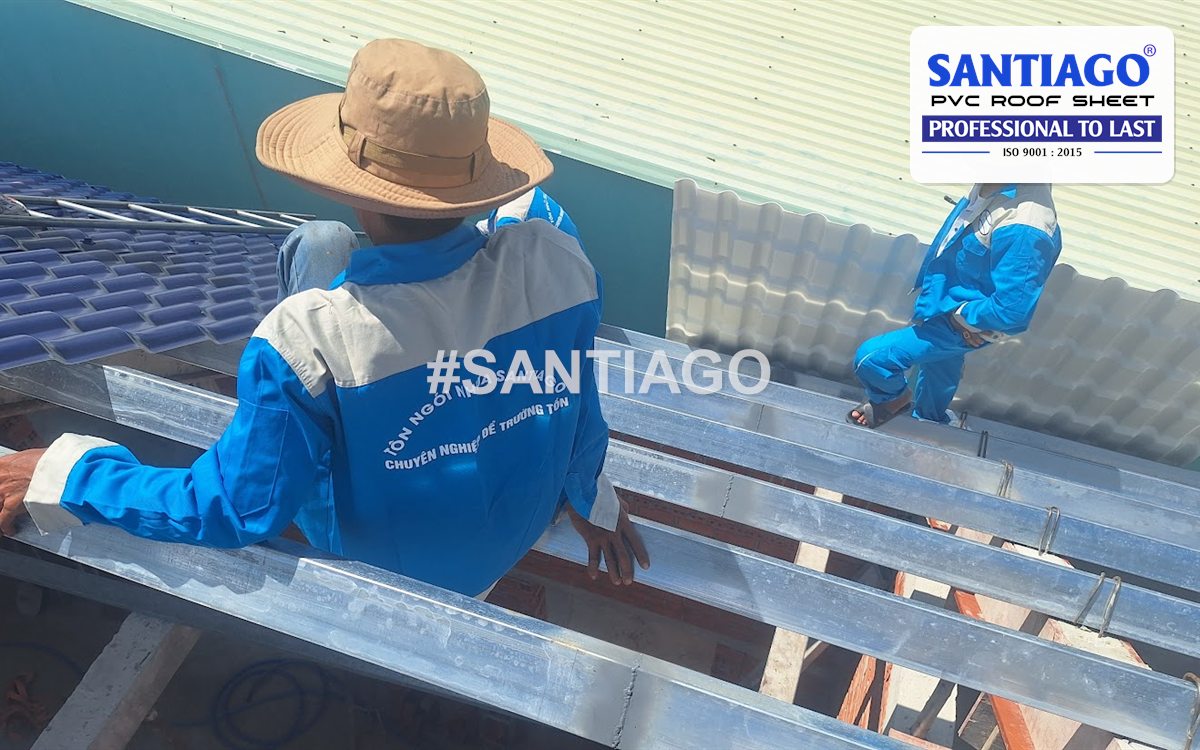
Installer standing on new steel purlins fixed beside an old roof before the new sheets go on, Vietnam
What is the order of work when replacing a clay roof?
Work in sections that can be closed the same day. Clay comes off fast, but an open roof in rain causes more damage than the old tiles did.
- Deliver the sheets, ridge pieces and screw sets first and store them flat and shaded
- Set up scaffolding or a safe edge and keep people out of the area below
- Strip clay tiles from one section, ridge downwards, and lower them, never throw them
- Remove old mortar and broken battens, then check the rafters in that section
- Fix purlins at less than 700 mm, keeping them in one plane so the sheets sit flat
- Lay the first sheet at the eave and work up the slope, side laps of one full rib
- Pre-drill 6 mm holes on top of the wave and fix 70 mm screws with ASA caps, 4 to 5 sets per m²
- Close the section with ridge pieces or a temporary cover before the end of the day
The full installation steps, from the first sheet to the ridge, are in our guide on how to install PVC roof tile sheets. If the work falls in the wet months, plan each day as described in re-roofing in the rainy season.
What does a tile-sheet re-roof look like while it is being fixed?
Mr Quyen shows a green ASA/PVC sheet in the Santiago factory in Vietnam, then climbs onto a grey tile-profile roof that installers are still screwing down onto steel purlins. Near the end he and a colleague walk along a finished section. This is the stage a clay roof reaches once the old tiles are off and the purlins are in.
Grey tile-sheet roof during installation (Santiago video on YouTube).
More short videos to compare roofs
Both clips below come from Santiago's own YouTube channel and were filmed at the factory in Vietnam or on Santiago roofs.
How does the sheet behave under heat?
The heat-test short: grey and red sheets under a flame, Mr Quyen on grey sheets at the factory, then a warehouse roof re-laid in blue. It shows how the sheet behaves under heat, not a certified fire rating.
Heat test and a warehouse re-roof with uPVC sheets (Santiago video on YouTube).
How does a 2.5 mm sheet flex compared with rigid roofing?
A 45-second factory short: beige and orange ASA/PVC sheets are flexed by hand and cut with shears to show how the material behaves. On a roof, purlins still go less than 700 mm apart.
Bending and cutting test on Santiago ASA/PVC sheets (Santiago video on YouTube).
How are ridges, valleys and wall joints finished?
The mortar-bedded ridges of a clay roof are replaced with screwed ridge pieces made in the same ASA/PVC material and colour as the sheets. Hips use the same ridge pieces, valleys get a valley gutter under the sheet edges, and where the roof meets a wall a flashing or eave sealing tile closes the gap.
- Ridge and hip: ASA/PVC ridge caps screwed through the top of the wave, with end caps at gable ends
- Valleys: a valley gutter wide enough for heavy rain, with sheet edges cut clean along it
- Roof against a wall: wall flashing, with sealant along the wall line
- Eaves: eave sealing pieces or foam fillers to close the wave profile against birds and wind
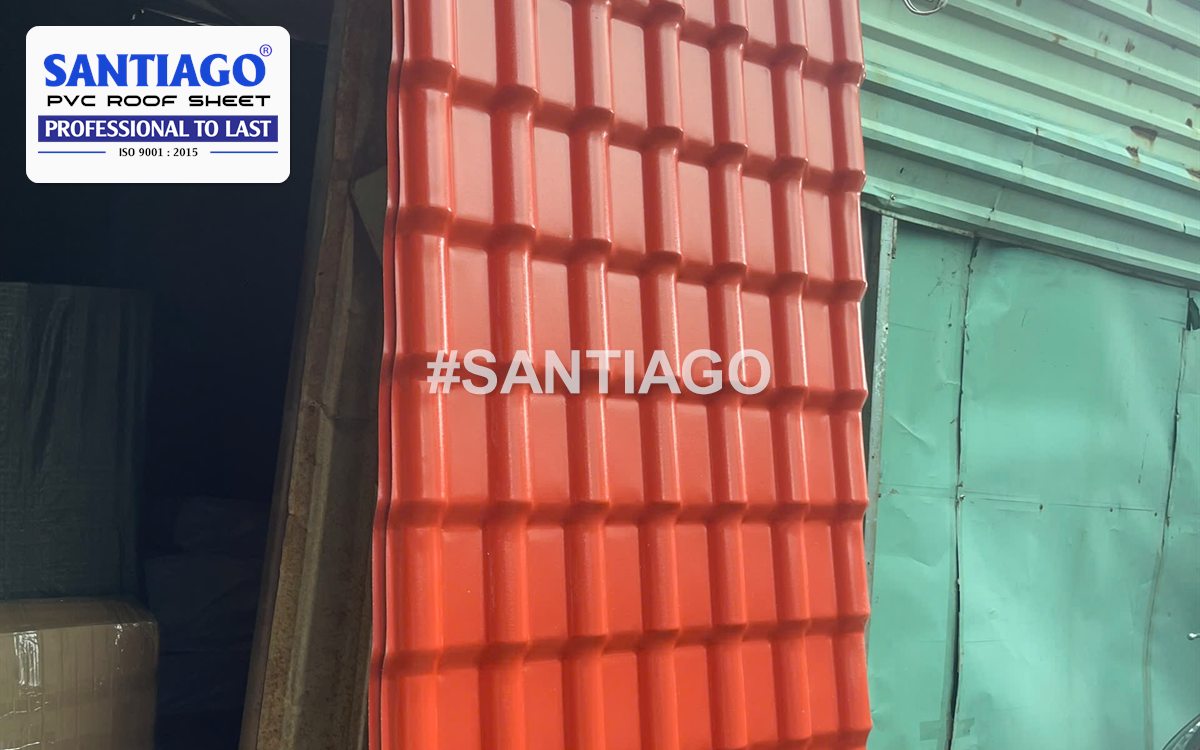
Orange-red ASA/PVC tile sheet standing upright on site, showing the tile-row profile that replaces clay tiles on the roof, Vietnam
The pieces that finish a sheet roof are listed in our UPVC roofing accessories and ridge cap guide, and the choice at a wall is covered in eave sealing tile or wall flashing.
What can you do with the old clay tiles?
Old clay tiles are heavy but not hazardous, and many have a second use. Sort them as they come off the roof so the good ones are not broken in a skip.
- Keep a few whole tiles for a garden wall, path edging or a small shed
- Offer whole tiles to builders repairing clay roofs nearby
- Crushed tiles can serve as fill or drainage material where local rules allow
- Ask the local authority about disposal of mixed rubble with mortar
Clay is not asbestos. If an old roof has grey fibre cement sheets as well as clay tiles, treat those sheets separately and follow the steps in replacing asbestos roof sheets with PVC.
Will the new roof still look like a tile roof?
Yes. ASA/PVC tile sheets are pressed into a row-and-step tile profile, with a 219 mm step between tile rows, so from the street the roof reads as tiles rather than as sheeting. The colour sits in the ASA top layer, which passes 2,000 hours of UV testing and carries a 30-year colour expectation; red, dark red, grey, blue and other colours are chosen from the colour board. For houses in conservation areas, ask the local authority before changing the roof covering.
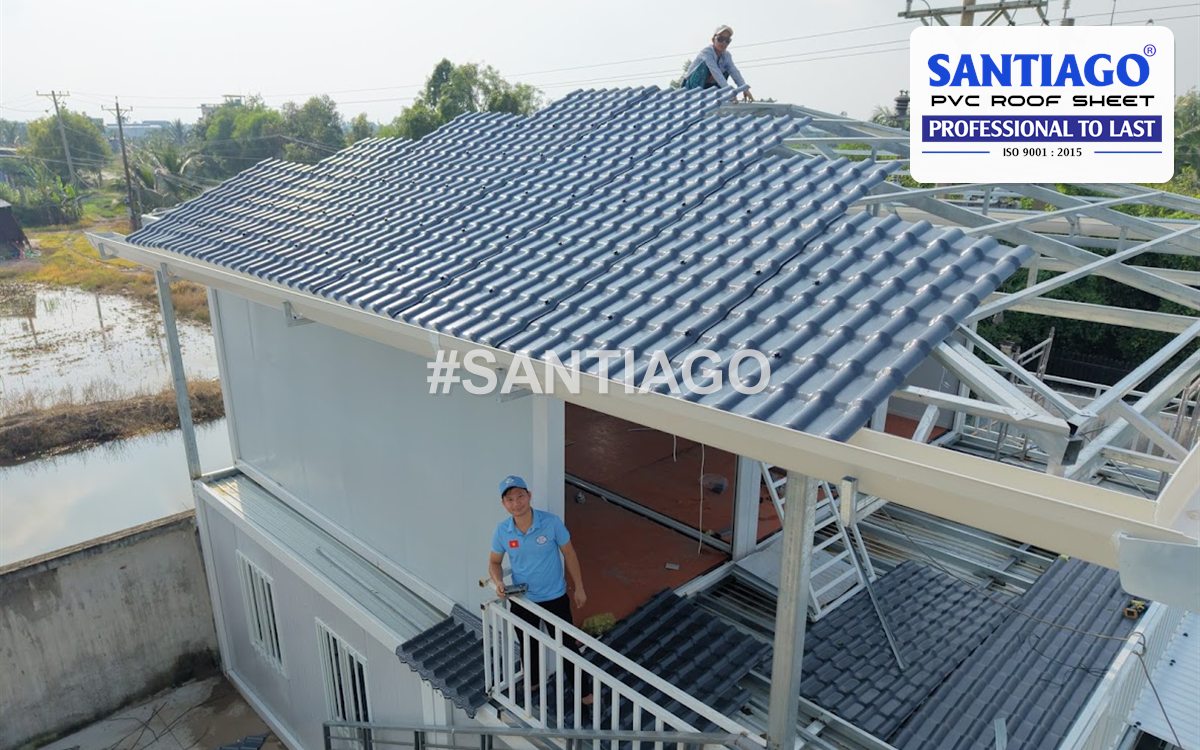
Grey ASA/PVC tile sheets fixed on a new steel roof frame, the tile-row profile visible along the slope, Vietnam
What should you send when ordering tile sheets for a clay re-roof?
Measure the roof slope by slope and send the lengths with a sketch. Sheets are cut to the length of each slope, so there are no end laps on most house roofs.
- Length of each slope from ridge to eave, and the width along the eave
- Number of ridges, hips and valleys, with their lengths
- Walls the roof meets, and their lengths
- Colour, and 2.5 mm or 3.0 mm thickness
- Photos of the old roof and the frame
For a house, villa or shophouse roof, the sheet sizes, colours and accessories are on the Santiago ASA/PVC roof tile sheet page. Send the measurements through the Santiago quotation form; one 40 ft container holds about 5,000 m of sheet and can mix colours and accessories.
Santiago – a leading exporter of ASA/PVC roofing from Vietnam
Santiago roofing is produced and loaded into containers at our factory in Vietnam. It has been exported to India since 2023, Thailand since 2024 and the USA since 2025. Every export shipment comes with a commercial invoice, packing list, bill of lading and a certificate of origin (C/O) issued by Vietnam's Ministry of Industry and Trade, which importers use to claim the duty preference of their trade agreement.
| Item | Details |
|---|---|
| HS code | 3925.90.00 (ASA/PVC roofing sheets) |
| Certificate of origin | Form D (ASEAN), Form AI (India), Form AK / VK (Korea), Form AJ / VJ (Japan), Form VC (Chile), CPTPP proof of origin |
| Shipped from | Vietnam, by container |

Certificate of origin Form AI (ASEAN–India) for Santiago ASA/PVC roofing sheets, HS 39259000, certified on 24 September 2026. Buyer details are hidden.
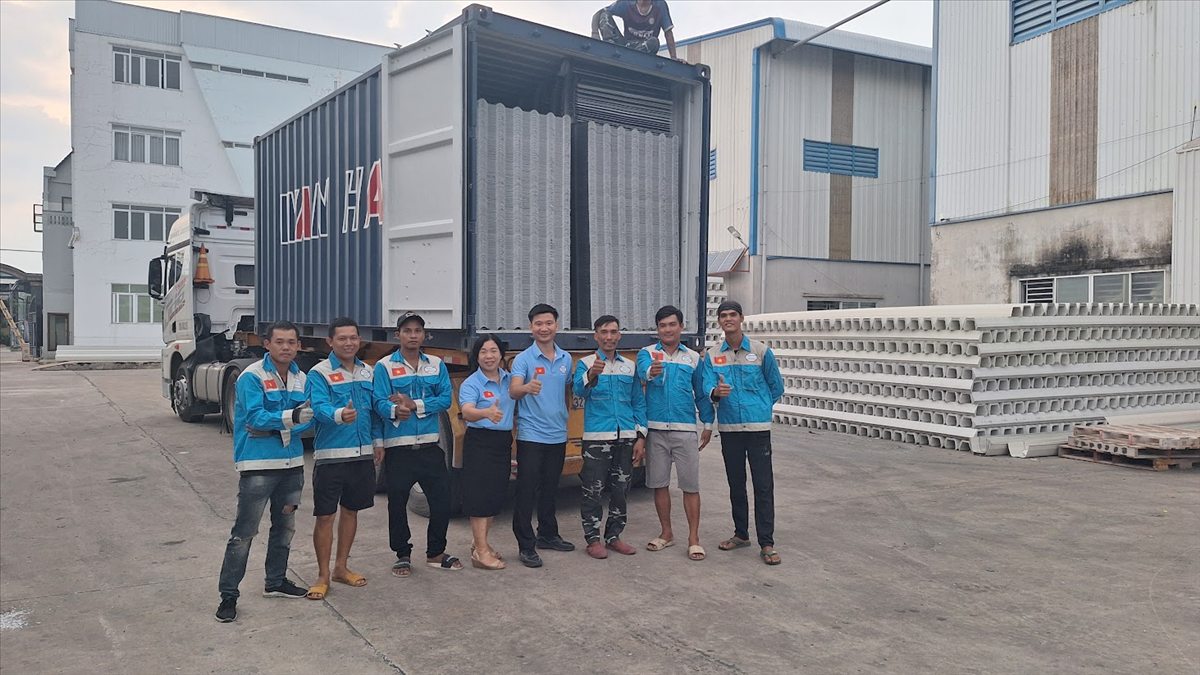
The Santiago team beside a loaded export container at the factory, November 2024
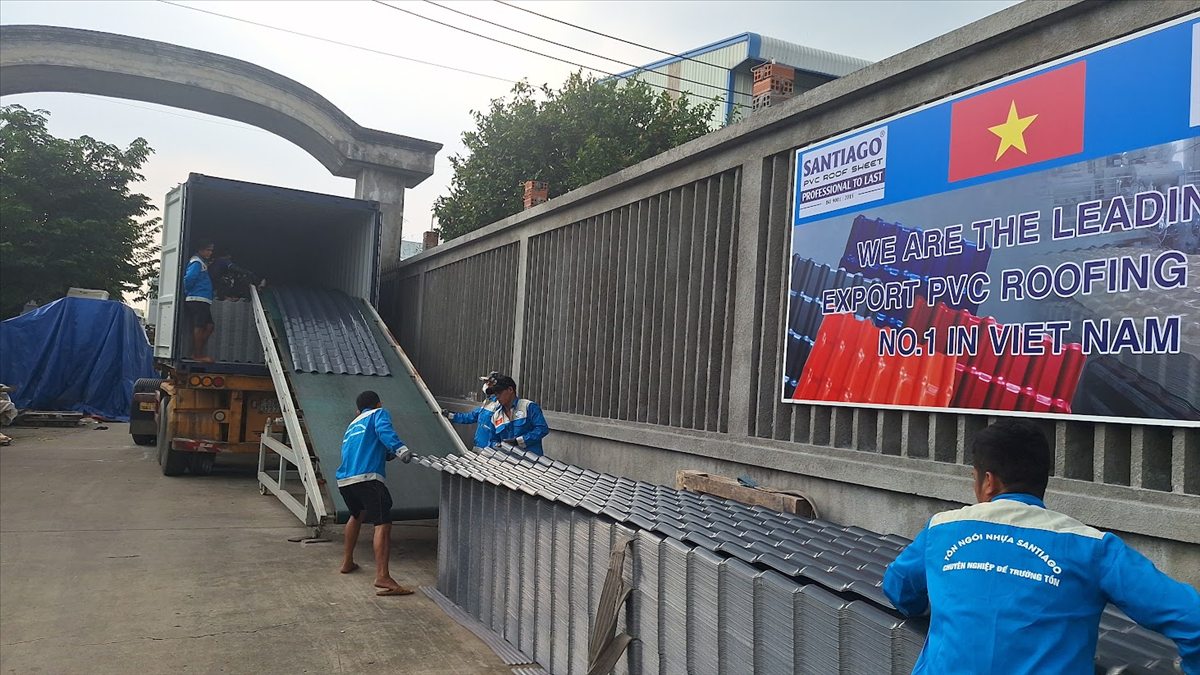
Loading Santiago roof tiles into an export container
Frequently asked questions
Can I replace clay roof tiles with PVC tile sheets?
Yes. The clay tiles come off section by section, the rafters are checked, purlins are fixed less than 700 mm apart and the tile sheets are screwed down with 70 mm screws and ASA caps.
How much lighter is a PVC tile sheet than clay tiles?
A 2.5 mm Santiago tile sheet weighs about 5.2 kg per m². Laid clay tiles are commonly quoted at 40 to 60 kg per m², so the load on the frame drops sharply.
Can I keep the old tile battens?
Only if they are straight, firm and fixed at less than 700 mm between fixing lines. Otherwise fix new purlins across the rafters.
Do I need to remove all the clay tiles at once?
No. Strip and re-roof one section at a time and close each section the same day.
Will the roof still look like a tile roof?
Yes. The sheets have a tile-row profile with a 219 mm step, in colours from the colour board.
Read more
- Check an old roof frame before re-roofing
- Re-roofing in the rainy season
- Lightweight roofing materials for old buildings
- How to install PVC roof tile sheets
- What a roofing sheet warranty covers
Read next on this topic
Main guide: Replacing a Rusted Metal Roof with PVC Sheets
Sources for the figures in this article
- Profiles, 2.5–3.0 mm thickness and 10-year warranty: Santiago ASA/PVC product specification.
- HS code 3925.90.00: Harmonized System Chapter 39 (builders' ware of plastics), as applied in Vietnam's export tariff.
- Certificates of origin (Form D, AI, AK/VK, AJ/VJ, VC, CPTPP): issued by Vietnam's Ministry of Industry and Trade under the country's free trade agreements.
- Minimum order of one 40 ft container (about 5,000 m) and about 5 days for production and loading: Santiago export desk, October 2026.
Updated 03/11/2026. Santiago Import Export Co., Ltd, Vietnam. WhatsApp +84 935 391 495 (Mr. Quyen), hotline +84 965 437 316 (Mrs. Ly), email salessantiagoroofing@gmail.com.


