


Mr Quyen - Santiago. Posted 13/11/2026
A Santiago ASA/PVC tile sheet has no metal in it, so salt air at a bach or holiday home has nothing to rust, and in Santiago's tests rain noise under it is about 80% lower than under metal sheet. It weighs about 5.4 kg per m², so a 3 × 4 m sleep-out roof is 10 sheets of 1.971 m and about 100 kg of sheet. Check consent with your council first; the sheet can be imported into New Zealand under CPTPP.
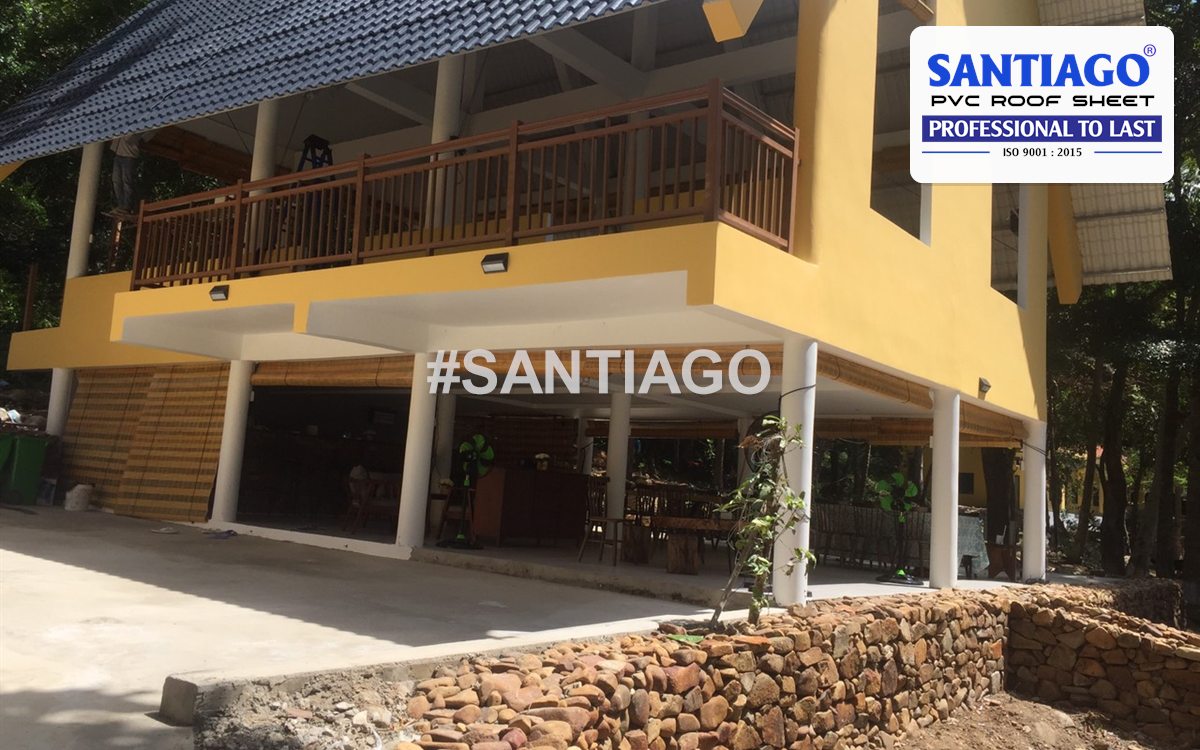
Raised yellow house with balcony and grey tile roof, Vietnam
What does salt air do to a bach roof?
A bach a few hundred metres from the beach gets salt spray on the wind most days of the year, and it is often left empty for weeks. Metal roofing suffers most at the laps, cut edges and fixings, where salt sits and dries, and nobody is there to wash it down. By the time the owners notice rust streaks, the repair is a job for the summer holidays.
Santiago's tile sheet has no metal in it. It is four co-extruded layers with no glue: an ASA top layer that carries the colour and blocks UV, virgin PVC, a PVC core and a milky-white PVC base. Without metal there is nothing for the salt to rust. The fixings and frame still need their own care, so ask your builder what they use near the sea.
Will a tile-look roof suit a bach or holiday home?
The profile is Spanish style, with a row of curved tiles every 219 mm, which suits a holiday home or a sleep-out that is meant to look like a small house rather than a shed. Standard colours are dark grey, red, blue, orange and chocolate; green, white and purple are made to order. Dark grey and chocolate blend in against bush and dunes, and blue reads well beside the water, but judge a free sample (the buyer pays the courier) against your own cladding in daylight before choosing.
Colour fading is the usual worry with plastic roofing in strong sun. The ASA layer showed no colour change after 2,000 hours of artificial UV, the colour is rated for 30 years and real service life is 25 – 30 years. The warranty is 10 years for 2.5 mm and thicker sheet installed as Santiago recommends.
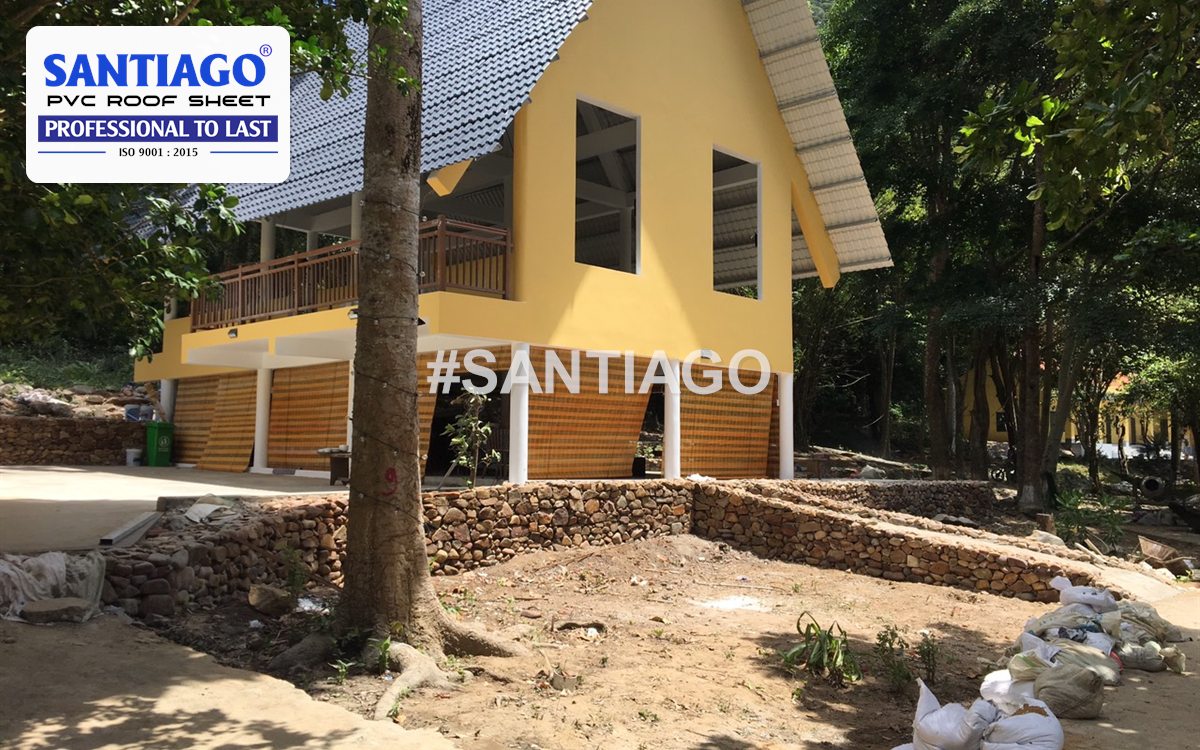
Yellow house with grey tile roof among trees, Vietnam
Is it quiet enough to sleep under in the rain?
For a sleep-out this is the question. Rain noise under the tile sheet is about 80% lower than under metal sheet in Santiago's tests, and the space under it stays 6 – 8 °C cooler than under bare metal sheet on a hot afternoon. A storm on a metal roof a metre above a bunk is loud; the same storm on the tile sheet is much softer.
How many sheets does a 3 × 4 m sleep-out need? A worked example
Take a sleep-out 4 m long and 3 m wide with a gable roof, ridge along the 4 m side, slope 35% (about 19°), 0.3 m eave overhang on each side and 0.2 m at each gable end.
| Step | Working | Result |
|---|---|---|
| Ridge height above the eaves | 1.5 m half-width × 35% | about 0.53 m |
| Length along the slope | (1.5 m + 0.3 m) × 1.059 = 1.91 m; 1.91 ÷ 0.219 = 8.7, round up to 9 steps | 9 × 219 mm = 1.971 m |
| Sheets per face | (4.0 m + 2 × 0.2 m) ÷ 0.96 = 4.6, round up | 5 sheets, covering 4.80 m |
| Sheets for the roof | 5 × 2 faces | 10 sheets, about 19.7 running metres |
| Roof area | 4.80 m × 1.971 m × 2 | about 18.9 m² |
| Purlin rows per face | One every 3 tile steps (660 mm), top row 15 – 18 cm below the ridge | about 4 rows |
| Screw sets with ASA caps | 18.9 m² × 4 – 5 per m² | about 76 – 95 |
| Ridge | Length of the ridge | 4.80 m of ridge cap and 2 ridge terminals |
| Eave sealing tile | Both eaves | 2 × 4.80 m |
| Sheet weight | 18.9 m² × 5.4 kg | about 102 kg |
About 100 kg of sheet on the whole roof, roughly 10 kg per sheet, means each piece can be carried by hand down a bach driveway, and the light timber frame of a sleep-out is not loaded with heavy tiles. Your builder still sizes the rafters and purlins.
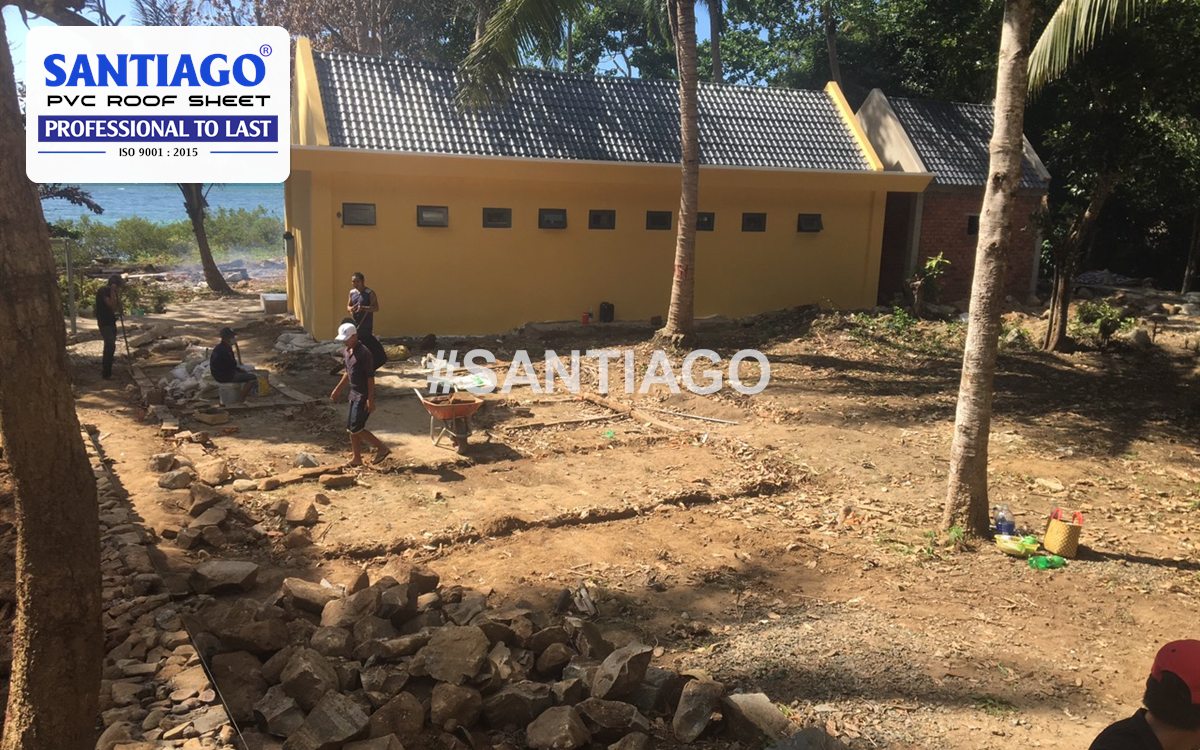
Long building with grey tile roof near the coast, workers in the yard, Vietnam
Do I need building consent for a sleep-out roof?
Check with your council before you build or re-roof. Whether a sleep-out, a bach extension or a re-roof needs consent depends on the building and on the council, and this article does not set any size limits.
Be clear with the council and your builder about what Santiago does and does not publish: there is no wind, fire or snow-load rating for this sheet, and no NZ Building Code or BRANZ certification. On an exposed coastal section, your builder and the council decide whether the sheet suits the site.
How is a sleep-out roof fixed?
Purlins go less than 700 mm apart, at 440 or 660 mm, with one purlin under the foot of a tile step. Keep the slope between 20% and 45%. Pre-drill 6 mm holes, drive 70 mm screws through the top of the wave over a purlin, 4 – 5 sets per m², each with an ASA cap, and never screw into the valley. Lap each sheet over the next by one wave. Santiago supplies the sheets and accessories and sends installation videos; it does not install. The full sequence is in our guide on how to install PVC roof tile sheets.
Getting tile sheets to New Zealand under CPTPP
New Zealand and Vietnam are both CPTPP members, so the sheet (HS 3925.90.00) can come in at a lower or zero duty under New Zealand's CPTPP schedule, with proof of origin from Santiago for each container. Your customs broker confirms the rate, and because the minimum export order is one 40 ft container (about 5,000 m, colours and accessories mixed), a bach owner usually buys through a New Zealand merchant or builder who imports.
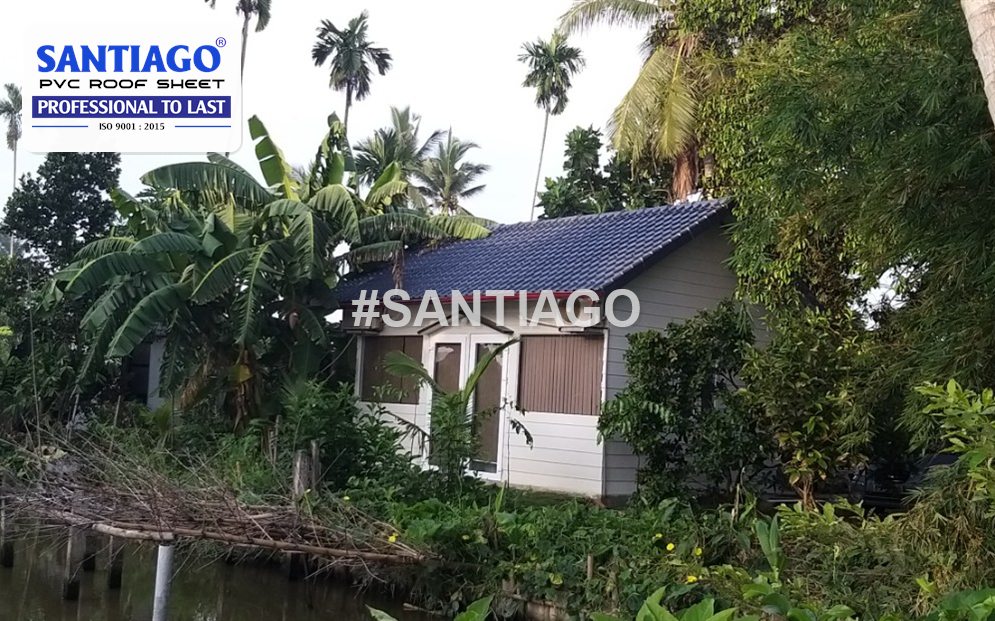
Small house with blue tile roof by the water, Vietnam
How do tile sheets cope with sun, rain and salt air?
Red ASA/PVC tile sheets are carried up to a house, a flame is put to a stack of sheets, and the short ends on a blue warehouse roof under installation and grey sheets on the factory roller line. A flame test is a demonstration, not a fire rating.
Santiago PVC roofing tiles in real conditions (Santiago video on YouTube).
Short videos for baches and holiday homes in New Zealand
Both clips below come from Santiago's own YouTube channel and were filmed at the factory in Vietnam or on Santiago roofs.
What does fixing a grey tile roof look like?
In under a minute the short goes from the Santiago factory floor to a grey tile-profile roof on site: some sheets already fixed, installers screwing down the rest, and a finished run next to the gutter.
Santiago uPVC tile roofs on site (Santiago video on YouTube).
Which ridge caps come in the same colour as the sheets?
The camera passes red ridge pieces and stacked red tile sheets in the Santiago warehouse, the stock that goes out on export and OEM orders. The short runs 19 seconds.
Red ridge caps and tile sheets in the Santiago warehouse (Santiago video on YouTube).
CPTPP: lower import duty on roofing sheets made in Vietnam
Vietnam is one of the 12 member countries of the Comprehensive and Progressive Agreement for Trans-Pacific Partnership (CPTPP), together with Australia, Brunei, Canada, Chile, Japan, Malaysia, Mexico, New Zealand, Peru, Singapore and the United Kingdom. Santiago ASA/PVC roofing sheets and accessories are made in Vietnam (HS 3925.90.00), so buyers in these countries can claim the CPTPP preference when they import them.
- Lower or zero import duty. Each member cuts its tariffs on goods of Vietnamese origin under its own CPTPP schedule, and many tariff lines are already at 0%. Your customs broker confirms the rate that applies to HS 3925.90.00 on the day of import.
- Proof of origin with every container. Santiago prepares the CPTPP origin documents for each shipment, so the importer can claim the preferential rate at clearance.
- Advance rulings. Under CPTPP, an importer can ask its customs authority for a written ruling on tariff classification and origin before the goods ship, so the duty is known before the order is confirmed.
- Faster, more predictable clearance. CPTPP members commit to publish their customs rules and, where possible, to release goods within 48 hours of arrival.
- The same preference on every repeat order. As long as the sheets are made in Vietnam and the origin documents are in order, each new container qualifies again.
Duty rates and paperwork change by country and over time: check the current rate and the proof-of-origin form with your customs broker before you order.
Santiago – a leading exporter of ASA/PVC roofing from Vietnam
Santiago roofing is produced and loaded into containers at our factory in Vietnam. It has been exported to India since 2023, Thailand since 2024 and the USA since 2025. Every export shipment comes with a commercial invoice, packing list, bill of lading and a certificate of origin (C/O) issued by Vietnam's Ministry of Industry and Trade, which importers use to claim the duty preference of their trade agreement.
| Item | Details |
|---|---|
| HS code | 3925.90.00 (ASA/PVC roofing sheets) |
| Certificate of origin | Form D (ASEAN), Form AI (India), Form AK / VK (Korea), Form AJ / VJ (Japan), Form VC (Chile), CPTPP proof of origin |
| Shipped from | Vietnam, by container |
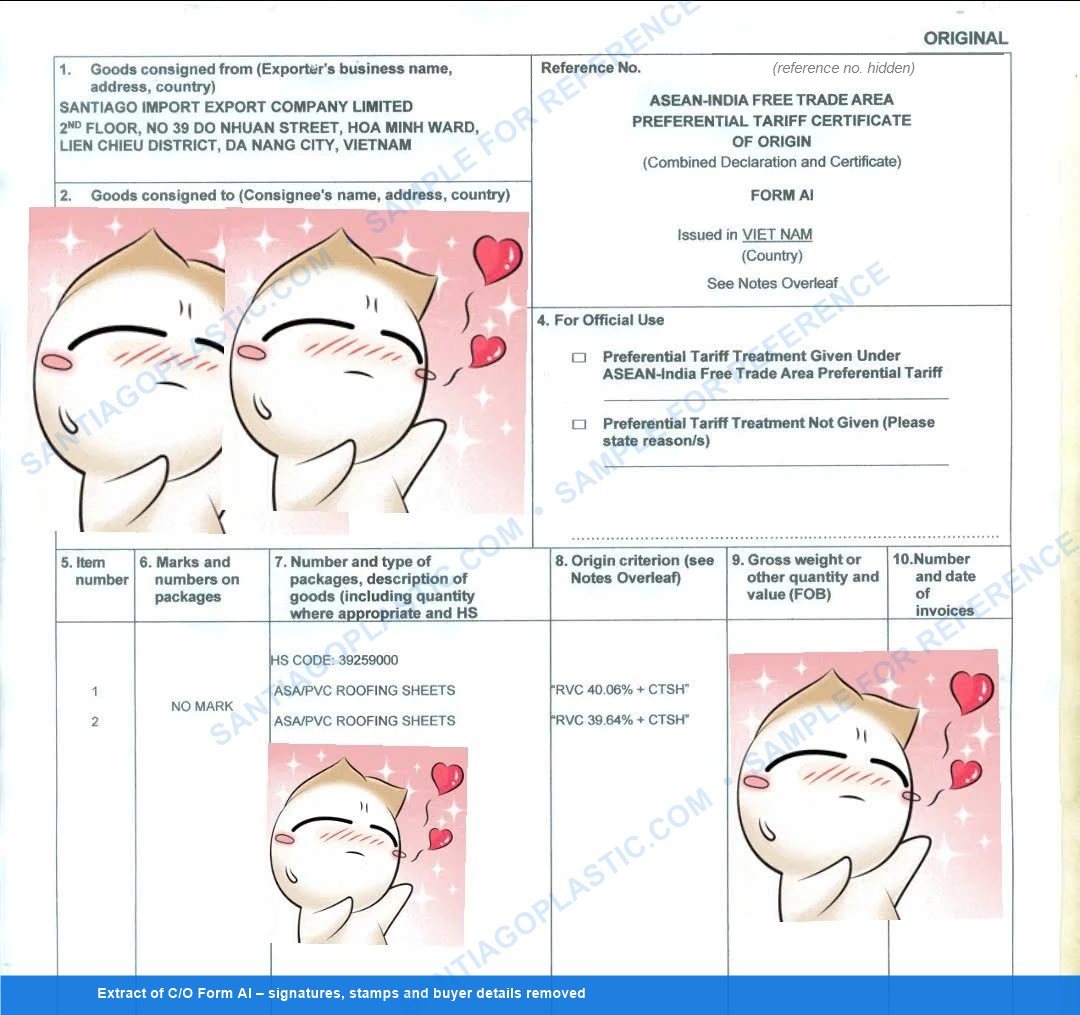
Certificate of origin Form AI (ASEAN–India) for Santiago ASA/PVC roofing sheets, HS 39259000, certified on 24 September 2026. Buyer details are hidden.
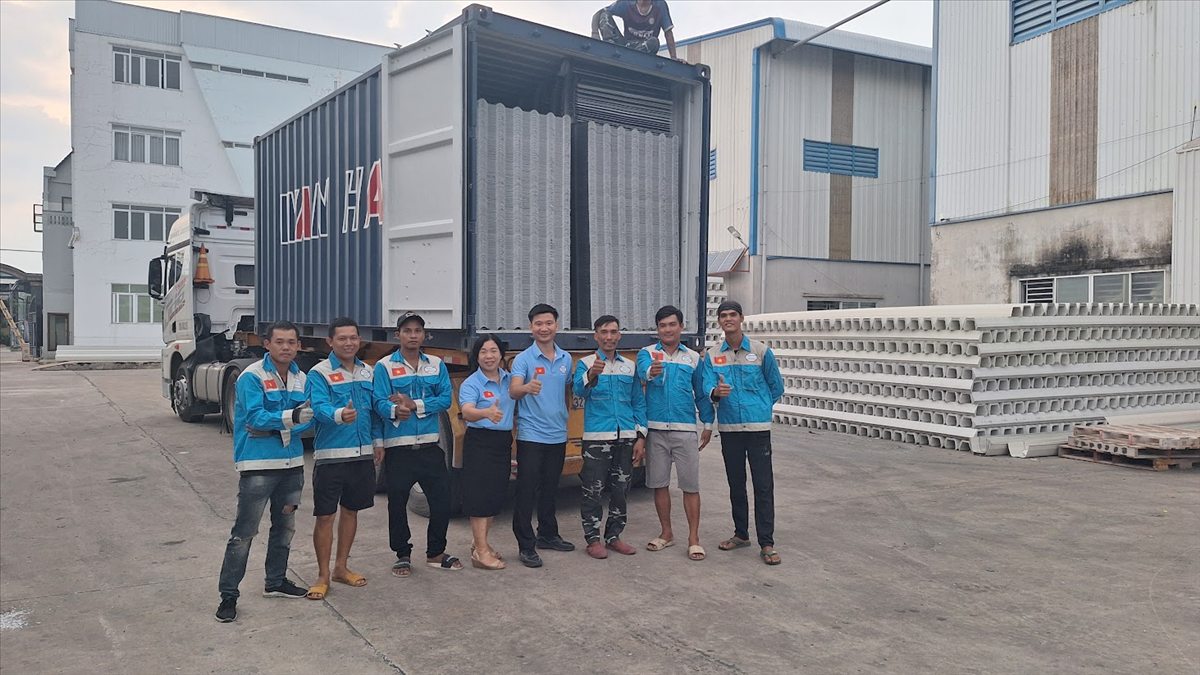
The Santiago team beside a loaded export container at the factory, November 2024
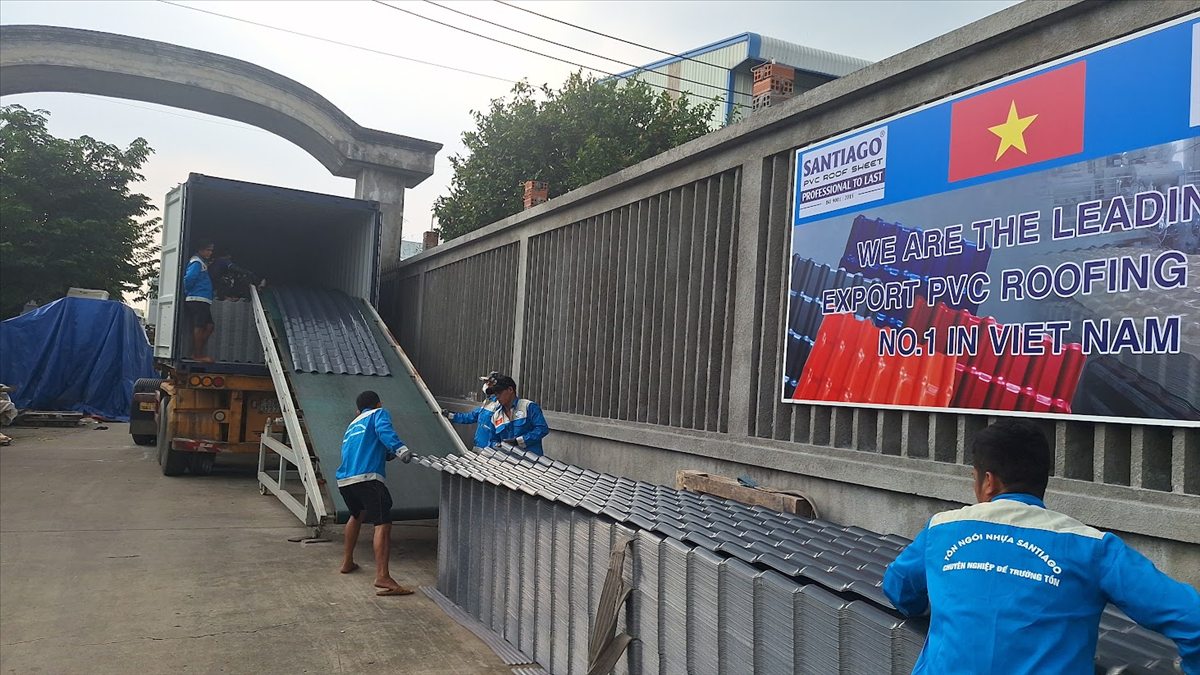
Loading Santiago roof tiles into an export container
Frequently asked questions
Is PVC roofing any good near the sea in NZ?
The Santiago ASA/PVC tile sheet contains no metal, so salt air has nothing to rust. The colour sits in an ASA layer that showed no change after 2,000 hours of artificial UV and is rated for 30 years.
How many sheets does a 3 × 4 m sleep-out roof need?
A gable roof at 35% with the ridge along the 4 m side takes 10 sheets of 1.971 m (about 19.7 running metres, 18.9 m² of roof), 76 – 95 screw sets and 4.80 m of ridge cap.
Is a PVC tile roof noisy in the rain?
Rain noise under the tile sheet is about 80% lower than under metal sheet in Santiago's tests.
Does the sheet have NZ Building Code or BRANZ certification?
No. Santiago publishes no wind, fire or snow-load rating and has no NZ Building Code or BRANZ certification for the sheet. Check consent with your council; your builder and the council decide whether it suits the site.
Can I import PVC roofing into NZ from Vietnam under CPTPP?
Yes. With proof of origin from Santiago for each container, the sheet (HS 3925.90.00) can get a lower or zero duty under New Zealand's CPTPP schedule. Your customs broker confirms the rate.
Read more
- Santiago heat, noise and corrosion tests
- Why the ASA surface layer counts
- ASA screw caps and fixing on top of the wave
- How Santiago handles quotations and samples
- ASA/PVC roof tile sheet
Sources for the figures in this article
- Profiles, 2.5–3.0 mm thickness and 10-year warranty: Santiago ASA/PVC product specification.
- About 6–8 °C cooler than bare metal sheet and about 80% less rain noise: Santiago's own comparisons on finished roofs in Vietnam.
- HS code 3925.90.00: Harmonized System Chapter 39 (builders' ware of plastics), as applied in Vietnam's export tariff.
- Certificates of origin (Form D, AI, AK/VK, AJ/VJ, VC, CPTPP): issued by Vietnam's Ministry of Industry and Trade under the country's free trade agreements.
- Minimum order of one 40 ft container (about 5,000 m) and about 5 days for production and loading: Santiago export desk, October 2026.
Updated 03/11/2026. Santiago Import Export Co., Ltd, Vietnam. WhatsApp +84 935 391 495 (Mr. Quyen), hotline +84 965 437 316 (Mrs. Ly), email salessantiagoroofing@gmail.com.


