


Mr Quyen - Santiago. Posted 13/11/2026
In Singapore's heat and frequent downpours, a Santiago ASA/PVC tile sheet gives a landed house, bungalow or resort pavilion the look of curved tiles at about 5.4 kg per m²; in Santiago tests the space under it stays 6 – 8 °C cooler than under bare metal sheet and rain noise drops by about 80%. It has no BCA approval and no published fire or wind rating, so your architect decides where it fits. A 10 × 6 m F&B pavilion takes 22 sheets of 4.161 m, and the sheets can enter Singapore under CPTPP or ASEAN Form D.
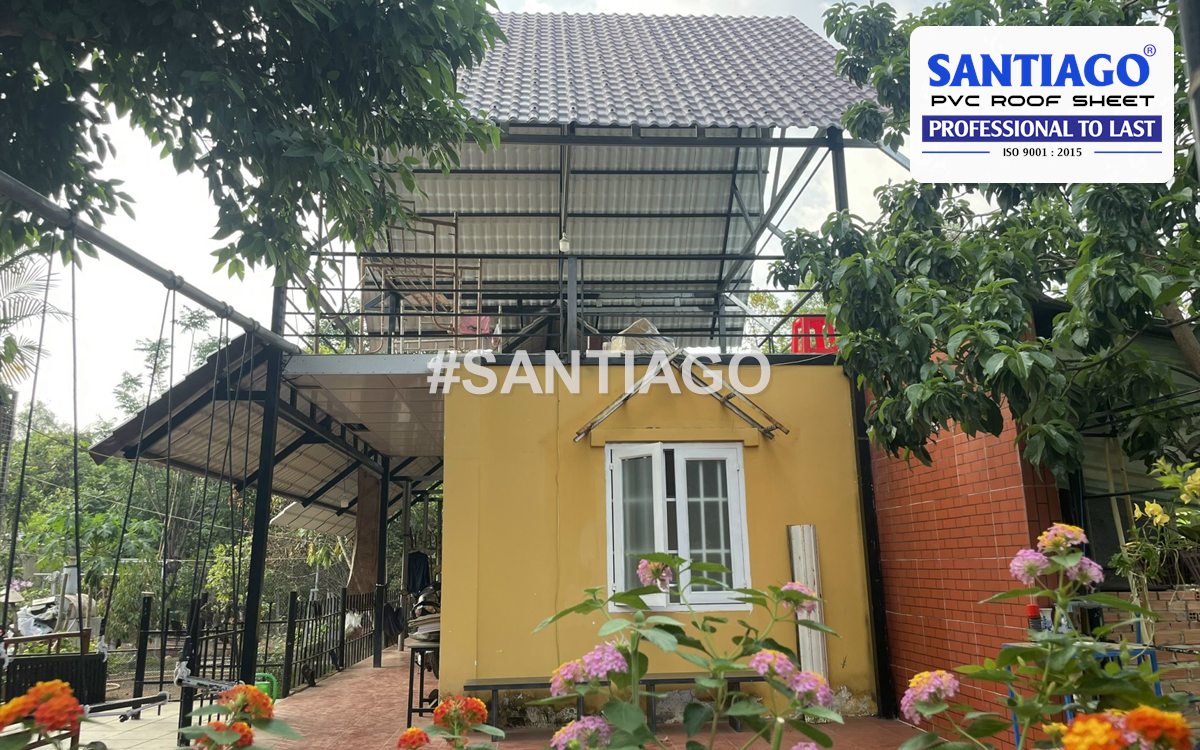
Yellow house with a tile roof behind a flowering garden, Vietnam
What does a roof in Singapore have to handle?
Strong sun nearly every day, humid air, and heavy afternoon storms that can drop a lot of rain in a short time. On a landed house the roof is the part that takes all of it. On a resort villa or a restaurant pavilion the roof is also part of what guests pay for: they notice a hot ceiling at lunch, and they notice a metal roof drumming over dinner.
Clay and concrete tiles look right on many tropical houses but are heavy and laid as hundreds of separate pieces. Metal sheet is light but hot and loud. An ASA/PVC tile sheet keeps the tiled look in long single sheets that run from ridge to eave.
Is a PVC tile sheet hot or noisy in Singapore?
In Santiago tests the space under the tile sheet stays 6 – 8 °C cooler than under bare metal sheet, and rain noise is about 80% lower. For a bedroom wing, a garden office or a pavilion where people eat, the noise figure is often the one owners remember after the first storm.
| Singapore condition | What the Santiago sheet does | What you still check |
|---|---|---|
| Afternoon heat | 6 – 8 °C cooler under the roof than bare metal sheet | Ceiling and ventilation, with your architect |
| Rain on the roof | About 80% less noise than metal | Gutter and downpipe sizes, with your designer |
| Daily UV | ASA layer: no colour change after 2,000 hours of artificial UV, colour rated 30 years | Choose the colour from a sample in daylight |
| Humid and salty air on islands | No metal in the sheet, nothing to rust | ASA caps over every screw head |
| Heavy downpours | One sheet ridge to eave, one-wave side lap, slope 20 – 45% | Screws only through the top of the wave |
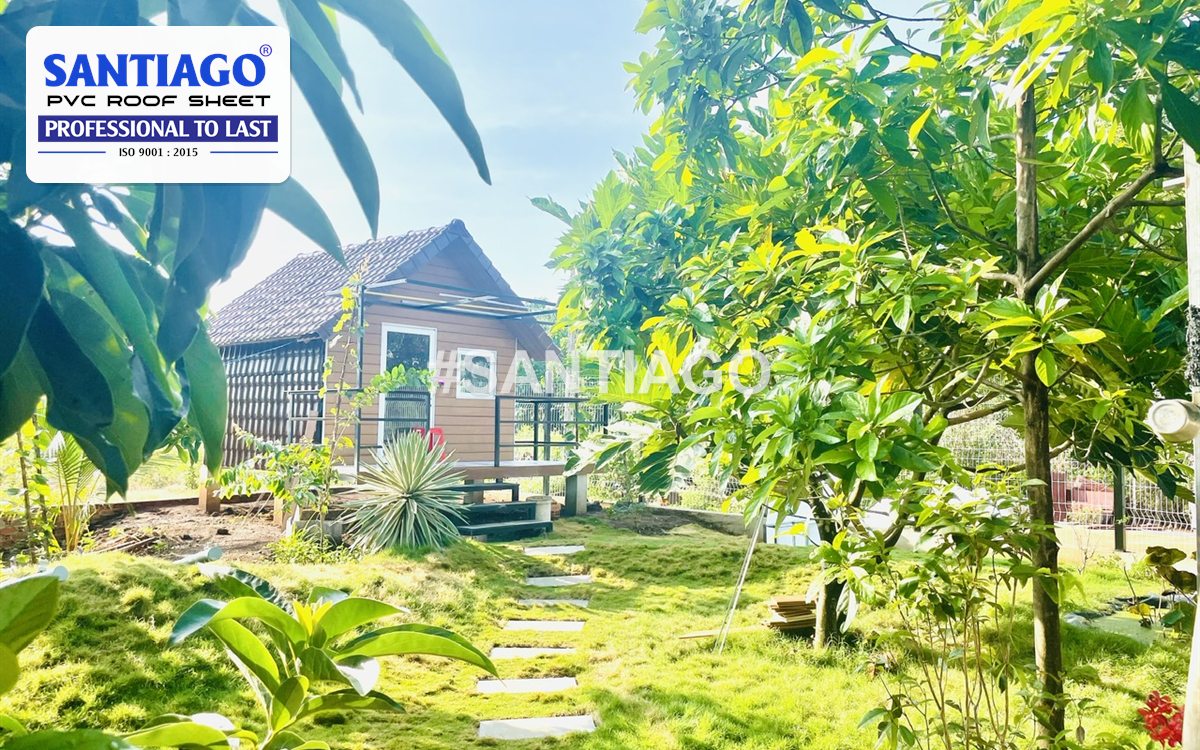
House with a tile roof seen through a garden, Vietnam
Which roof colour suits a landed house or villa?
There are five standard colours: dark grey, red, blue, orange and chocolate. Green, white and purple are made to order. The ridge cap, hip ridge, ridge terminals and eave sealing tile come in the same colours, so the finished roof has no odd-coloured edges.
Dark grey and chocolate sit quietly on white or timber walls and suit modern tropical houses. Red and orange read as a classic tiled roof from the street. Blue is a strong choice that works on some resort buildings and looks out of place on others. Do not pick from a screen: hold a free sample (you pay the courier) against the wall paint in daylight, at the time of day the house is most seen.
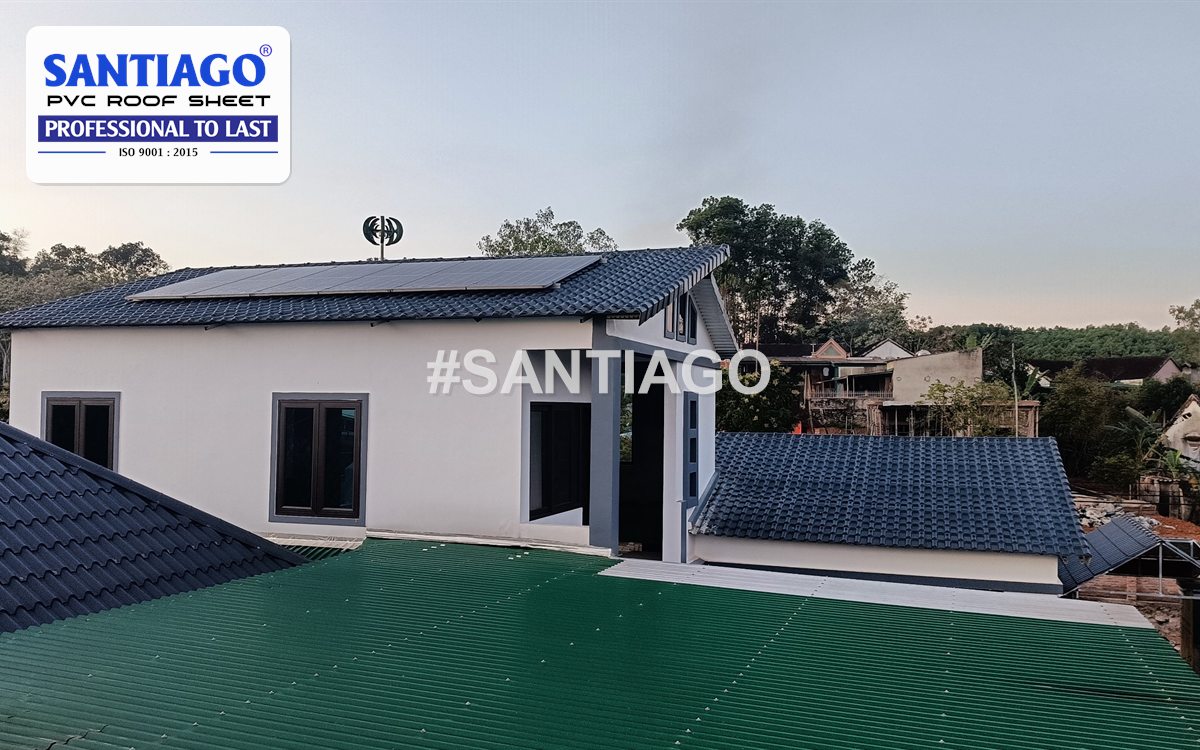
White house with a dark tile roof, Vietnam
Does the tile sheet have BCA approval in Singapore?
No. Santiago holds no Singapore BCA certification for this sheet and publishes no fire, wind or impact rating, so we make no claim about Singapore codes. For a new landed house or addition and alteration works, the architect or engineer on the project, and the authorities, decide which roof materials can be used. Some areas also have their own rules on roof form and colour; your architect checks those.
What Santiago can give your architect is the factory's ISO 9001:2015 certificate ICI-23087.D, Quatest test results and a quality certificate (CQ) with every lot. For resort projects on nearby islands, the same rule applies: the local authority and the project's designer decide.
How many sheets does a 10 × 6 m F&B pavilion need? A worked example
Take an open dining pavilion 10 m long and 6 m wide with a gable roof. The ridge runs along the 10 m side, the slope is 35% (about 19°), the eaves overhang 0.8 m to keep rain off the tables, and each gable end overhangs 0.25 m.
| Step | Working | Result |
|---|---|---|
| Ridge height above the eave line | 3.0 m half-width × 35% | about 1.05 m |
| Face length along the slope | (3.0 m + 0.8 m) × 1.0595 | about 4.03 m |
| Sheet length | 4.03 ÷ 0.219 = 18.4, round up to 19 steps; 19 × 219 mm | 4.161 m (the extra 13 cm goes into the eave) |
| Sheets per face | (10 m + 2 × 0.25 m) ÷ 0.96 = 10.9, round up | 11 sheets, covering 10.56 m |
| Sheets for the roof | 11 × 2 faces | 22 sheets, about 92 running metres |
| Roof area | 10.56 m × 4.161 m × 2 | about 88 m² |
| Screw sets with ASA caps | 88 m² × 4 – 5 per m² | about 350 – 440 |
| Ridge and eaves | Ridge length and both eaves | 10.56 m of ridge cap, 2 ridge terminals, 2 × 10.56 m of eave sealing tile |
| Sheet weight | 88 m² × 5.4 kg | about 475 kg |
The frame needs purlins less than 700 mm apart: 440 or 660 mm, one under the foot of a tile step, with the top purlin 15 – 18 cm below the ridge. Pre-drill 6 mm holes and use 70 mm screws through the top of the wave over a purlin. Santiago supplies the sheets and accessories and sends installation videos; it does not install.
Importing the sheets into Singapore under CPTPP or Form D
The sheets are made in Vietnam and ship under HS 3925.90.00 with an origin document for each container, so they can enter Singapore under CPTPP or the ASEAN Form D route. Your customs broker confirms the rate. One container holds about 5,000 m of sheet, so a single house is usually supplied through a Singapore trader who imports; our guide for Singapore roofing distributors explains that side.
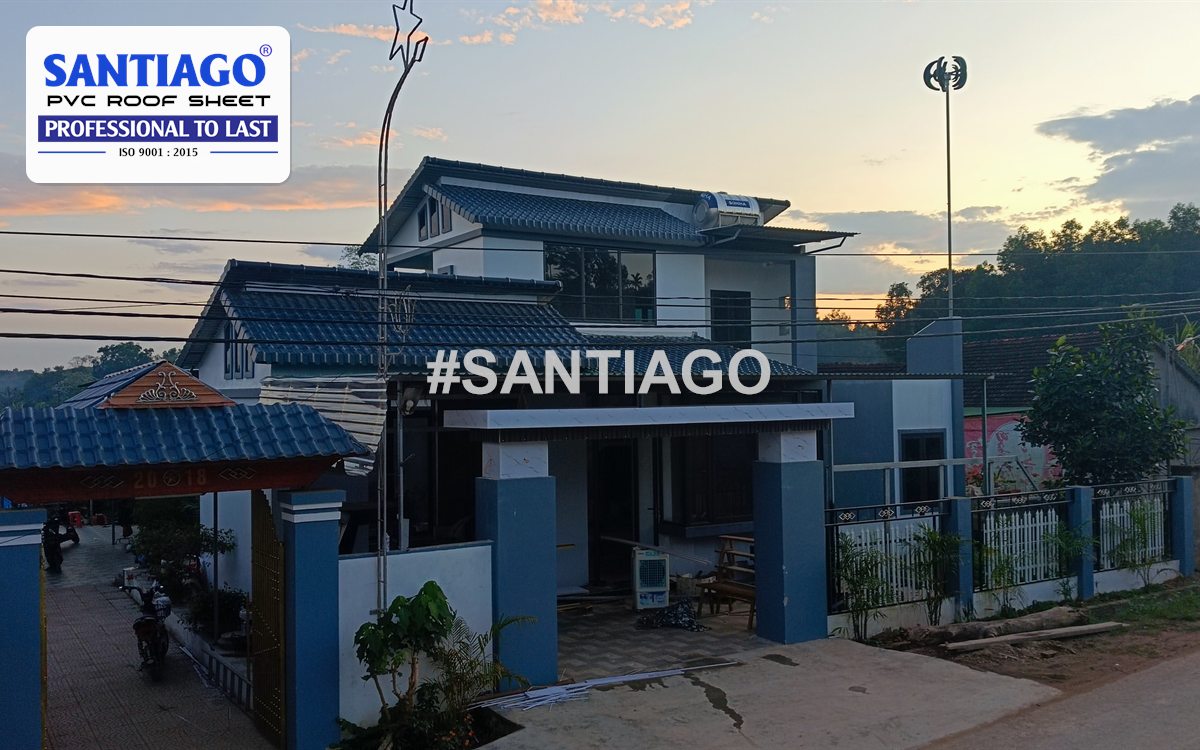
Two-storey house with a blue tile roof, Vietnam
What does a red tile-sheet roof look like on a finished building in the tropics?
Mr Quyen presents, in English, a restaurant in Da Nang, Vietnam, roofed with red Santiago ASA/PVC tile sheets and filmed from a drone. The video also shows a house with a blue tile roof and red, blue and navy tile samples.
A restaurant roof in Da Nang with Santiago ASA/PVC tile sheets (Santiago video on YouTube).
More shorts for homes and resorts in the tropics
Two more English shorts from the Santiago YouTube channel. Each one is about a minute or less.
What does a grey tile roof look like next to the gutter?
Installers screw grey Santiago tile sheets down on a roof while Mr Quyen and a colleague walk along the finished section near the gutter. The short opens in the factory with a green sheet.
Santiago uPVC tile roofs on site (Santiago video on YouTube).
How does the sheet behave under a flame?
The heat-test short: grey and red sheets under a flame, Mr Quyen on grey sheets at the factory, then a warehouse roof re-laid in blue. It shows how the sheet behaves under heat, not a certified fire rating.
Heat test and a warehouse re-roof with uPVC sheets (Santiago video on YouTube).
CPTPP: lower import duty on roofing sheets made in Vietnam
Vietnam is one of the 12 member countries of the Comprehensive and Progressive Agreement for Trans-Pacific Partnership (CPTPP), together with Australia, Brunei, Canada, Chile, Japan, Malaysia, Mexico, New Zealand, Peru, Singapore and the United Kingdom. Santiago ASA/PVC roofing sheets and accessories are made in Vietnam (HS 3925.90.00), so buyers in these countries can claim the CPTPP preference when they import them.
- Lower or zero import duty. Each member cuts its tariffs on goods of Vietnamese origin under its own CPTPP schedule, and many tariff lines are already at 0%. Your customs broker confirms the rate that applies to HS 3925.90.00 on the day of import.
- Proof of origin with every container. Santiago prepares the CPTPP origin documents for each shipment, so the importer can claim the preferential rate at clearance.
- Advance rulings. Under CPTPP, an importer can ask its customs authority for a written ruling on tariff classification and origin before the goods ship, so the duty is known before the order is confirmed.
- Faster, more predictable clearance. CPTPP members commit to publish their customs rules and, where possible, to release goods within 48 hours of arrival.
- The same preference on every repeat order. As long as the sheets are made in Vietnam and the origin documents are in order, each new container qualifies again.
Duty rates and paperwork change by country and over time: check the current rate and the proof-of-origin form with your customs broker before you order.
Santiago – a leading exporter of ASA/PVC roofing from Vietnam
Santiago roofing is produced and loaded into containers at our factory in Vietnam. It has been exported to India since 2023, Thailand since 2024 and the USA since 2025. Every export shipment comes with a commercial invoice, packing list, bill of lading and a certificate of origin (C/O) issued by Vietnam's Ministry of Industry and Trade, which importers use to claim the duty preference of their trade agreement.
| Item | Details |
|---|---|
| HS code | 3925.90.00 (ASA/PVC roofing sheets) |
| Certificate of origin | Form D (ASEAN), Form AI (India), Form AK / VK (Korea), Form AJ / VJ (Japan), Form VC (Chile), CPTPP proof of origin |
| Shipped from | Vietnam, by container |
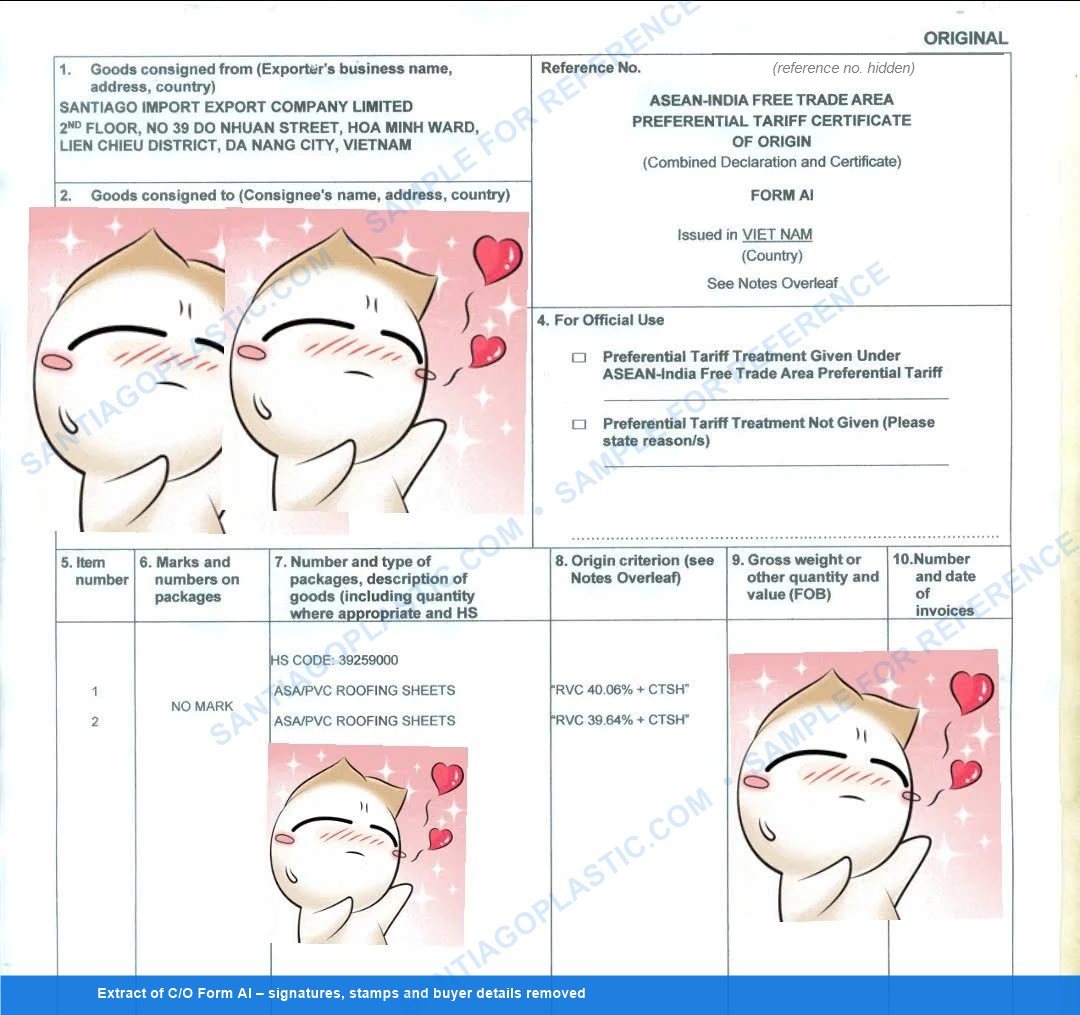
Certificate of origin Form AI (ASEAN–India) for Santiago ASA/PVC roofing sheets, HS 39259000, certified on 24 September 2026. Buyer details are hidden.
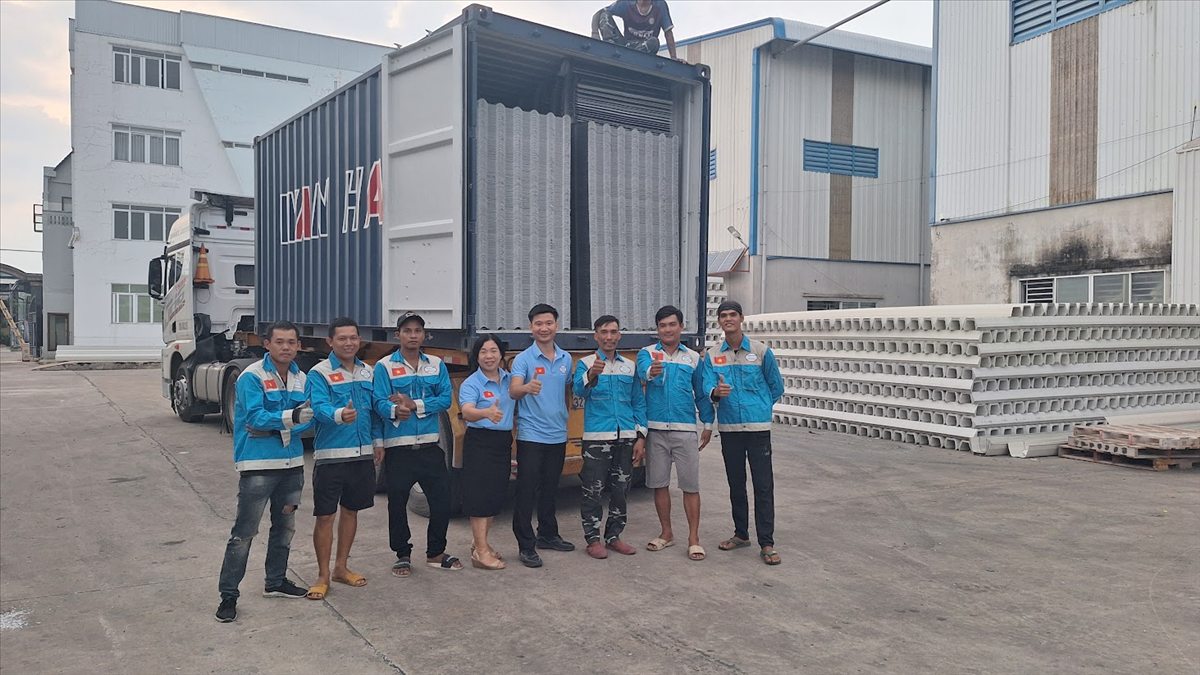
The Santiago team beside a loaded export container at the factory, November 2024
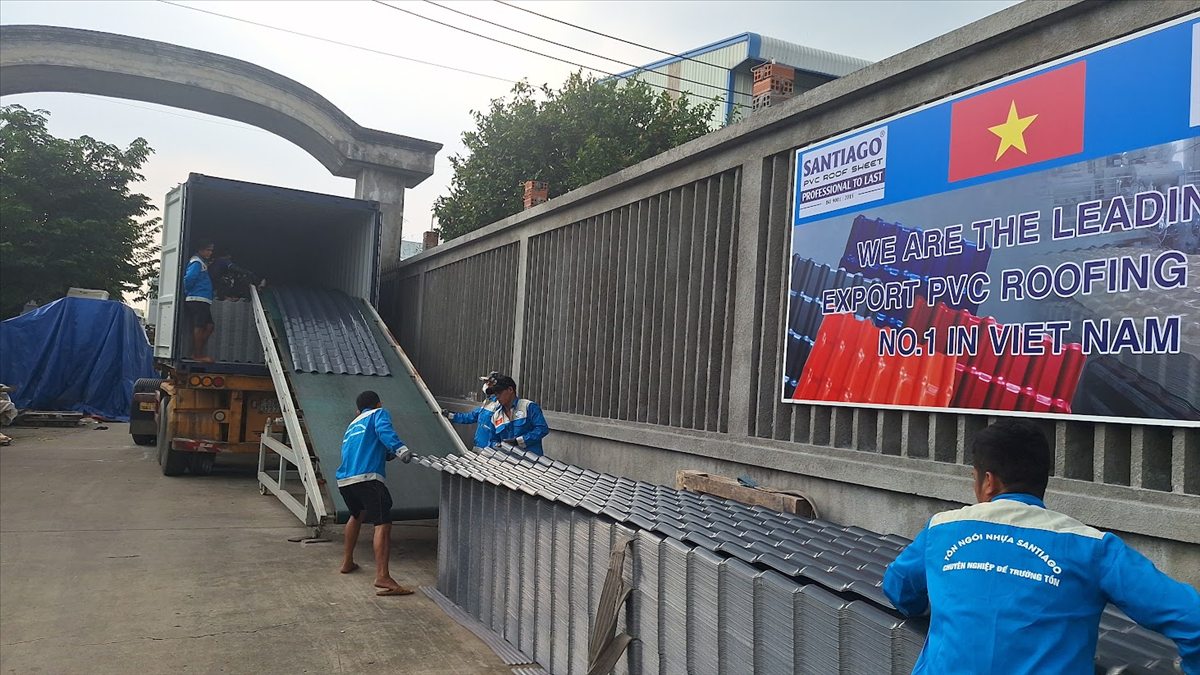
Loading Santiago roof tiles into an export container
Frequently asked questions
Is a PVC roof tile sheet hot under the Singapore sun?
In Santiago tests the space under its ASA/PVC tile sheet stays 6 – 8 °C cooler than under bare metal sheet, and rain noise is about 80% lower.
Will the colour fade in Singapore?
The colour sits in the ASA top layer, which showed no colour change after 2,000 hours of artificial UV. The colour is rated for 30 years and real roofs last 25 – 30 years.
Do I need approval to use PVC roof tiles on a landed house?
Your architect or engineer and the authorities decide. Santiago holds no Singapore BCA certification and publishes no fire or wind rating for the sheet, so ask before you order.
Can the roof sheets be imported into Singapore under CPTPP?
Yes. They are made in Vietnam and ship under HS 3925.90.00 with an origin document for each container; CPTPP and ASEAN Form D are both possible. Your customs broker confirms the rate.
How many sheets does a 10 × 6 m pavilion take?
With a 35% gable roof, 0.8 m eaves and 0.25 m gable overhangs: 22 sheets of 4.161 m (about 92 m), 350 – 440 screw sets, 10.56 m of ridge cap and 2 ridge terminals.
Read more
- Santiago heat, noise and corrosion tests
- Why the ASA surface layer matters
- PVC roofing sheet colours
- PVC roof sheet design for a house
- ASA/PVC roof tile sheet
Sources for the figures in this article
- Profiles, 2.5–3.0 mm thickness and 10-year warranty: Santiago ASA/PVC product specification.
- About 6–8 °C cooler than bare metal sheet and about 80% less rain noise: Santiago's own comparisons on finished roofs in Vietnam.
- HS code 3925.90.00: Harmonized System Chapter 39 (builders' ware of plastics), as applied in Vietnam's export tariff.
- Certificates of origin (Form D, AI, AK/VK, AJ/VJ, VC, CPTPP): issued by Vietnam's Ministry of Industry and Trade under the country's free trade agreements.
- Minimum order of one 40 ft container (about 5,000 m) and about 5 days for production and loading: Santiago export desk, October 2026.
Updated 03/11/2026. Santiago Import Export Co., Ltd, Vietnam. WhatsApp +84 935 391 495 (Mr. Quyen), hotline +84 965 437 316 (Mrs. Ly), email salessantiagoroofing@gmail.com.


