


Mr Quyen - Santiago. Posted 14/11/2026
For houses, churches and halls in Douala's humid, very wet climate, a Santiago ASA/PVC tile sheet has no metal to rust, and in Santiago tests it cuts rain noise by about 80% and keeps the space under it 6 – 8 °C cooler than bare metal sheet. It weighs about 5.4 kg per m² of roof. An 18 × 10 m church hall with a gable roof takes 40 sheets of 6.132 m, about 245 m, fixed to purlins less than 700 mm apart.
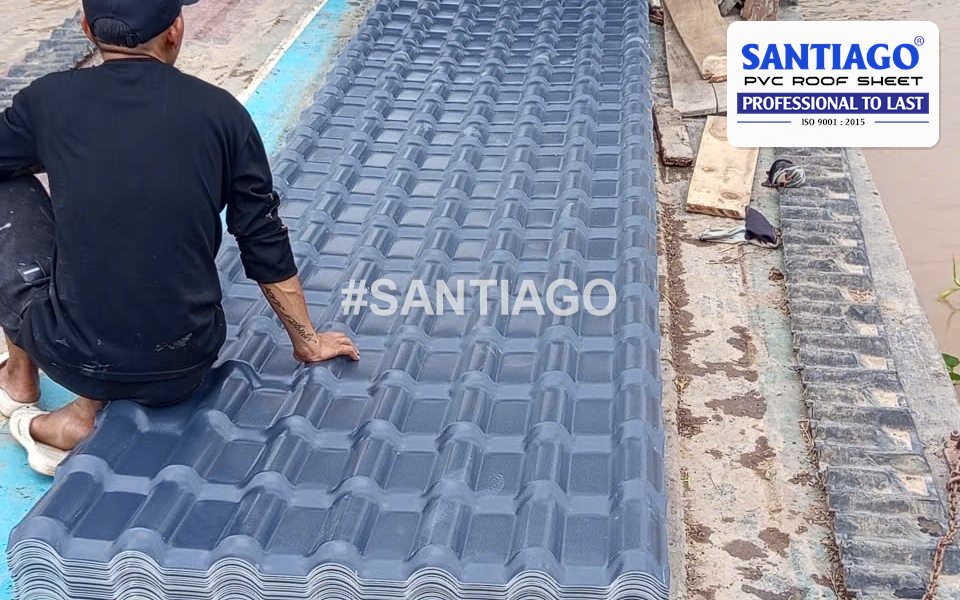
A worker on a grey tile sheet, Vietnam
What does a roof in Douala and Yaoundé have to put up with?
Douala lies close to the sea and gets very heavy rain for much of the year, with warm, damp air in between. Yaoundé stands higher and is a little cooler, with two rainy seasons. In both cities a large share of roofs are tôle bac or tôle ondulée: light, quick to fix and known to every builder.
Owners also know what comes with it. A long storm on a metal roof drowns out a sermon, a choir, a meeting or the television. In the afternoon sun the rooms below get hot. And in damp air, rust shows up after some years at the laps, around the screw holes and along the eaves, often first as a brown streak on the ceiling.
Most people in Cameroon who search for "toiture pvc" or "tuile pvc" want two things from the next roof: less noise and no rust. Many also want a tiled look on a villa or a church without loading the frame with clay tiles.
Tôle bac or tuile PVC: what changes when the rain comes?
| Point | Metal sheet (tôle bac, tôle ondulée) | Santiago ASA/PVC tile sheet |
|---|---|---|
| Rain noise | Loud in a hard storm | About 80% lower than metal (Santiago test) |
| Heat under the roof | Gets hot in the sun | 6 – 8 °C cooler than bare metal sheet (Santiago test) |
| Damp air | Rust can start at laps, holes and edges over the years | No metal in the sheet; ASA caps cover the screw heads |
| Look | Flat ribs or plain waves | Spanish-style tile profile in five standard colours |
| Weight | Depends on the gauge | About 5.4 kg per m² of roof at 2.5 mm |
| Colour in the sun | Depends on the paint | ASA layer: no colour change after 2,000 hours of artificial UV; colour rated 30 years |
The tile sheet is made in Vietnam from four co-extruded layers with no glue: an ASA top layer that carries the colour and blocks UV, a virgin PVC layer, a PVC core and a milky-white PVC base that faces the room. The material is virgin, not recycled. Bending strength is above 1,000 N. Real roofs last 25 – 30 years, and the warranty is 10 years for 2.5 mm and thicker sheet installed as Santiago recommends.
Metal sheet still has a place. For a site store or a shed you plan to take down in a few years, tôle does the job. The tile sheet makes sense on buildings where people live, pray or meet for decades, and where the noise of the rainy season really matters.
How many sheets for an 18 × 10 m church or community hall?
Take a hall 18 m long and 10 m wide with a two-slope roof (toiture 2 pans). The ridge runs along the 18 m side, the slope is 35% (about 19°), the eaves overhang 0.6 m to keep rain off the walls, and each gable end overhangs 0.3 m.
| Step | Working | Result |
|---|---|---|
| Ridge height above the eave line | 5 m half-width × 35% | 1.75 m |
| Face length along the slope | (5 m + 0.6 m) × 1.0595 | about 5.93 m |
| Sheet length | 5.93 ÷ 0.219 = 27.1, round up to 28 steps; 28 × 219 mm | 6.132 m (the extra 20 cm goes into the eave) |
| Sheets per face | (18 m + 2 × 0.3 m) ÷ 0.96 = 19.4, round up | 20 sheets, covering 19.2 m |
| Sheets for the roof | 20 × 2 faces | 40 sheets, about 245 running metres |
| Roof area | 19.2 m × 6.132 m × 2 | about 235 m² |
| Screw sets with ASA caps | 235 m² × 4 – 5 per m² | about 940 – 1,180 |
| Ridge and edges | Ridge length and both eaves | 19.2 m of ridge cap, 2 ridge terminals, 2 × 19.2 m of eave drip tile |
| Sheet weight | 235 m² × 5.4 kg | about 1,270 kg |
The sheet is cut to order in 219 mm steps, so each sheet runs in one piece from ridge to eave with no cross joint for water to find. If the hall has a porch or side aisle with a hip roof, add hip ridge pieces and three-way or four-way pieces where the ridges meet.
Purlins, slope and screws for a wet climate
Purlins go less than 700 mm apart: 440 or 660 mm for the tile sheet, which is two or three tile steps, with a purlin under the foot of a step. On the 6.132 m sheets above, 660 mm spacing gives about 10 purlin rows on each face. The top purlin sits 15 – 18 cm below the ridge.
Keep the slope between 20% and 45%. Below 20% water drains too slowly and Santiago does not recommend it, which matters in a city where rain can fall hard for hours. Pre-drill 6 mm holes and fix 70 mm screws with ASA caps through the top of the wave over a purlin, 4 – 5 sets per m². Never screw in the valley, because that is where the water runs. Lap each sheet one wave over the next.
Santiago publishes no wind rating for the sheet and holds no Cameroonian certification, so the builder or engineer designs the frame and the fixings for the site, and the local authority decides on any approval. Santiago supplies the sheets and accessories and sends installation videos; it does not install.
Gutters (chéneaux), eaves and walls
A 235 m² roof sends a lot of water to its eaves in a Douala downpour. Fit eave drip tile along the lower edge so the water drops clear into the gutter instead of running back under the sheet. Size the gutters (chéneaux or gouttières) and downpipes with your builder for the roof area.
Where a roof meets a wall, two different pieces are used. If the sheets run along a wall, parallel to the water flow, fit side wall flashing (left or right; product name "eave sealing tile"). If the top of a slope runs into a wall, such as a bell tower or a taller main building, fit vertical wall flashing. All accessories come in the same colours as the sheets.
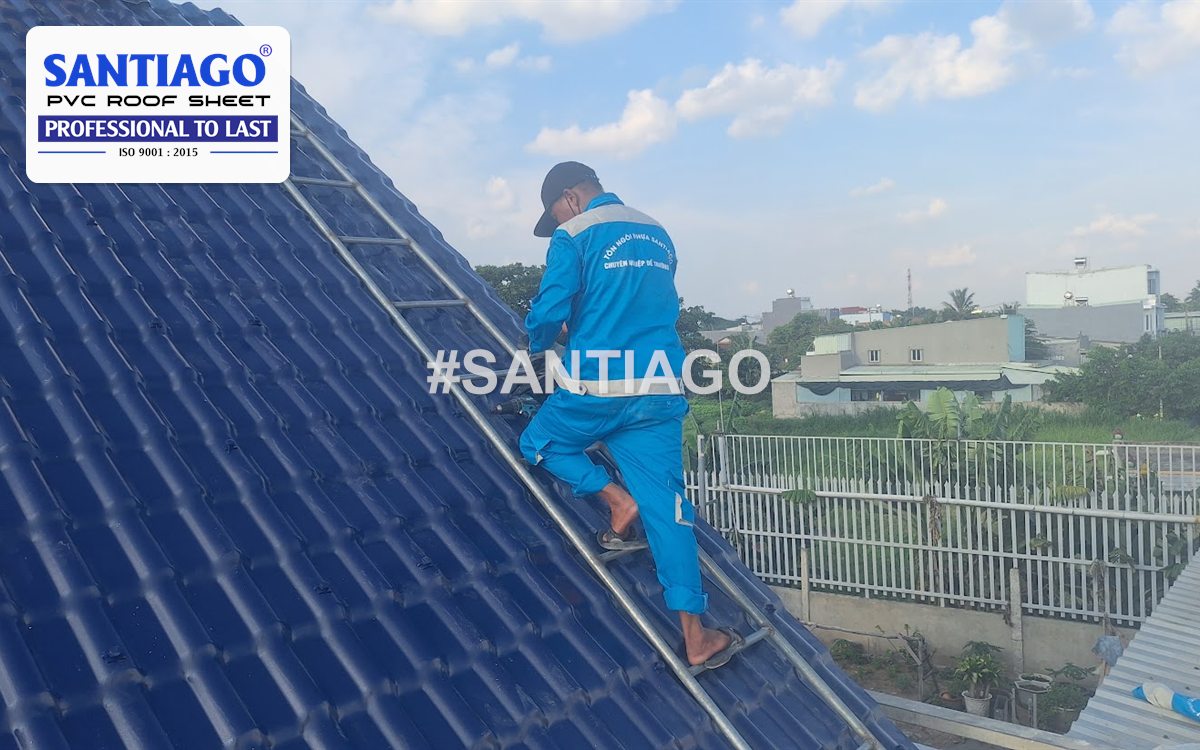
An installer climbing a blue tile roof, Vietnam
Which colour for a villa, house or church?
The standard colours are dark grey, red, blue, orange and chocolate. Green, white and purple are made to order, and so is a dark underside. Red and chocolate give the classic tiled look that suits churches and family houses; dark grey sits well on modern villas with white walls. Blue stands out and suits some buildings more than others.
Choose from a sample held against the wall paint in daylight, not from a screen. Samples are free; the buyer pays the courier.
How do you get the sheets in Cameroon?
Santiago sells for export by the container: the minimum order is one 40 ft container of about 5,000 m of sheet, with colours, profiles and accessories mixed, and production takes about 5 days after the order is confirmed. One hall needs about 245 m, so a single building is normally supplied through a Cameroonian importer, dealer or quincaillerie that brings in containers. Our guide for importers using Douala or Kribi covers that side.
There is no free-trade agreement between Cameroon and Vietnam that we can confirm, so we promise no duty saving. Santiago issues a certificate of origin (Vietnam) and ships under HS 3925.90.00; your customs broker confirms the classification, the duty and the documents. The price is quoted per order in writing.
Why are bare metal roofs hot and loud, and what changes with a tile sheet?
Mr Quyen holds a white tile sheet in the Santiago factory in Vietnam and explains in English, with captions, why bare metal roofs are hot, noisy in rain and costly to repair. The short then moves to a red tile roof on a house and a finished grey tile roof beside the gutter.
Heat and rain noise: Santiago ASA/uPVC roofing explained (Santiago video on YouTube).
More short videos from Santiago
Two more English shorts from the Santiago YouTube channel. Each one is about a minute or less.
How do the tile sheets look on real roofs in sun and rain?
Red ASA/PVC tile sheets are carried up to a house, a flame is put to a stack of sheets, and the short ends on a blue warehouse roof under installation and grey sheets on the factory roller line. A flame test is a demonstration, not a fire rating.
Santiago PVC roofing tiles in real conditions (Santiago video on YouTube).
How does the sheet behave when bent and cut?
Mr Quyen stands in the Santiago factory in Vietnam and bends and cuts beige and orange sheets with metal shears while he explains in English, with captions, how the sheet holds up. Bending by hand is a demonstration; a roof still needs purlins less than 700 mm apart.
Bending and cutting test on Santiago ASA/PVC sheets (Santiago video on YouTube).
Santiago – a leading exporter of ASA/PVC roofing from Vietnam
Santiago roofing is produced and loaded into containers at our factory in Vietnam. It has been exported to India since 2023, Thailand since 2024 and the USA since 2025. Every export shipment comes with a commercial invoice, packing list, bill of lading and a certificate of origin (C/O) issued by Vietnam's Ministry of Industry and Trade, which importers use to claim the duty preference of their trade agreement.
| Item | Details |
|---|---|
| HS code | 3925.90.00 (ASA/PVC roofing sheets) |
| Certificate of origin | Form D (ASEAN), Form AI (India), Form AK / VK (Korea), Form AJ / VJ (Japan), Form VC (Chile), CPTPP proof of origin |
| Shipped from | Vietnam, by container |

Certificate of origin Form AI (ASEAN–India) for Santiago ASA/PVC roofing sheets, HS 39259000, certified on 24 September 2026. Buyer details are hidden.
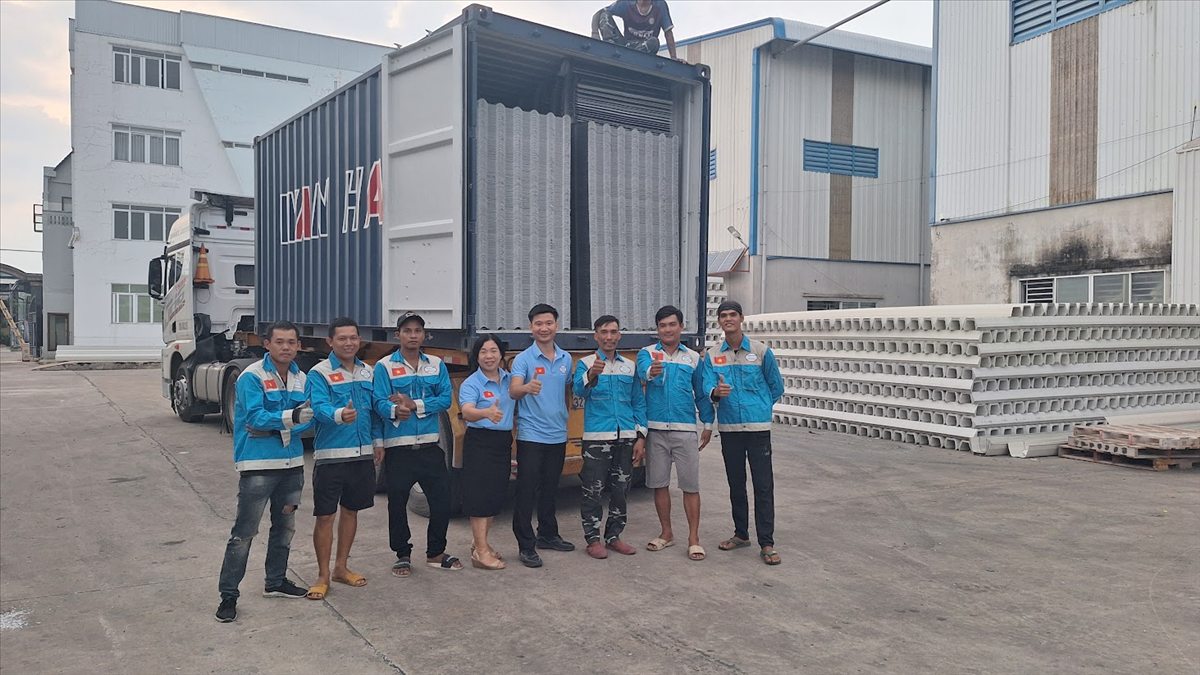
The Santiago team beside a loaded export container at the factory, November 2024
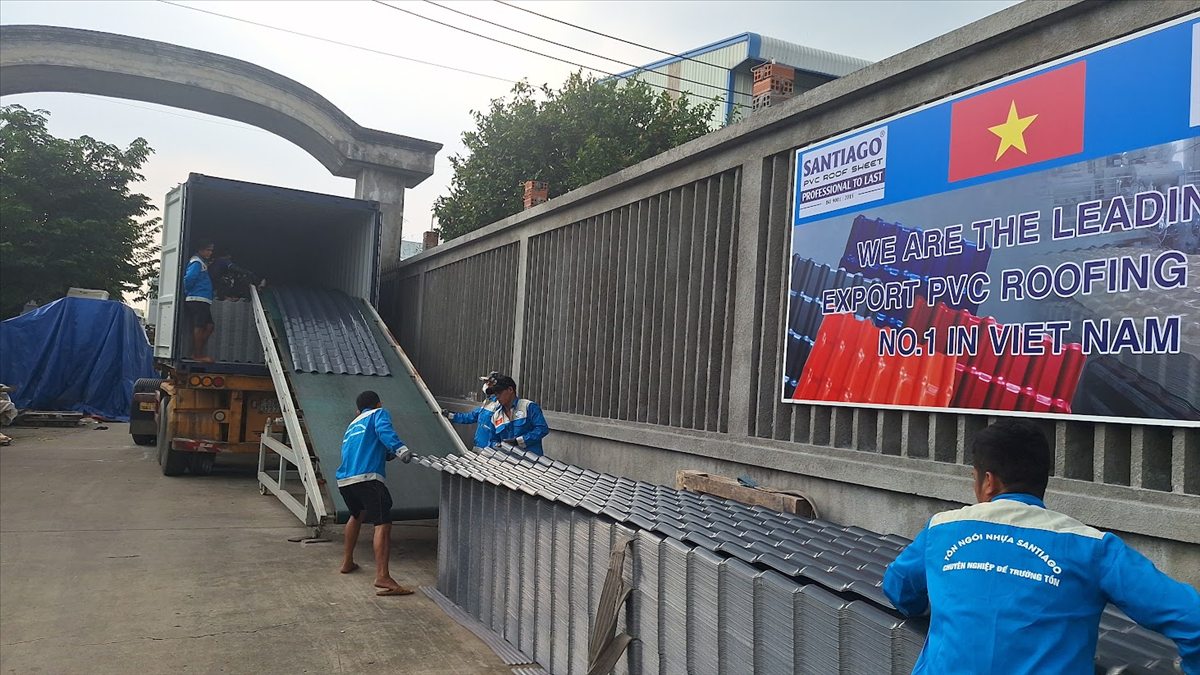
Loading Santiago roof tiles into an export container
Frequently asked questions
Is a PVC roof quieter than tôle bac in heavy rain?
Yes. In Santiago tests rain noise under its ASA/PVC tile sheet is about 80% lower than under metal sheet, and the space under it stays 6 – 8 °C cooler than under bare metal.
Will a PVC tile roof rust in Douala's damp air?
The sheet has no metal in it, so it cannot rust. The screws are the only metal part, and ASA caps cover their heads.
How many sheets does an 18 × 10 m church hall need?
With a 35% gable roof, 0.6 m eaves and 0.3 m gable overhangs: 40 sheets of 6.132 m (about 245 m), 940 – 1,180 screw sets, 19.2 m of ridge cap and 2 ridge terminals.
What purlin spacing does the tile sheet need?
Less than 700 mm: 440 or 660 mm, with a purlin under the foot of a tile step and the top purlin 15 – 18 cm below the ridge. Slope 20 – 45%.
What is the price of PVC roofing in Cameroon?
Santiago does not publish prices. It quotes per order in writing, based on thickness, colour, lengths, accessories and quantity, and sells through importers by the container.
Read more
- Santiago heat, noise and corrosion tests
- Edge and wall flashing pieces explained
- How to install PVC roof tile sheets
- A cooler, quieter house roof
- ASA/PVC roof tile sheet
Version française
Pour une maison, une villa, une église ou une salle à Douala, où il pleut très fort une bonne partie de l'année, la tuile PVC ASA de Santiago ne rouille pas (il n'y a pas de métal dedans). Dans les tests Santiago, le bruit de la pluie est environ 80 % plus faible que sur une tôle et il fait 6 – 8 °C de moins sous la toiture que sous une tôle nue. Une salle de 18 × 10 m demande 40 feuilles de 6,132 m.
Toiture PVC ou tôle bac : qu'est-ce qui change en saison des pluies ?
À Douala comme à Yaoundé, la tôle bac et la tôle ondulée couvrent beaucoup de maisons. Elles tiennent la pluie, mais tout le monde connaît le vacarme d'un gros orage pendant la messe ou la réunion, la chaleur de l'après-midi et la rouille qui finit par apparaître aux recouvrements et autour des vis. La tuile PVC de Santiago est une grande feuille au profil de tuile espagnole, fabriquée au Vietnam en quatre couches co-extrudées sans colle : une couche ASA qui porte la couleur et arrête les UV, du PVC vierge, une âme en PVC et une sous-face en PVC blanc laiteux.
| Critère | Tôle bac / tôle ondulée | Tuile PVC ASA Santiago |
|---|---|---|
| Bruit de pluie | Fort sous l'orage | Environ 80 % plus faible (test Santiago) |
| Chaleur sous la toiture | Chauffe au soleil | 6 – 8 °C de moins qu'une tôle nue (test Santiago) |
| Rouille | Possible avec les années | Pas de métal ; capuchons ASA sur les têtes de vis |
| Aspect | Nervures ou ondes | Tuile, 5 couleurs standard |
| Poids | Selon l'épaisseur | Environ 5,4 kg par m² de toiture (2,5 mm) |
| Tenue de la couleur | Selon la peinture | Aucun changement après 2 000 heures d'UV artificiels ; couleur prévue pour 30 ans |
| Durée et garantie | Selon le fournisseur | 25 – 30 ans sur toit réel ; garantie 10 ans (2,5 mm et plus, pose selon Santiago) |
Pour un magasin de chantier ou un abri qu'on démontera dans quelques années, la tôle reste un choix pratique. La tuile PVC est faite pour les bâtiments où l'on vit, prie ou se réunit pendant des décennies.
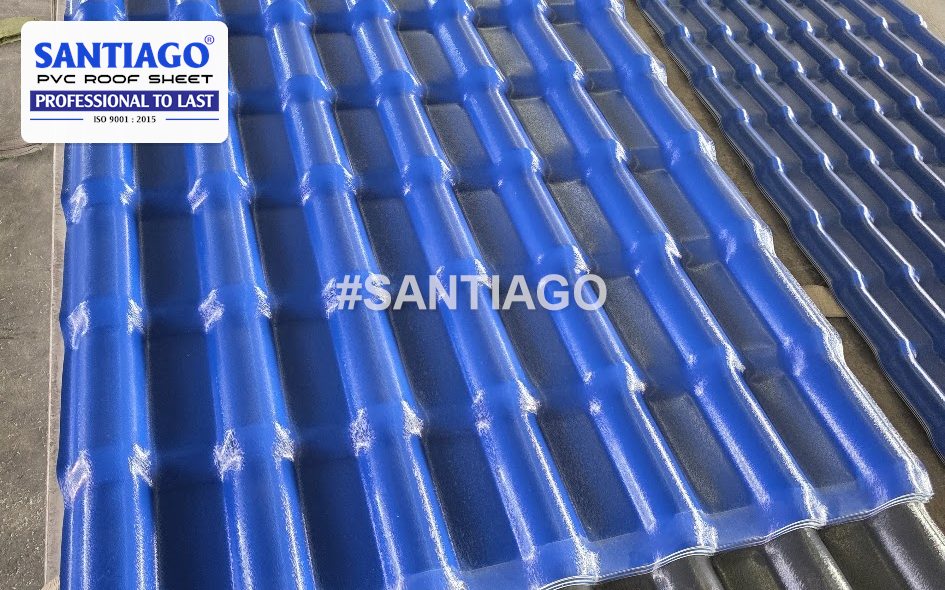
Feuilles de tuile PVC bleues, Vietnam
Exemple : combien de feuilles pour une église ou une salle de 18 × 10 m ?
Toiture 2 pans, faîtage sur le côté de 18 m, pente 35 % (environ 19°), débord d'égout 0,6 m, débord de pignon 0,3 m de chaque côté.
| Calcul | Résultat |
|---|---|
| Longueur du pan : (5 m + 0,6 m) × 1,0595 | environ 5,93 m |
| Longueur de feuille : 28 pas × 219 mm | 6,132 m |
| Feuilles par pan : (18 + 0,6) ÷ 0,96 = 19,4 | 20 feuilles (19,2 m) |
| Total | 40 feuilles, environ 245 m |
| Surface de toiture | environ 235 m² |
| Vis avec capuchon ASA (4 – 5 par m²) | environ 940 – 1 180 |
| Faîtière | 19,2 m et 2 embouts de faîtage |
| Tuile d'égout (bord bas) | 2 × 19,2 m |
| Poids des feuilles | environ 1 270 kg |
Pannes, pente, vis et chéneaux
Les pannes sont espacées de moins de 700 mm : 440 ou 660 mm pour la tuile PVC, avec une panne sous le pied d'un pas de tuile, et la panne du haut à 15 – 18 cm sous le faîtage. Pente entre 20 % et 45 %, jamais moins de 20 % sous une pluie pareille. Percez d'abord à 6 mm, puis posez des vis de 70 mm avec capuchon ASA sur le haut de l'onde, au droit d'une panne, 4 – 5 par m², jamais dans le creux où coule l'eau. Recouvrement latéral d'une onde.
En bas de pente, la tuile d'égout envoie l'eau dans le chéneau ou la gouttière ; leur taille se décide avec votre maçon ou votre charpentier. Le long d'un mur parallèle à l'écoulement, on pose la bande de rive murale gauche ou droite (nom produit « eave sealing tile ») ; là où le haut d'un pan bute contre un mur, on pose le solin de mur vertical. Santiago ne publie aucune résistance au vent et n'a pas de certification au Cameroun : c'est le constructeur ou l'ingénieur qui conçoit la charpente et la fixation. Santiago fournit les feuilles, les accessoires et des vidéos de pose, sans faire la pose.
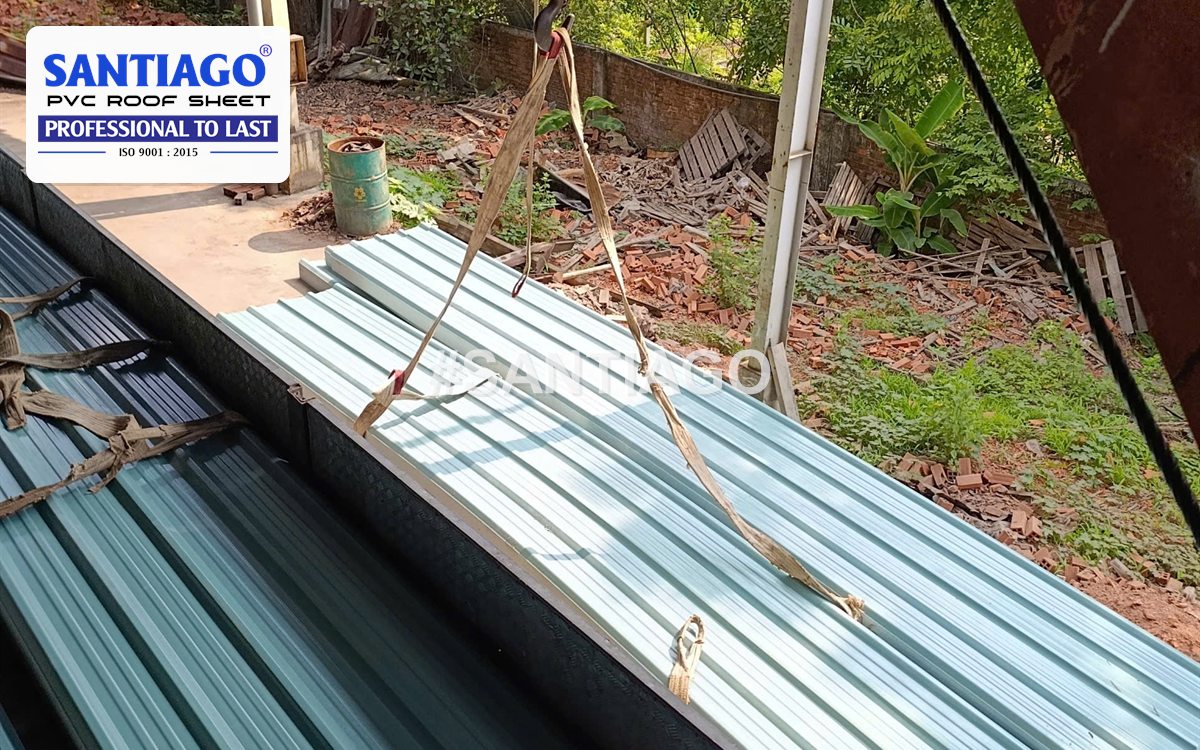
Tôles ondulées PVC sur un chantier, Vietnam
Couleurs et achat au Cameroun
Cinq couleurs standard : gris foncé, rouge, bleu, orange et chocolat ; vert, blanc et violet sur commande. Les accessoires (faîtière, arêtier, embout de faîtage, pièces à trois et quatre voies, tuile d'égout, bandes de rive, solin, capuchons de vis) sont de la même couleur. Santiago vend à l'export par conteneur de 40 pieds (environ 5 000 m, couleurs et profils mélangés) ; une maison ou une église passe donc par un importateur ou une quincaillerie. Nous ne connaissons pas d'accord de libre-échange entre le Cameroun et le Vietnam : votre déclarant en douane confirme les droits et les documents. Le prix est donné sur devis écrit pour chaque commande.
Questions fréquentes
La toiture PVC fait-elle moins de bruit que la tôle bac sous la pluie ?
Oui. Dans les tests Santiago, le bruit de pluie sous la tuile PVC ASA est environ 80 % plus faible que sous une tôle métallique.
La tuile PVC rouille-t-elle à Douala ?
Non, la feuille ne contient pas de métal. Seules les vis sont en métal, et leurs têtes sont couvertes par des capuchons ASA.
Combien de feuilles pour une salle de 18 × 10 m ?
Avec une toiture 2 pans à 35 % : 40 feuilles de 6,132 m (environ 245 m), 940 – 1 180 vis et 19,2 m de faîtière.
Quel est le prix de la tôle tuile PVC au Cameroun ?
Santiago ne publie pas de prix : il établit un devis écrit pour chaque commande selon l'épaisseur, la couleur, les longueurs, les accessoires et la quantité.
Read next on this topic
Main guide: Heat Resistant Roofing Sheet for a Hot Climate
Sources for the figures in this article
- Profiles, 2.5–3.0 mm thickness and 10-year warranty: Santiago ASA/PVC product specification.
- About 6–8 °C cooler than bare metal sheet and about 80% less rain noise: Santiago's own comparisons on finished roofs in Vietnam.
- HS code 3925.90.00: Harmonized System Chapter 39 (builders' ware of plastics), as applied in Vietnam's export tariff.
- Certificates of origin (Form D, AI, AK/VK, AJ/VJ, VC, CPTPP): issued by Vietnam's Ministry of Industry and Trade under the country's free trade agreements.
- Minimum order of one 40 ft container (about 5,000 m) and about 5 days for production and loading: Santiago export desk, October 2026.
Updated 03/11/2026. Santiago Import Export Co., Ltd, Vietnam. WhatsApp +84 935 391 495 (Mr. Quyen), hotline +84 965 437 316 (Mrs. Ly), email salessantiagoroofing@gmail.com.


