


Mr Quyen - Santiago. Posted 14/11/2026
Plastic roof sheets listed as 10 mm, 12 mm or 16 mm are usually multiwall (twin-wall) panels: two or more thin walls joined by ribs with air cells between them, and the figure is the depth of the whole panel. A solid ASA/PVC roof sheet is measured through its single wall. Santiago makes its sheets 2.5 and 3.0 mm thick, 2.5 mm is the minimum for a roof, and a 2.5 mm tile sheet weighs about 5.4 kg per m² of roof.
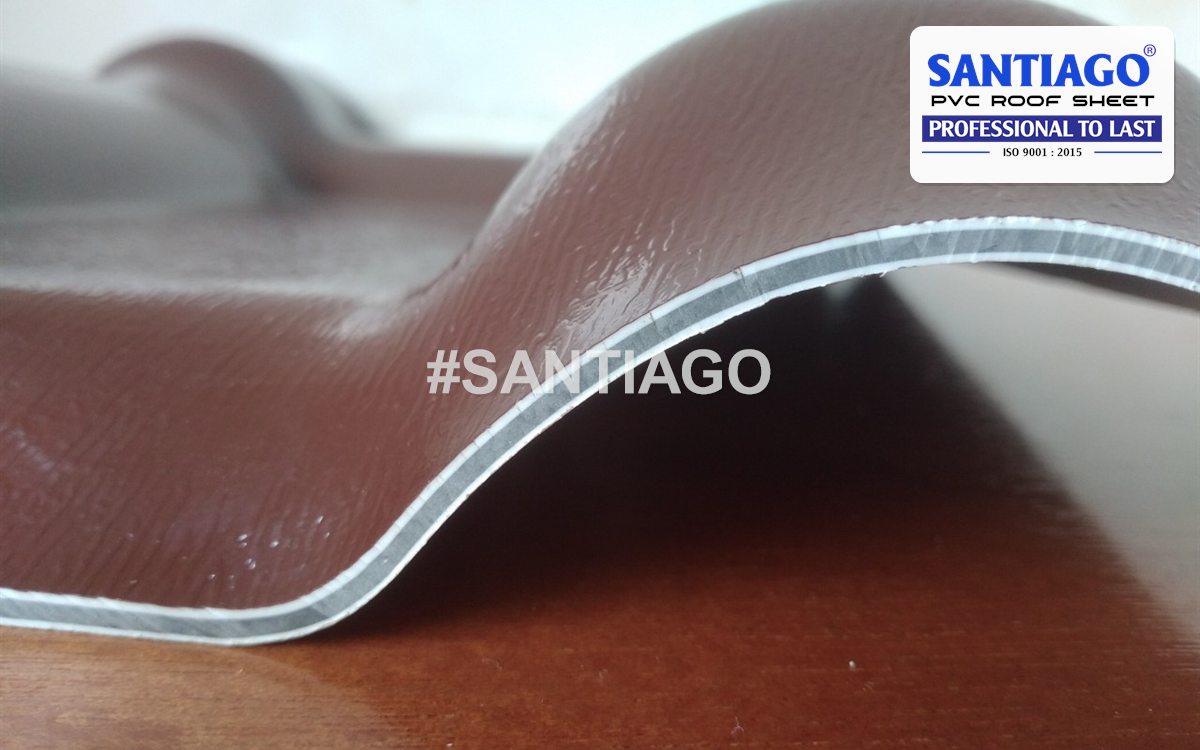
Cut edge of a brown tile sheet showing its layers, Vietnam
What does "10 mm" or "16 mm" mean in a plastic roof sheet listing?
Search for "plastic roof sheets 10mm" or "plastic roof sheets 16mm" and most of the results are multiwall polycarbonate panels. The 10 or 16 mm is the overall depth of the panel, measured from the outer face of the top wall to the outer face of the bottom wall, air cells included. Each wall on its own is much thinner. These panels are clear, opal or tinted and let daylight through, which is why they go on conservatories, greenhouses, canopies and carport covers. They are a different product from a solid roof sheet, and Santiago does not make them.
"12mm PVC roofing sheets" is harder to read. Some sellers mean a hollow panel; others give the height of the wave or tile profile, from the bottom of the sheet to the top of a rib. Without a photo of the cut edge you cannot tell which.
| What the listing says | What the figure usually measures | What to ask the seller |
|---|---|---|
| 10 mm or 16 mm plastic roof sheet | Overall depth of a multiwall panel with air cells | Wall thickness, number of walls, light it lets through |
| 12 mm PVC roofing sheet | A hollow panel, or the height of the profile | A photo of the cut edge and the thickness of the solid wall |
| 20 mm, 32 mm or 34 mm wave | Height of a corrugated wave (Santiago 11-wave: 20 mm, 5-wave: 32 mm, 6-wave: 34 mm) | The sheet thickness, which is a separate figure |
| 2.5 mm or 3.0 mm | Thickness of a solid sheet through its wall | Where it was measured and what one metre weighs |
Multiwall panel or solid ASA/PVC sheet: which roof needs which?
The two products answer different questions. A multiwall panel is chosen when the roof has to let light in. A solid ASA/PVC sheet is chosen when the roof has to give shade, look like tiles or corrugated sheet, and keep the space below cooler and quieter than bare metal. Neither replaces the other.
| Point | Multiwall panel (10 – 16 mm) | Solid ASA/PVC sheet (2.5 – 3.0 mm) |
|---|---|---|
| Light | Lets daylight through | Opaque; Santiago skylight sheets on 5 – 10% of the roof let through 80 – 90% of the light where they sit |
| Look | Flat panel with visible internal ribs | Spanish tile profile, or 5, 6 and 11-wave corrugated, in five standard colours |
| Under the roof | Bright | Shaded; in Santiago tests 6 – 8 °C cooler than under bare metal sheet, with about 80% less rain noise than metal |
| Typical buildings | Conservatories, greenhouses, canopies, carport covers | Houses, villas, verandas, sheds, warehouses, farm buildings |
| Published data | Ask the panel maker | No colour change after 2,000 hours of artificial UV; bending strength above 1,000 N |
Some roofs use both ideas: an opaque ASA/PVC roof with a few translucent skylight sheets laid in the same profile. The skylight article explains how many to plan.

White and red tile-sheet pieces side by side, Vietnam
How thick is a solid PVC roofing sheet?
Santiago makes its tile sheet and its corrugated sheets 2.5 mm and 3.0 mm thick. Each sheet is four co-extruded layers with no glue between them: an ASA top layer that blocks UV and carries the colour, a virgin PVC layer, a PVC core and a milky-white PVC base. The thickness you measure is that one solid wall. Material is virgin, not recycled.
Below 2.5 mm a plastic roof sheet is too soft for a roof. It sags between purlins, its ribs dent when the screws are tightened, and it is easily damaged when someone steps on it during repairs. That is why 2.5 mm is Santiago's minimum for roofs and why the 10-year warranty covers sheets of 2.5 mm and thicker, installed as Santiago recommends. A thicker sheet does not allow wider purlin spacing: keep purlins less than 700 mm apart, at 440 or 660 mm for the tile sheet.
How do you measure the thickness of a roof sheet at the cut edge?
- Find a clean, square cut end. A sheet cut to length at the factory has one at each end.
- Use a caliper, not a tape measure. Measure the flat wall of the sheet, not across a wave or tile step, or you are measuring the profile height.
- Take readings at several points across the width and keep the smallest one.
- Compare it with the thickness written on the quotation and the packing list.
- Weigh a piece one metre long. A 2.5 mm Santiago tile sheet weighs about 5.2 kg per running metre, which is about 5.4 kg per m² of roof. A piece that is much lighter is thinner.
The cut edge also shows the build of the sheet. On a Santiago sheet you can see the coloured ASA skin on top and the milky-white base underneath, as in the cover photo.

White and grey tile-sheet pieces laid next to each other, Vietnam
What does sheet thickness change on the roof?
| Thickness | Weight | Used for | Warranty |
|---|---|---|---|
| 2.5 mm | About 5.4 kg per m² of roof (tile sheet), about 5.2 kg per running metre | The standard roof sheet for houses, verandas, sheds, warehouses and farms | 10 years |
| 3.0 mm | Heavier; the packing list states the real weight | Roofs that need a stiffer sheet | 10 years |
| Under 2.5 mm | Not offered by Santiago for roofs | Not recommended on a roof | None |
The weight matters for the frame and for freight. A 60 m² house roof in 2.5 mm tile sheet carries about 324 kg of sheet (60 × 5.4 kg). A 16 mm multiwall panel and a 2.5 mm solid sheet cannot be compared by the number in the listing; compare them by what the roof has to do and by weight per m².
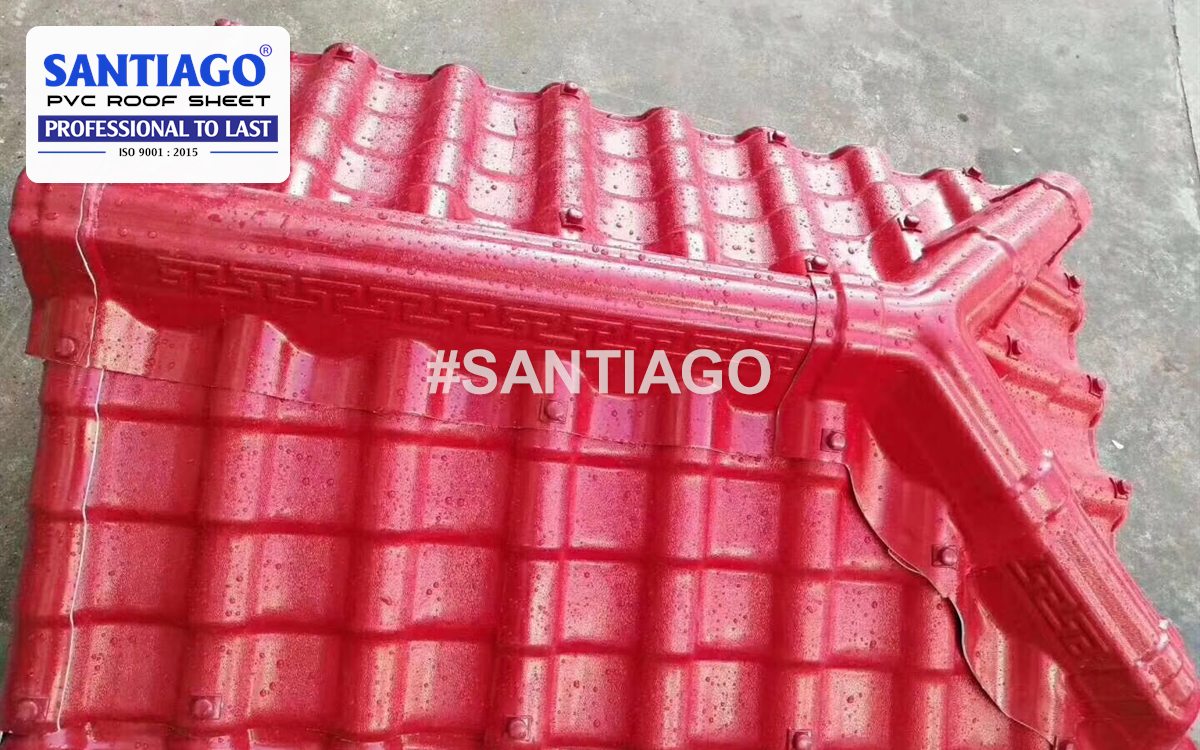
Red tile sheet with a ridge piece on top, Vietnam
How tough is a 2.5 mm sheet? The truck test
A Santiago delivery truck drives over a blue ASA/PVC tile sheet and a blue corrugated sheet laid on the factory yard in Vietnam. It is a demonstration only; on a roof the sheet still needs purlins less than 700 mm apart.
Truck test on Santiago ASA/PVC sheets (Santiago video on YouTube).
More short videos on sheet thickness
Two short clips in English, filmed by Santiago. Tap a video to play it here on the page.
How does a 2.5 mm sheet behave when bent by hand?
A 45-second factory short: beige and orange ASA/PVC sheets are flexed by hand and cut with shears to show how the material behaves. On a roof, purlins still go less than 700 mm apart.
Bending and cutting test on Santiago ASA/PVC sheets (Santiago video on YouTube).
Can a worker stand on a 2.5 mm tile sheet on the floor?
A short factory clip: a white tile sheet takes a worker's weight on the floor, a torch is aimed at red and blue sheets, and the Santiago team lines up in front of a container.
Santiago tile sheets at the factory (Santiago video on YouTube).
Santiago – a leading exporter of ASA/PVC roofing from Vietnam
Santiago roofing is produced and loaded into containers at our factory in Vietnam. It has been exported to India since 2023, Thailand since 2024 and the USA since 2025. Every export shipment comes with a commercial invoice, packing list, bill of lading and a certificate of origin (C/O) issued by Vietnam's Ministry of Industry and Trade, which importers use to claim the duty preference of their trade agreement.
| Item | Details |
|---|---|
| HS code | 3925.90.00 (ASA/PVC roofing sheets) |
| Certificate of origin | Form D (ASEAN), Form AI (India), Form AK / VK (Korea), Form AJ / VJ (Japan), Form VC (Chile), CPTPP proof of origin |
| Shipped from | Vietnam, by container |

Certificate of origin Form AI (ASEAN–India) for Santiago ASA/PVC roofing sheets, HS 39259000, certified on 24 September 2026. Buyer details are hidden.
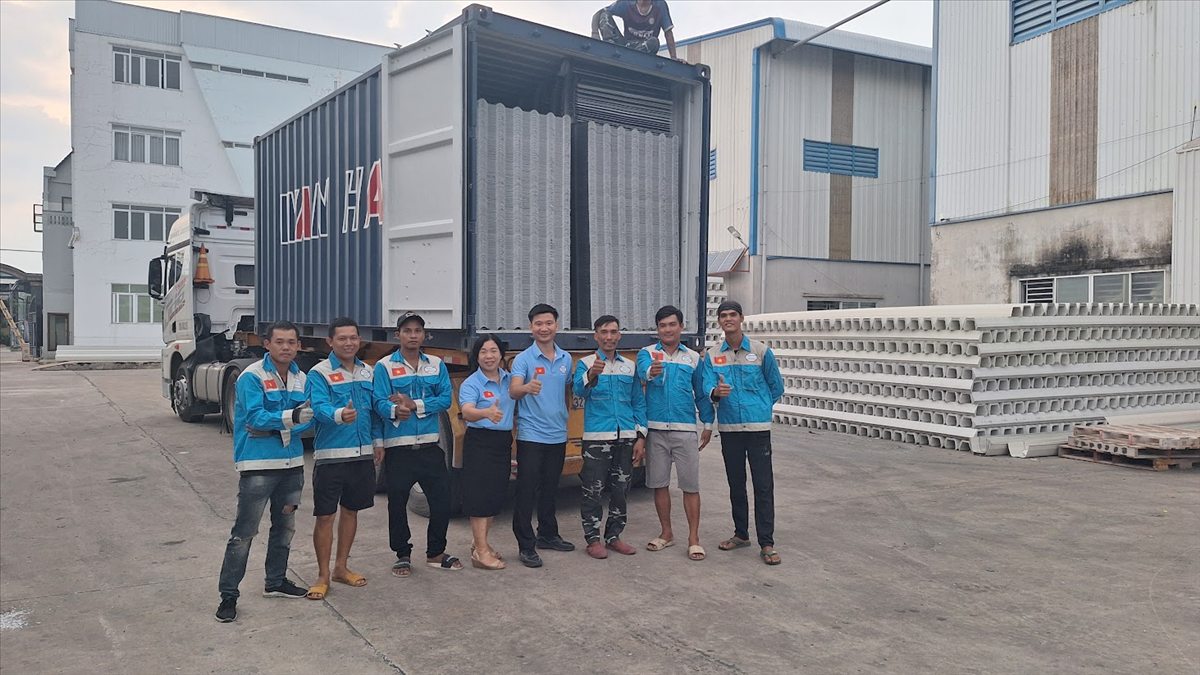
The Santiago team beside a loaded export container at the factory, November 2024
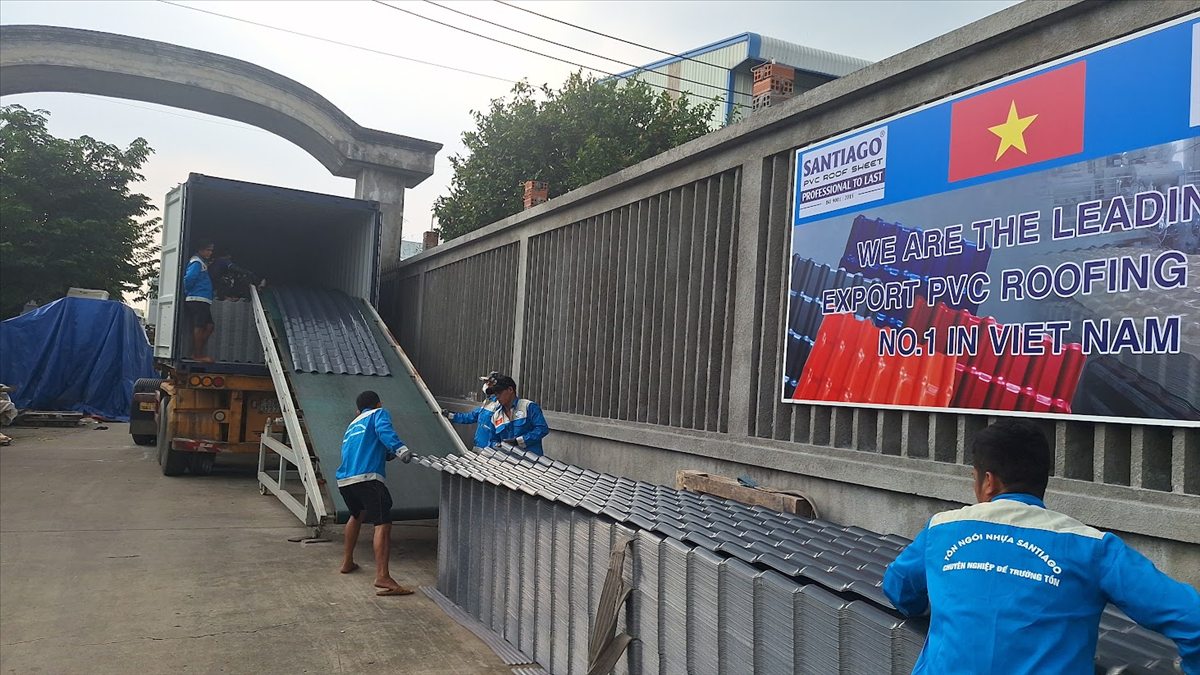
Loading Santiago roof tiles into an export container
Frequently asked questions
What is a 10 mm plastic roof sheet?
Usually a multiwall polycarbonate or twin-wall panel: thin walls joined by ribs with air cells between them. The 10 mm is the depth of the whole panel. Santiago does not make these panels.
Are 16 mm plastic roof sheets thicker than a 2.5 mm PVC sheet?
The figures measure different things. 16 mm is the overall depth of a hollow multiwall panel; 2.5 mm is the wall of a solid ASA/PVC sheet. Compare the use (light or shade) and the weight per m², not the listing number.
What thickness should a PVC roofing sheet be?
At least 2.5 mm for a roof. Santiago makes 2.5 and 3.0 mm sheets, and the 10-year warranty covers both when installed as Santiago recommends.
How do I check the thickness of a PVC roof sheet?
Measure the flat wall at a cut end with a caliper at several points and keep the smallest reading, then weigh a one-metre piece. A 2.5 mm Santiago tile sheet weighs about 5.2 kg per running metre.
Does Santiago make multiwall or twin-wall roofing panels?
No. Santiago makes solid ASA/PVC tile sheets, 5, 6 and 11-wave corrugated sheets, translucent skylight sheets and matching accessories.
Read more
- PVC roofing sheet thickness and weight: 2.5 or 3.0 mm
- PVC or polycarbonate roofing: which to use where
- Why the ASA surface layer matters on a PVC roof
- Skylight roofing sheets: which profile and how many
- ASA/PVC roof tile sheet
Read next on this topic
Main guide: UPVC Roofing Sheets Advantages and Disadvantages
Sources for the figures in this article
- Profiles, 2.5–3.0 mm thickness and 10-year warranty: Santiago ASA/PVC product specification.
- About 6–8 °C cooler than bare metal sheet and about 80% less rain noise: Santiago's own comparisons on finished roofs in Vietnam.
- HS code 3925.90.00: Harmonized System Chapter 39 (builders' ware of plastics), as applied in Vietnam's export tariff.
- Certificates of origin (Form D, AI, AK/VK, AJ/VJ, VC, CPTPP): issued by Vietnam's Ministry of Industry and Trade under the country's free trade agreements.
- Minimum order of one 40 ft container (about 5,000 m) and about 5 days for production and loading: Santiago export desk, October 2026.
Updated 03/11/2026. Santiago Import Export Co., Ltd, Vietnam. WhatsApp +84 935 391 495 (Mr. Quyen), hotline +84 965 437 316 (Mrs. Ly), email salessantiagoroofing@gmail.com.


