


Mr Quyen - Santiago. Posted 14/11/2026
A buyer choosing between UPVC roofing sheet companies in China and Vietnam should compare the same points with every supplier: measured thickness, the ASA surface layer, physical samples, quality papers, the certificate of origin your customs accepts, lead time, minimum order and how a container can be mixed. The country printed on the box tells you little about the sheet inside. Santiago, in Vietnam, makes 2.5 – 3.0 mm ASA/PVC sheets in about 5 days per order and ships by the 40 ft container, about 5,000 m.

Red tile sheet on the production line, Vietnam
Does it matter whether a UPVC roofing sheet comes from China or Vietnam?
For the sheet itself, what counts is how that factory makes it, and you find that out from samples, test papers and the first container, not from the country name. Buyers find PVC roofing sheet makers in both countries, and sheets differ from one factory to the next. We do not comment on other makers. This article lists what to check with any of them, and then gives Santiago's own answers so you can put them beside the others.
Country of origin does matter in three practical ways: the certificate of origin and the duty your customs applies, the time the goods spend at sea, and how easy it is to reach the people who made your order when something needs checking.
What should you compare with any UPVC roofing sheet manufacturer?
| Point | What to ask or check | Santiago's answer |
|---|---|---|
| 1. Thickness | Thickness written on every quotation line; caliper on the sample | 2.5 and 3.0 mm; 2.5 mm minimum for roofs |
| 2. Surface layer | Is there an ASA (or similar) UV layer, and how thick a part of the sheet is it | ASA top layer on a four-layer co-extruded sheet, no glue |
| 3. Material | Virgin or recycled PVC | Virgin material, not recycled |
| 4. Test data | UV ageing hours, bending strength, who tested | No colour change after 2,000 hours artificial UV; bending strength above 1,000 N; Quatest results |
| 5. Quality system | Certificate number you can verify | ISO 9001:2015, certificate ICI-23087.D; a quality certificate (CQ) with every lot |
| 6. Warranty | In writing, with conditions | 10 years for 2.5 mm and thicker, installed as Santiago recommends |
| 7. Samples | Physical pieces of each profile and colour | Free; the buyer pays the courier |
| 8. Origin document | The form your customs accepts for a lower duty, if any | Form D, Form AI, CPTPP proof of origin, Form VC (see below) |
| 9. Lead time | When the clock starts and what delays it | Production about 5 days after the order is confirmed |
| 10. Minimum order and mixing | Container size, mixing of colours, profiles and accessories | One 40 ft container, about 5,000 m, colours, profiles and accessories mixed |
Ask the same ten questions in writing to every supplier on your list and keep the answers in one sheet. Gaps show up quickly: a missing thickness, a warranty promised only in a chat, a test with no named laboratory.
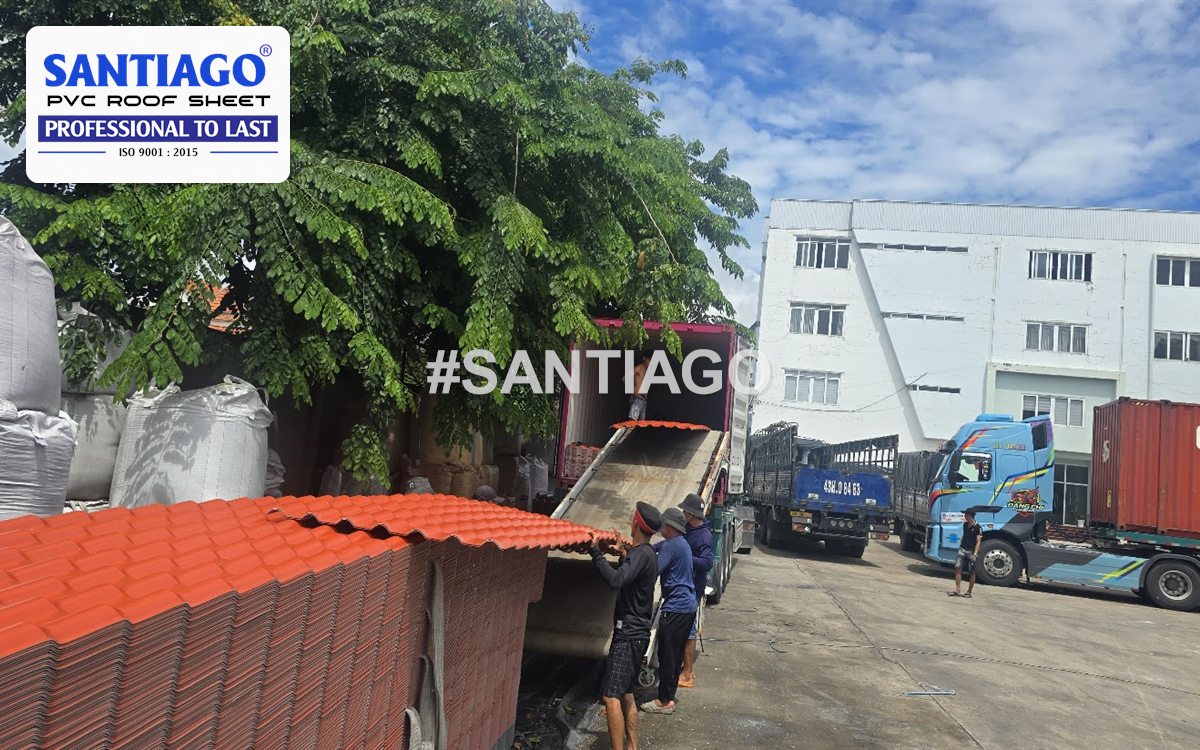
Workers unloading orange tile sheets from a truck in the factory yard, Vietnam
How do certificates of origin change the comparison?
The duty you pay depends on the trade agreements between your country and the country of origin, and on the HS code. Santiago ships under HS code 3925.90.00. From Vietnam, these documents can support a preference:
| Your market | Document Santiago issues |
|---|---|
| ASEAN countries, such as Thailand and Laos | Form D |
| India | Form AI |
| CPTPP members (12 countries including Vietnam), such as Mexico, Peru and Chile | CPTPP proof of origin |
| Chile | Form VC, or CPTPP proof of origin |
| USA, Venezuela | No FTA preference with Vietnam |
For goods from any other origin, ask your customs broker which agreements apply. We give no duty rates: the rate for your shipment is confirmed by your broker, and a document only helps if the goods meet that agreement's rules.
Lead time, minimum order and mixed containers
Santiago produces an order in about 5 days once it is confirmed, then loads it; sea transit depends on your port and the shipping line, so ask your forwarder. Standard colours (dark grey, red, blue, orange, chocolate) and made-to-order colours (green, white, purple) can share a container with tile sheets, 5, 6 and 11-wave sheets, skylight sheets and all accessories. When comparing suppliers, ask each one the same thing: does the lead time start at the order, at the deposit or at colour approval?
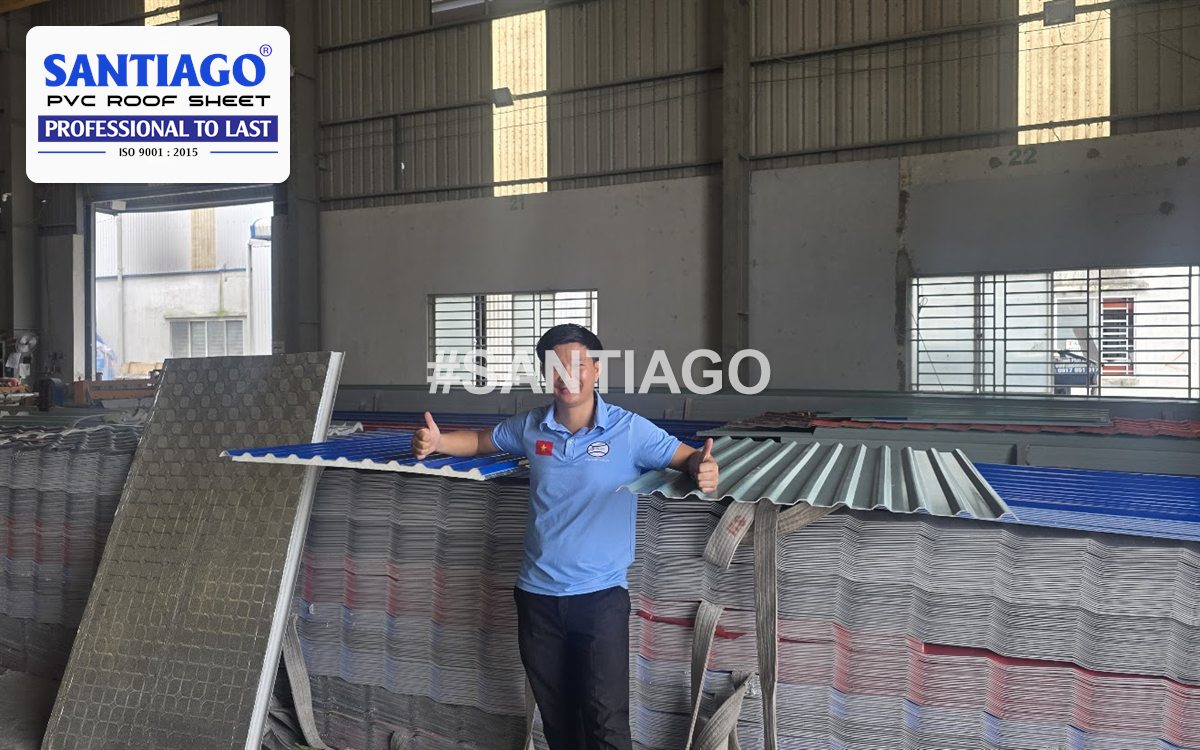
A Santiago staff member in the factory warehouse beside stacks of tile and corrugated sheets, Vietnam
How should you compare samples from two suppliers side by side?
- Measure the flat wall of each sample with a caliper at several points and note the smallest reading.
- Weigh a one-metre piece of each; a 2.5 mm Santiago tile sheet weighs about 5.2 kg per running metre.
- Look at the cut edge for the separate surface layer.
- Put the samples next to each other outdoors in daylight, not on a screen.
- Ask both suppliers for the test reports behind their UV and strength figures, in writing.
What do importers usually ask Santiago first?
Whether Santiago already ships to markets like theirs: it has exported to India since 2023, to Thailand since 2024 and to the USA since 2025. Whether it installs: no, Santiago supplies sheets and accessories and sends installation videos for the buyer's installers. And how the roof should be fixed: purlins less than 700 mm apart, slope 20 – 45%, 70 mm screws with ASA caps through the top of the wave at 4 – 5 sets per m². Prices are quoted per order in writing.
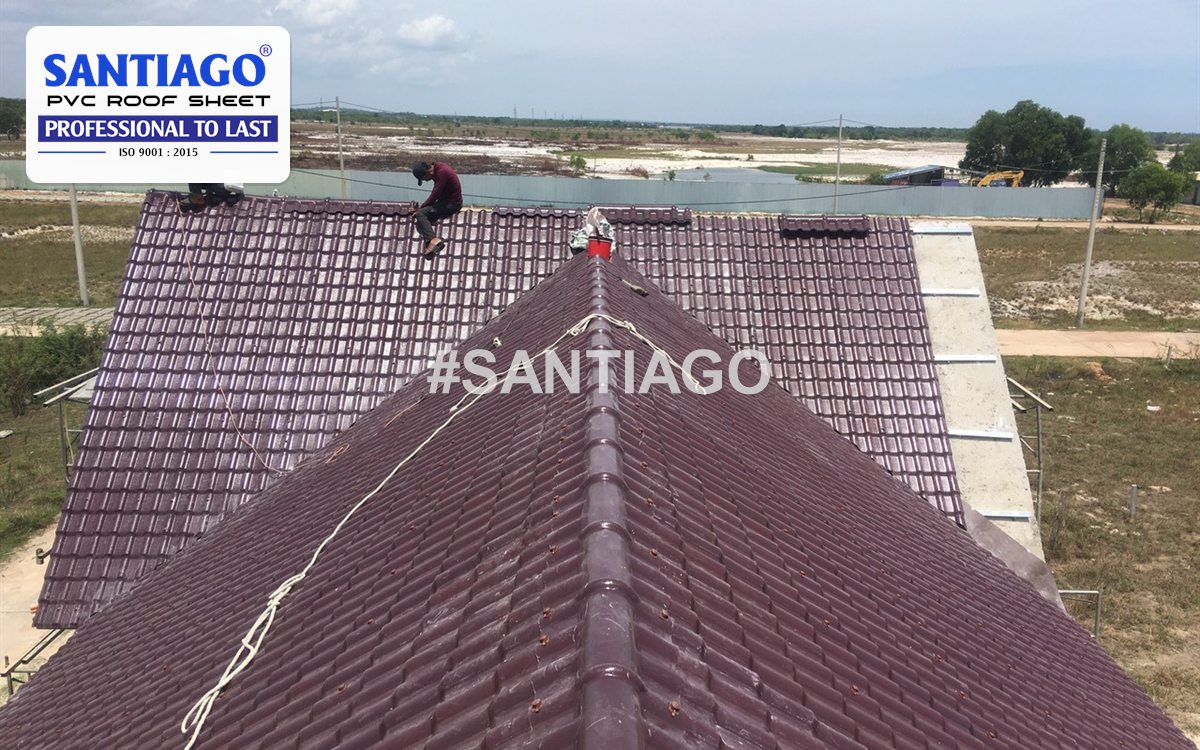
Installers laying a purple tile-sheet roof, Vietnam
What does a Vietnamese roofing factory show a buyer, from stock to roof?
Mr Quyen stands among stacks of brown tile sheets in the Santiago factory, then walks with a colleague along a finished grey tile roof near the gutter. Installers carry a grey tile sheet into place, and the WhatsApp number is shown at the end.
Santiago uPVC tile sheets from the factory to the roof (Santiago video on YouTube).
More short videos from a Vietnamese factory
Both clips below come from Santiago's own YouTube channel and were filmed at the factory in Vietnam or on Santiago roofs.
What does the extrusion line look like?
A 14-second clip from the Santiago factory: a long white corrugated ASA/PVC sheet moves along the extrusion line.
A Santiago ASA/PVC sheet on the extrusion line (Santiago video on YouTube).
How is a container loaded at a Vietnamese factory?
This one-minute short is the loading process for an export order: orange sheets go down a ramp into the container and the crew stacks them inside, with Mr Quyen explaining in English.
Loading PVC roof tiles into an export container (Santiago video on YouTube).
Santiago – a leading exporter of ASA/PVC roofing from Vietnam
Santiago roofing is produced and loaded into containers at our factory in Vietnam. It has been exported to India since 2023, Thailand since 2024 and the USA since 2025. Every export shipment comes with a commercial invoice, packing list, bill of lading and a certificate of origin (C/O) issued by Vietnam's Ministry of Industry and Trade, which importers use to claim the duty preference of their trade agreement.
| Item | Details |
|---|---|
| HS code | 3925.90.00 (ASA/PVC roofing sheets) |
| Certificate of origin | Form D (ASEAN), Form AI (India), Form AK / VK (Korea), Form AJ / VJ (Japan), Form VC (Chile), CPTPP proof of origin |
| Shipped from | Vietnam, by container |
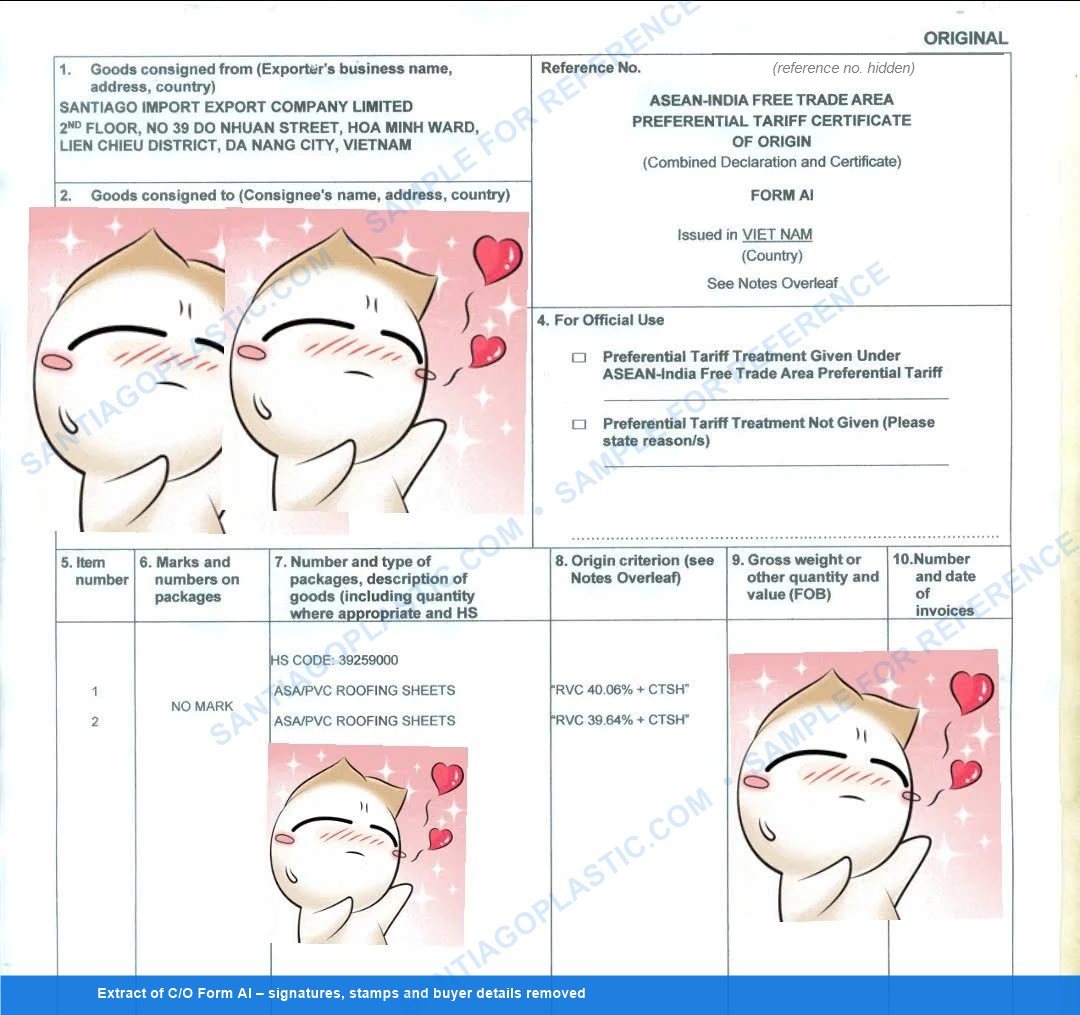
Certificate of origin Form AI (ASEAN–India) for Santiago ASA/PVC roofing sheets, HS 39259000, certified on 24 September 2026. Buyer details are hidden.
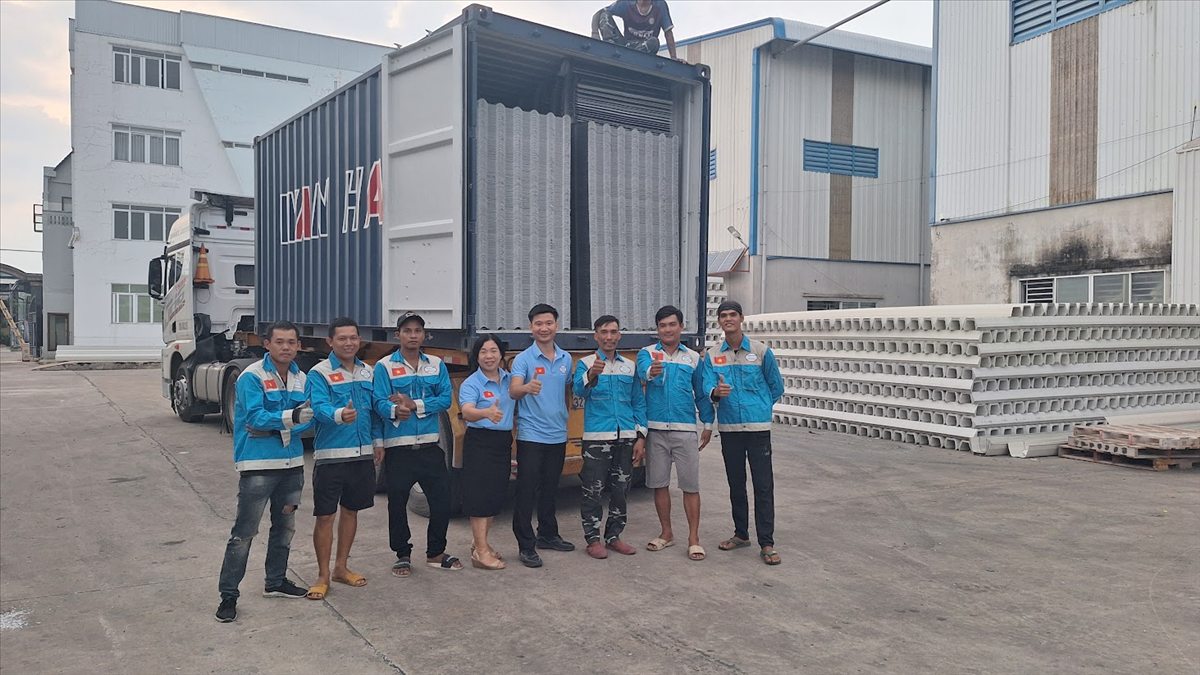
The Santiago team beside a loaded export container at the factory, November 2024
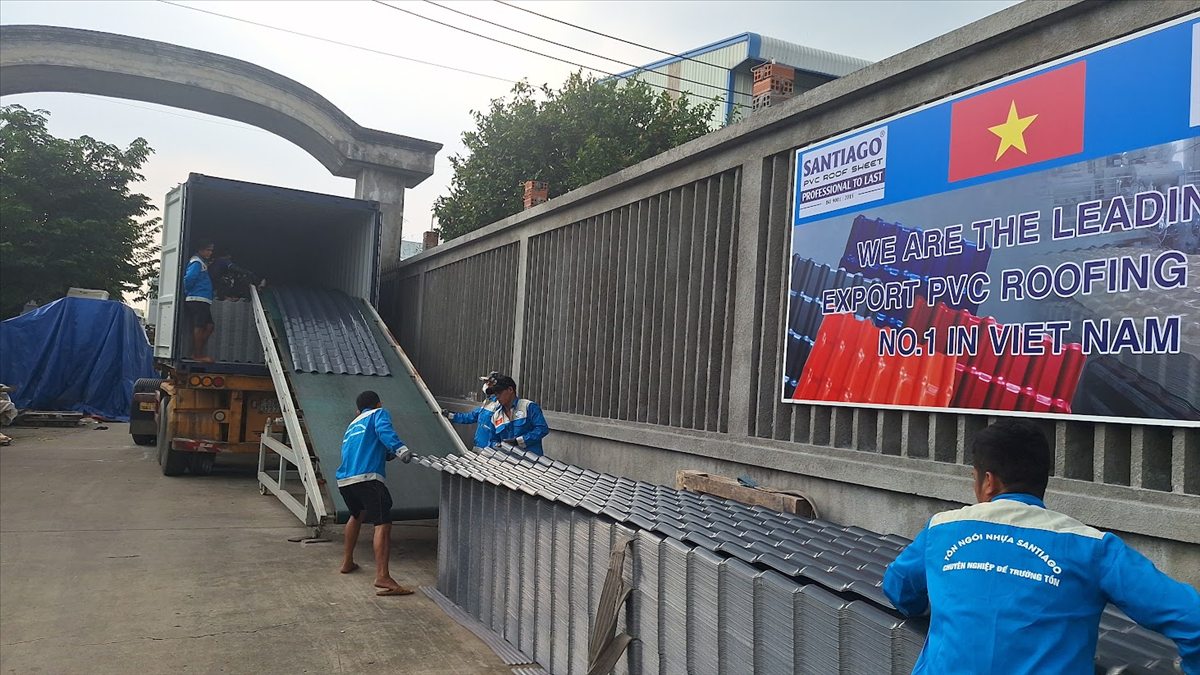
Loading Santiago roof tiles into an export container
Frequently asked questions
Should I buy UPVC roofing sheets from China or Vietnam?
Compare suppliers, not countries: thickness, ASA layer, samples, test papers, warranty, origin document, lead time and minimum order. Your customs broker tells you which origin gives your market a lower duty.
Which certificate of origin does Santiago issue?
Form D for ASEAN, Form AI for India, CPTPP proof of origin for CPTPP members such as Mexico, Peru and Chile, and Form VC for Chile. The USA and Venezuela have no FTA preference with Vietnam.
What is Santiago's minimum order and lead time?
One 40 ft container, about 5,000 m of sheet, with colours, profiles and accessories mixed. Production takes about 5 days after the order is confirmed.
Is Santiago a UPVC roofing sheet manufacturer?
Yes. Santiago makes its ASA/PVC tile sheets, corrugated sheets and accessories in Vietnam and works under ISO 9001:2015, certificate ICI-23087.D.
Can I get samples before ordering a container?
Yes. Samples are free; the buyer pays the courier.
Read more
- How to choose a PVC roofing sheet supplier
- Santiago export markets and certificates of origin
- Quotes, samples and OEM orders from Santiago
- How Santiago loads an export container
- ASA/PVC roof tile sheet
Read next on this topic
Main guide: How to Choose a PVC Roofing Sheet Supplier
Sources for the figures in this article
- Profiles, 2.5–3.0 mm thickness and 10-year warranty: Santiago ASA/PVC product specification.
- HS code 3925.90.00: Harmonized System Chapter 39 (builders' ware of plastics), as applied in Vietnam's export tariff.
- Certificates of origin (Form D, AI, AK/VK, AJ/VJ, VC, CPTPP): issued by Vietnam's Ministry of Industry and Trade under the country's free trade agreements.
- Minimum order of one 40 ft container (about 5,000 m) and about 5 days for production and loading: Santiago export desk, October 2026.
Updated 03/11/2026. Santiago Import Export Co., Ltd, Vietnam. WhatsApp +84 935 391 495 (Mr. Quyen), hotline +84 965 437 316 (Mrs. Ly), email salessantiagoroofing@gmail.com.


