


Mr Quyen - Santiago. Posted 14/11/2026
An anti-corrosion roofing sheet is one the air in and around the building cannot rust or eat away. Santiago's ASA/PVC sheets contain no metal, so they do not rust in salt air, fertiliser dust or the damp of a livestock house. For chemical plants and other aggressive sites, send Santiago the list of chemicals and gases first, because the screws and the frame under the roof matter as much as the sheet.

Aerial view of a warehouse with a green corrugated roof, Vietnam
What makes a roofing sheet anti-corrosion?
Rust needs iron, water and oxygen. A coated steel sheet resists it for as long as its zinc or zinc-aluminium coating and paint stay whole. A plastic sheet has no iron to begin with. Santiago's sheets are four co-extruded layers with no glue between them: an ASA top layer, virgin PVC, a PVC core and a milky-white PVC base. Nothing in them can rust, and the ASA top layer protects the colour from the sun: no colour change after 2,000 hours of artificial UV in Santiago's test.
"Rust proof roofing sheets" and "anti rust roofing sheet" are what most buyers type, but rust is only one kind of corrosion. Acid fumes, salt and alkaline dust attack materials in different ways. That is why, for a chemical plant, Santiago asks for the list of substances instead of promising resistance to all of them.
Is corrugated metal rust proof?
Not completely. Galvanised and aluminium-zinc coatings protect steel well in a dry, clean building, and plenty of metal roofs give years of service there. Problems start where the coating is broken or where water and salt sit for long periods. The table shows where a roof usually starts to corrode, and what changes when the sheet is ASA/PVC.
| Where corrosion starts | Coated metal sheet | ASA/PVC sheet |
|---|---|---|
| Cut ends and edges | Bare steel is exposed when the sheet is cut | No metal; the cut edge is plastic all through |
| Scratches from installation, tools or hail | Coating broken; rust can creep under the paint | Surface marked, nothing to rust |
| Screw holes | Steel around the hole is exposed | No metal in the sheet; the screw head sits under an ASA cap |
| Side and end laps | Damp and salt stay trapped between the sheets | Nothing in the lap can rust |
| Screws and washers | Metal | Still metal: keep every ASA cap in place |
| Purlins and frame | Same air as the sheet | Same air as the sheet: protect them separately |
The last two rows are the honest part. A plastic sheet takes rust out of the roof skin, not out of the whole roof. The screws, purlins and brackets under it breathe the same air.
Which buildings need an anti-corrosion roofing sheet?
| Building | What attacks the roof | What to tell the supplier |
|---|---|---|
| Fertiliser and chemical stores | Dust and fumes from the stored products | What is stored and how it is packed |
| Chemical, plating and processing plants | Acid or alkaline fumes, vapour from tanks | The full chemical and gas list, and where vents and stacks are |
| Poultry and pig houses, dairy sheds | Ammonia from manure, damp, wash-down water | Type of animals, ventilation, how the house is cleaned |
| Coastal buildings | Salt spray and salty wind | Distance from the sea and the usual wind direction |
| Salt, fish and seafood stores | Salt and brine | What is stored and whether floors are washed down |
| Wastewater and water treatment sites | Gases from open tanks, constant damp | The gas list and the roof height above the tanks |
For any of these buildings, send the list before you ask for a quotation. Santiago does not publish a chemical-resistance table and will not guess one; a written answer for your own site is worth more than a general claim.
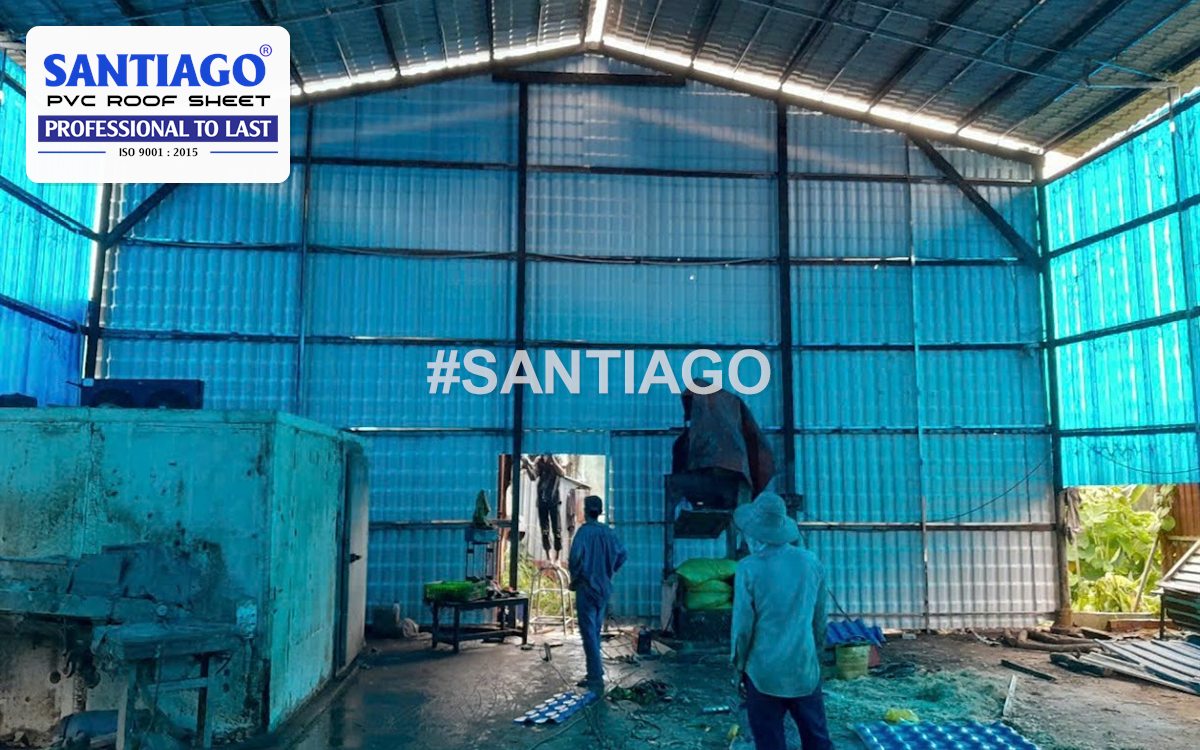
Blue sheet walls inside a workshop, Vietnam
What should I send Santiago before ordering for a chemical plant?
- The chemicals and gases present in the building, using the names on your safety data sheets.
- Where they come from: open tanks, vents, stacks or stored bags.
- How hot the air under the roof gets, and whether steam or hot vapour reaches the roof.
- How the building is cleaned: dry, washed down with water, or with cleaning chemicals.
- Distance from the sea, if the site is near the coast.
- Photos of the current roof, especially the places that corroded first.
- A roof drawing with spans, slopes and purlin spacing.
Santiago supplies the sheets and accessories and sends installation videos; it does not install. Samples are free (the buyer pays the courier), so you can place a piece inside the building and watch it before committing to a whole roof.
Which profile suits a factory or warehouse roof?
| Profile | Full / cover width | Wave height or tile step | Weight at 2.5 mm |
|---|---|---|---|
| 5-wave sheet | 1.08 / 1.00 m | 32 mm | About 5.2 kg per running metre |
| 6-wave sheet | 1.06 / 0.95 m | 34 mm | About 5.2 kg per running metre |
| 11-wave sheet | 1.05 / 1.00 m | 20 mm | About 5.2 kg per running metre |
| Tile sheet | 1.05 / 0.96 m | 219 mm tile step | About 5.4 kg per m² of roof |
Sheets come in 2.5 and 3.0 mm, and 2.5 mm is the minimum for a roof. Every sheet is cut to the length on the order, so a factory slope can be covered from eave to ridge with as few end laps as possible, which also means fewer places where damp can sit.
Skylight sheets let through 80 – 90% of light and are usually laid on 5 – 10% of the roof area. The same sheets can also clad walls, as the photos from Vietnam show, which keeps the wall and the roof in one material.
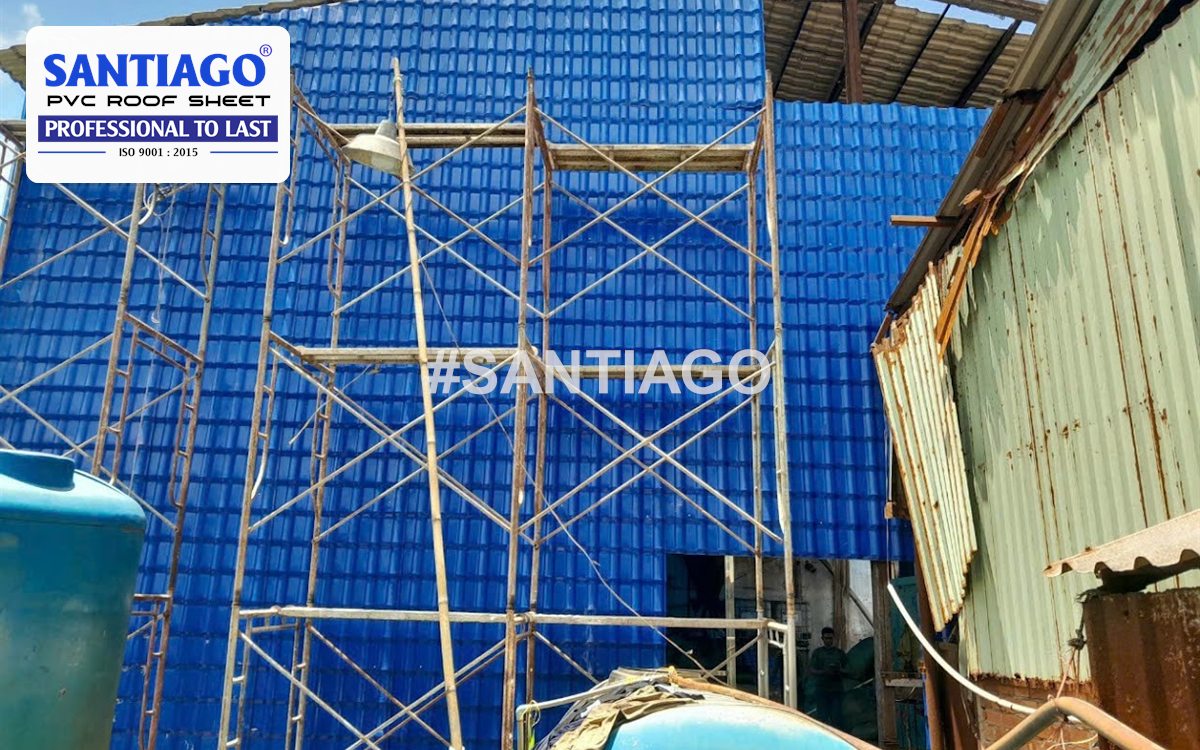
A wall clad in blue tile sheets with scaffolding in front, Vietnam
What about the screws, purlins and frame?
Santiago's fixing method keeps metal out of the wet as far as it can. Each sheet is screwed through the top of the wave over a purlin, never in the valley where water runs, with 70 mm screws in pre-drilled 6 mm holes and an ASA cap over every screw head. Plan 4 – 5 screw sets per m². A missing cap leaves a screw head open to the air, so replace any that are lost during maintenance.
Purlins must be less than 700 mm apart, 440 or 660 mm for the tile sheet. If they are steel, give them a coating that suits the site and check them at every inspection, because a rusted purlin stops holding the screws long before the sheet wears out. The FRP purlin article linked below describes a frame with no steel in it.
What can a buyer check before shipment?
Every lot ships with a quality certificate (CQ). The factory works under ISO 9001:2015 certificate ICI-23087.D, and Quatest test results are available on request. Real service life is 25 – 30 years, and the warranty is 10 years for sheets 2.5 mm and thicker installed as Santiago recommends. The minimum export order is one 40 ft container, about 5,000 m of sheet, with profiles, colours and accessories mixed, and production takes about 5 days.

Blue corrugated roof with a ridge vent, Vietnam
Where do corrosion-resistant roofing sheets come from?
Mr Quyen walks through the Santiago factory in Vietnam and explains it in English: roof tiles and ridge pieces in the yard, a green 5-wave sheet coming off the line, a delivery truck, and the warehouses where a container is being loaded.
Inside the Santiago ASA/PVC roofing factory in Vietnam (Santiago video on YouTube).
More short videos on industrial roofs
Two short clips in English, filmed by Santiago. Tap a video to play it here on the page.
What does a warehouse re-roof with blue sheets look like?
The short follows Santiago sheets from real roofs back to the factory: red tile sheets on a house, a quick flame test on the stack, a blue warehouse roof being fitted and grey sheets on the roller line.
Santiago PVC roofing tiles in real conditions (Santiago video on YouTube).
How is a long corrugated sheet made?
A 14-second look at the Santiago line, where a long white corrugated sheet comes off the extruder.
A Santiago ASA/PVC sheet on the extrusion line (Santiago video on YouTube).
Santiago – a leading exporter of ASA/PVC roofing from Vietnam
Santiago roofing is produced and loaded into containers at our factory in Vietnam. It has been exported to India since 2023, Thailand since 2024 and the USA since 2025. Every export shipment comes with a commercial invoice, packing list, bill of lading and a certificate of origin (C/O) issued by Vietnam's Ministry of Industry and Trade, which importers use to claim the duty preference of their trade agreement.
| Item | Details |
|---|---|
| HS code | 3925.90.00 (ASA/PVC roofing sheets) |
| Certificate of origin | Form D (ASEAN), Form AI (India), Form AK / VK (Korea), Form AJ / VJ (Japan), Form VC (Chile), CPTPP proof of origin |
| Shipped from | Vietnam, by container |
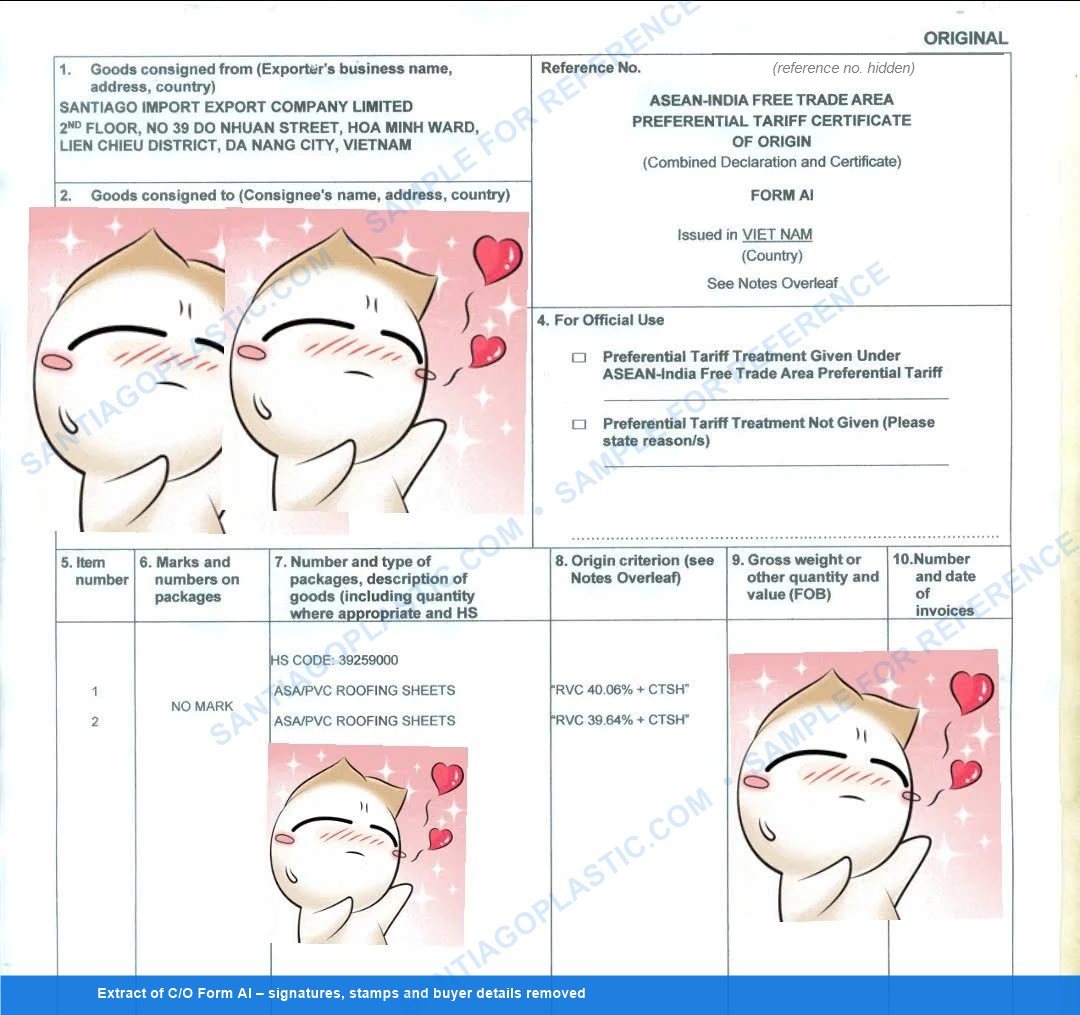
Certificate of origin Form AI (ASEAN–India) for Santiago ASA/PVC roofing sheets, HS 39259000, certified on 24 September 2026. Buyer details are hidden.
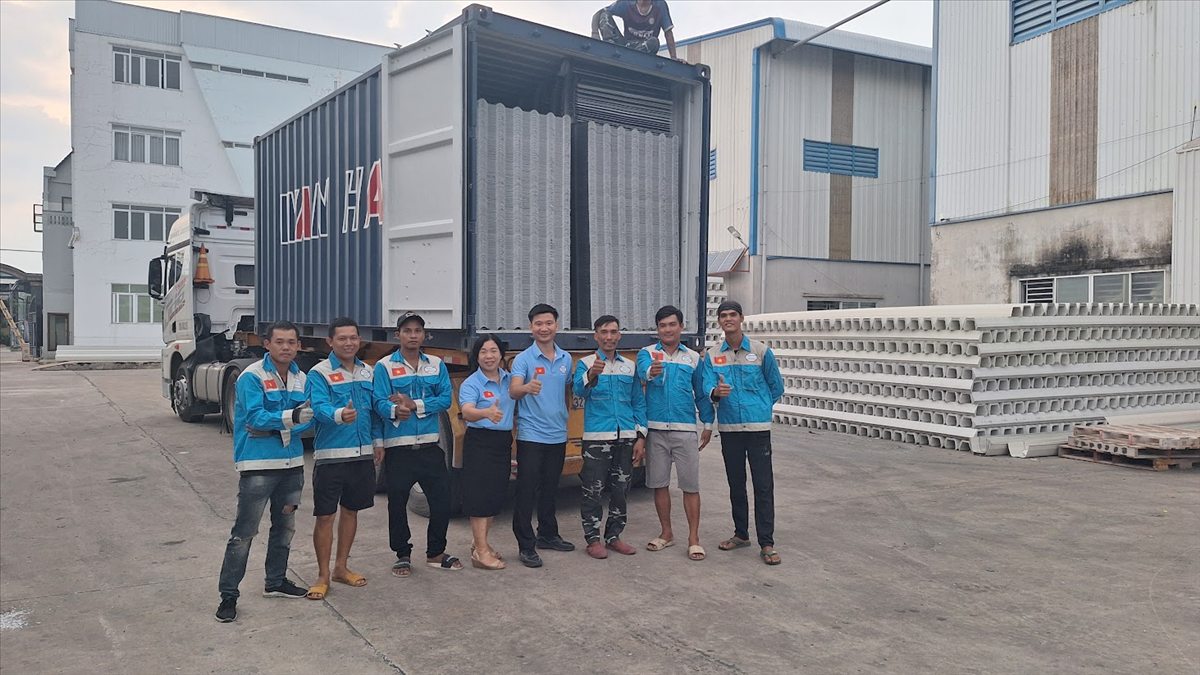
The Santiago team beside a loaded export container at the factory, November 2024
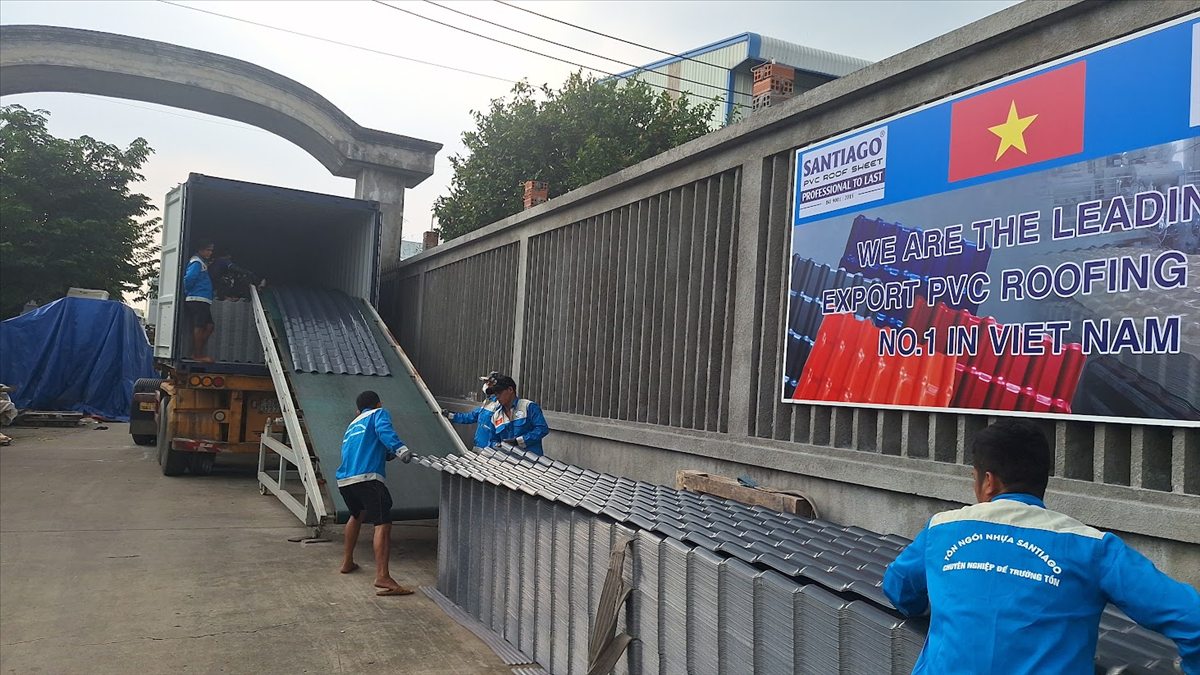
Loading Santiago roof tiles into an export container
Frequently asked questions
What is an anti corrosion roofing sheet?
A sheet that does not rust or break down in the air around the building. Santiago's ASA/PVC sheets contain no metal, so they cannot rust in salt air, fertiliser dust or livestock houses.
Are PVC roofing sheets rust proof?
The sheet is: there is no metal in it. The screws and any steel purlins are still metal, so keep an ASA cap on every screw and protect the frame to suit the site.
Is corrugated metal rust proof?
Not completely. The coating protects the steel until it is cut, scratched or drilled, and rust usually starts at cut edges, screw holes and laps where salt and damp sit.
Can ASA/PVC sheets be used in a chemical factory?
Send Santiago the list of chemicals and gases in the building first. Santiago answers for your site in writing; it does not publish a general chemical-resistance table.
Do I still need to protect the purlins under a plastic roof?
Yes. Steel purlins sit in the same air as the roof and need a coating that suits the site, or a non-steel frame.
Read more
- What Santiago's heat, noise and corrosion tests show
- A rust-free roof from sheet to frame: ASA/PVC on FRP purlins
- Rust-free roofs for fertiliser and rice stores
- Roofs for poultry houses and piggeries
- ASA/PVC roofing sheet, 5 square waves
Read next on this topic
All articles in this topic: farms, factories and stores.
- Poultry Shed Roofing, Guatemala | Techo de Galera
- Shed Roofing NZ: Plastic Roofing for Barns and Stables
- Shed Roofing Sheets Australia: Farm Sheds, No Rust
- Poultry House Roofing Uganda, Tanzania | Banda la kuku
- Flower Farm Shed Roof | Techo invernadero y poscosecha
- Corrugated Roofing for Chicken Coops and Poultry Houses
- Poultry House and Piggery Roofing in the Philippines
- Rust-Free Roofs for Fertiliser and Rice Stores in Laos
- Poultry and Pig Farm Roofs in Laos: Rust-Free Options
- Coffee Drying and Storage Roofs on the Bolaven Plateau
In other languages:
- Telha de PVC para aviários e pocilgas
- Teja de PVC para galpones avícolas en Argentina
- Techo para galpones en el sur de Chile: lluvia y humedad
- Teja de PVC para camaroneras y bodegas en la Costa
- Techo para galpones avícolas y porcícolas sin óxido
- 축사 지붕재|암모니아에 녹슬지 않는 지붕
- 牛舎・豚舎・鶏舎の屋根材|アンモニアで錆びない
- Atap Tahan Asam untuk Kandang Ayam dan Pabrik Pupuk
Sources for the figures in this article
- Profiles, 2.5–3.0 mm thickness and 10-year warranty: Santiago ASA/PVC product specification.
- HS code 3925.90.00: Harmonized System Chapter 39 (builders' ware of plastics), as applied in Vietnam's export tariff.
- Certificates of origin (Form D, AI, AK/VK, AJ/VJ, VC, CPTPP): issued by Vietnam's Ministry of Industry and Trade under the country's free trade agreements.
- Minimum order of one 40 ft container (about 5,000 m) and about 5 days for production and loading: Santiago export desk, October 2026.
Updated 03/11/2026. Santiago Import Export Co., Ltd, Vietnam. WhatsApp +84 935 391 495 (Mr. Quyen), hotline +84 965 437 316 (Mrs. Ly), email salessantiagoroofing@gmail.com.


