


Mr Quyen - Santiago. Posted 21/11/2026
Under a sheet roof in a hot climate, a radiant barrier with an air gap blocks radiant heat, while mineral wool or foam slows heat that is conducted through. University of Florida extension guidance puts a radiant barrier's cut in ceiling heat flow at roughly 30 – 50%. Combine insulation with a cooler roof covering and a ventilated roof space, and follow local fire rules for foam.
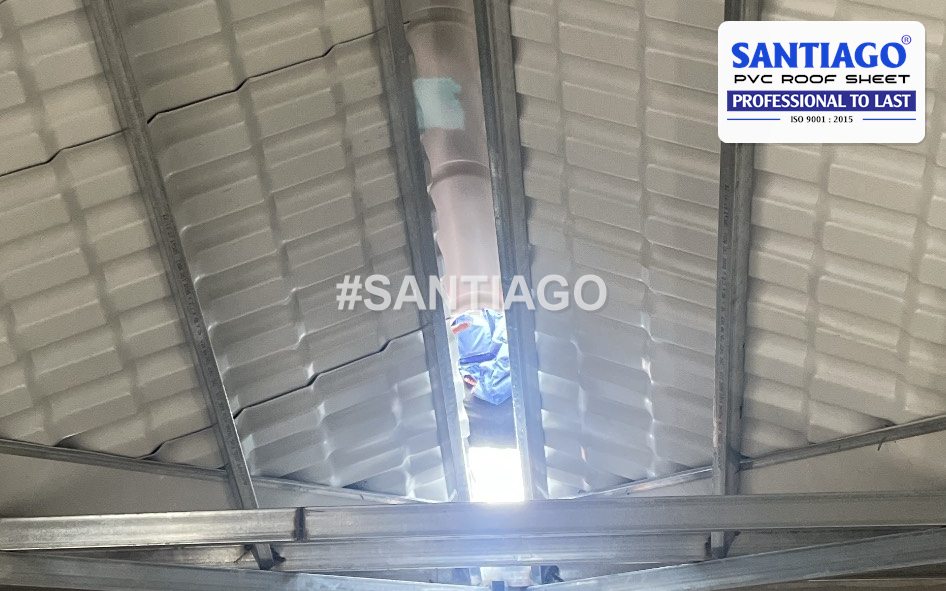
Underside of a tile-sheet roof on steel purlins with daylight at the ridge, Vietnam
Why insulate under a roofing sheet?
A single sheet is a thin layer between the sun and the room. In the afternoon its underside radiates heat downward, and at night it can cool below the dew point and drip. Insulation slows both. It also softens rain noise and, with a ceiling, hides purlins and fixings.
Heat moves through a roof in three ways: radiation from the hot underside, conduction through solid materials, and convection in the air of the roof space. Each type of insulation tackles mainly one of them, which is why they are often combined.
How does a radiant barrier work?
A radiant barrier is a sheet with a shiny aluminium face, often foil laminated to paper or a woven film. It works by reflecting radiant heat and by giving off very little of its own, so it needs an air gap on its shiny side to do anything. Laid tight against the roof sheet with no gap, it mostly conducts heat through.
University of Florida extension guidance reports that roof radiant barriers can cut heat flow through the ceiling by about 30 – 50% and save around 7 – 10% of yearly cooling electricity in the US Southeast. Dust settling on an upward-facing foil reduces its effect, so foil fixed under the purlins with the shiny face down keeps working longer.
A cooler roof covering reduces what a radiant barrier can add. Research summarised from the Florida Solar Energy Center found that white tile or white metal roofs could outperform a dark shingle roof with a radiant barrier underneath.
Which insulation type should I use under a sheet roof?
| Type | How it works | Where it goes | Points to know |
|---|---|---|---|
| Radiant barrier foil | Reflects radiant heat across an air gap | Under the purlins or rafters, shiny side facing an air space | Needs the gap; dust lowers performance on upward faces |
| Mineral or glass wool | Traps air to slow conducted heat | On a ceiling or between rafters, kept dry | Must stay dry; needs a ceiling or netting to hold it |
| Rigid foam board (EPS, XPS, PIR) | Closed cells slow conducted heat | On a ceiling or fixed to the frame | Check its fire classification and local code |
| Spray foam | Sprayed onto the underside or deck | Fills gaps and adds stiffness | Applied by specialists; fire rules and vapour control apply |
| Ceiling with a ventilated roof space | Keeps the hot air layer away from the room | Below the roof structure | Often the most effective single step with ventilation |
Check the declared thermal performance (R-value, or lambda and thickness) on each product, and compare like with like. Insulation only works where it is continuous; gaps around purlins and walls let heat around it.
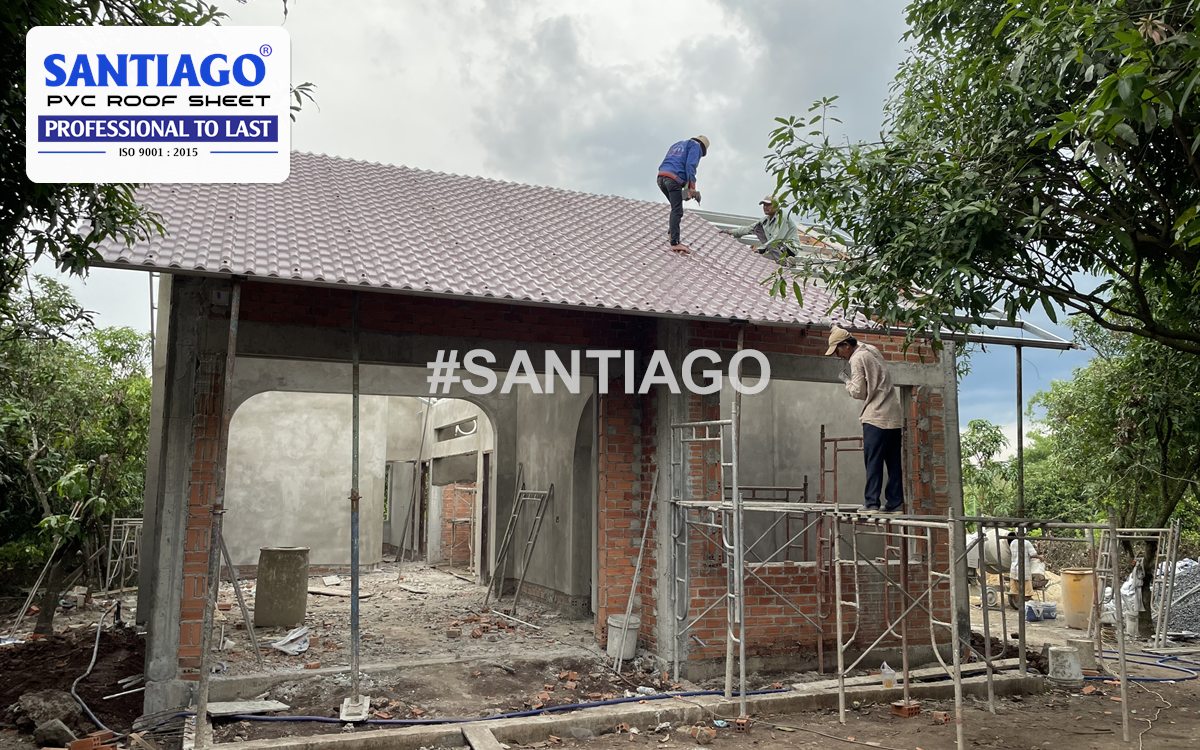
House under construction with installers fixing a tile-sheet roof, Vietnam
Does insulation stop condensation under a roof sheet?
It helps only when it is detailed well. Condensation forms when warm, humid air meets a surface colder than its dew point. Insulation that keeps the room air away from the cold sheet stops drips, but humid air that leaks behind it can condense out of sight and soak the insulation. In a hot, humid climate, keep indoor moisture out of the roof space, ventilate the space above the insulation and ask your builder which side, if any, needs a vapour control layer. Our anti-condensation guide covers the details for open sheds and workshops.
What about fire safety?
Foams and some facings burn, and many building codes limit which insulation may be left exposed inside a building. Ask for the fire classification of every layer under your local standard, and follow the fire code for the building type. A factory, school or shop usually has stricter rules than a house or shed.
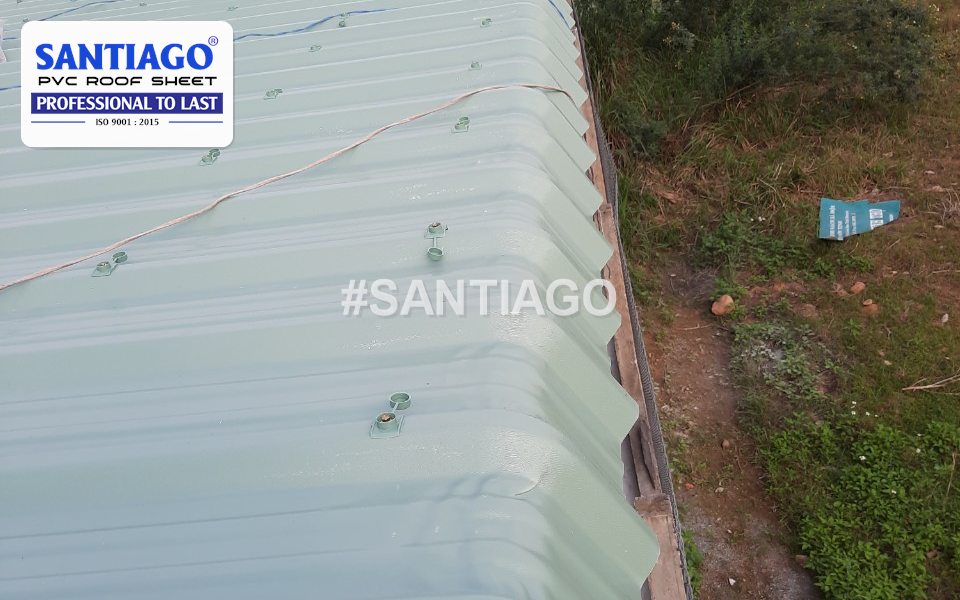
Pale corrugated sheets with screw caps on a roof, seen from above, Vietnam
Can insulation be added under an ASA/PVC roof?
Yes, by your builder, usually as a ceiling with insulation on it or as foil and wool fixed to the frame below the purlins. Keep the sheet free to move with heat: do not glue foam or foil to the underside, and do not block the 6 mm pre-drilled screw holes that let the sheet expand.
The sheet itself already helps. Santiago's tests show 6 – 8 °C lower temperature under the roof than bare metal sheet and about 80% less rain noise, and the milky-white underside reflects light into the room. Santiago does not supply foam or insulation, so ask your local insulation supplier, and send Santiago your roof drawing if you want to check purlin spacing for a ceiling.
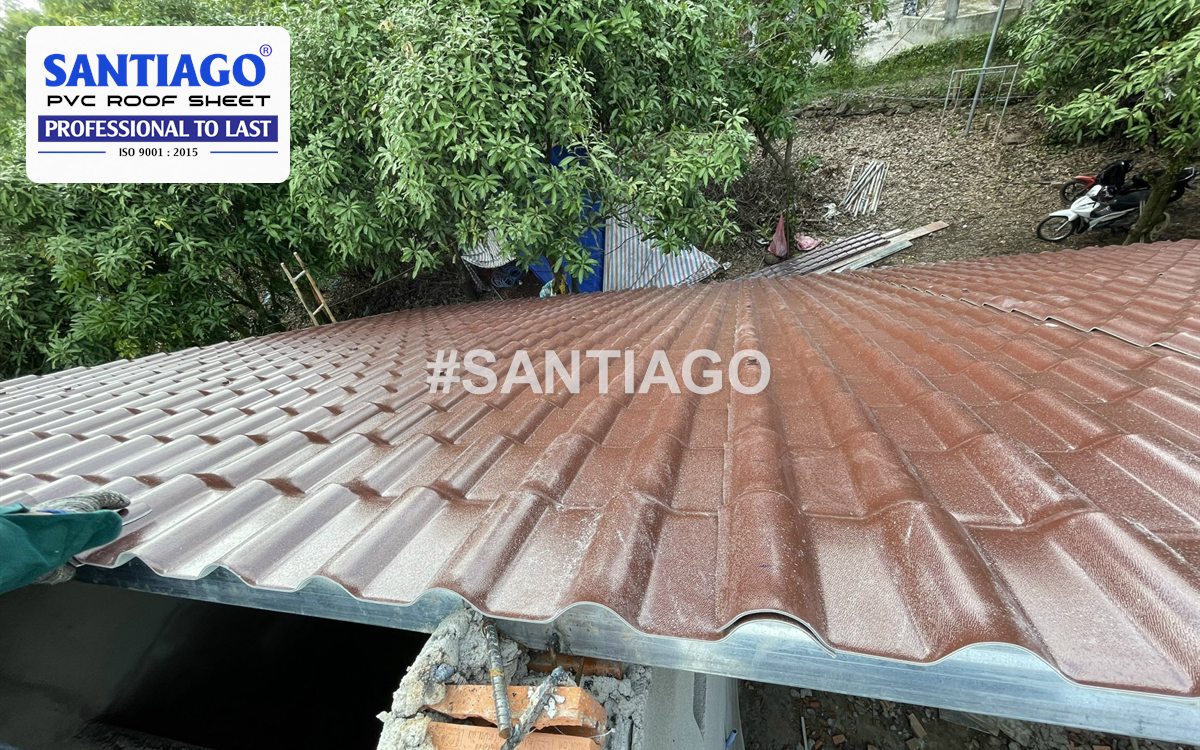
Close view of a brown tile-sheet roof edge above a wall, Vietnam
Can a foam layer go under an ASA/uPVC roofing sheet?
A 48-second short from the Santiago channel that answers a question buyers often ask: whether a foam layer can be added under an ASA/uPVC roofing sheet.
Foam under an ASA/uPVC roofing sheet (Santiago video on YouTube).
More short videos on heat and drips
Both clips below come from Santiago's own YouTube channel and were filmed at the factory in Vietnam or on Santiago roofs.
Why do bare metal roofs drip and roar?
Mr Quyen holds a white tile sheet in the Santiago factory and explains in English, with captions, why bare metal roofs are hot, noisy in rain and costly to repair. The short then shows a red tile roof on a house and a finished grey tile roof beside the gutter.
Heat and rain noise: Santiago ASA/uPVC roofing explained (Santiago video on YouTube).
How does the sheet react to heat?
The heat-test short: grey and red sheets under a flame, Mr Quyen on grey sheets at the factory, then a warehouse roof re-laid in blue. It shows how the sheet behaves under heat, not a certified fire rating.
Heat test and a warehouse re-roof with uPVC sheets (Santiago video on YouTube).
Santiago – a leading exporter of ASA/PVC roofing from Vietnam
Santiago roofing is produced and loaded into containers at our factory in Vietnam. It has been exported to India since 2023, Thailand since 2024 and the USA since 2025. Every export shipment comes with a commercial invoice, packing list, bill of lading and a certificate of origin (C/O) issued by Vietnam's Ministry of Industry and Trade, which importers use to claim the duty preference of their trade agreement.
| Item | Details |
|---|---|
| HS code | 3925.90.00 (ASA/PVC roofing sheets) |
| Certificate of origin | Form D (ASEAN), Form AI (India), Form AK / VK (Korea), Form AJ / VJ (Japan), Form VC (Chile), CPTPP proof of origin |
| Shipped from | Vietnam, by container |
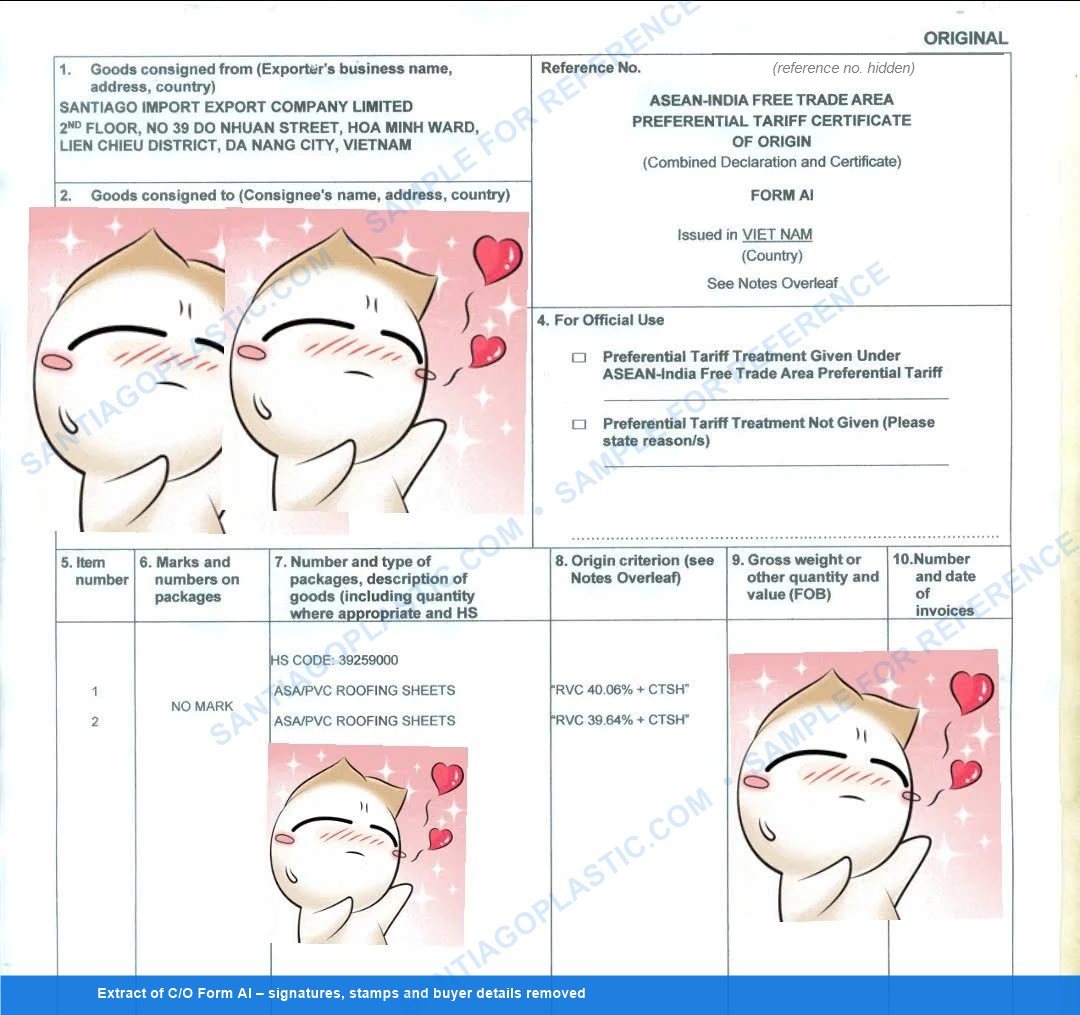
Certificate of origin Form AI (ASEAN–India) for Santiago ASA/PVC roofing sheets, HS 39259000, certified on 24 September 2026. Buyer details are hidden.
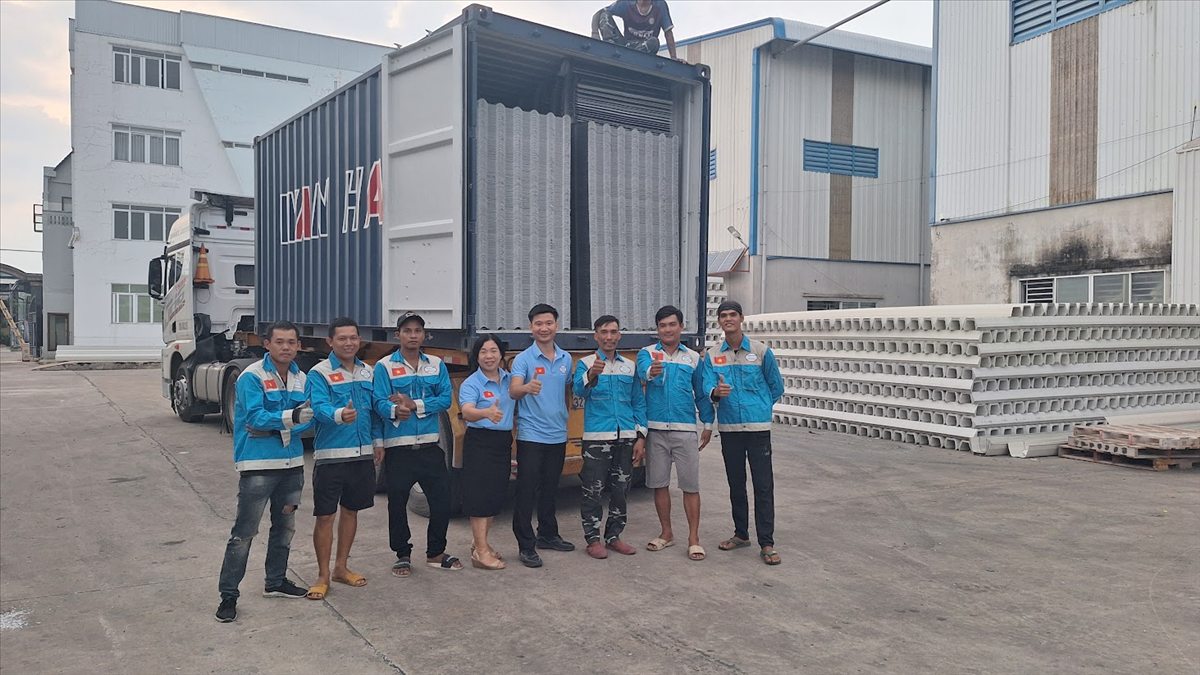
The Santiago team beside a loaded export container at the factory, November 2024
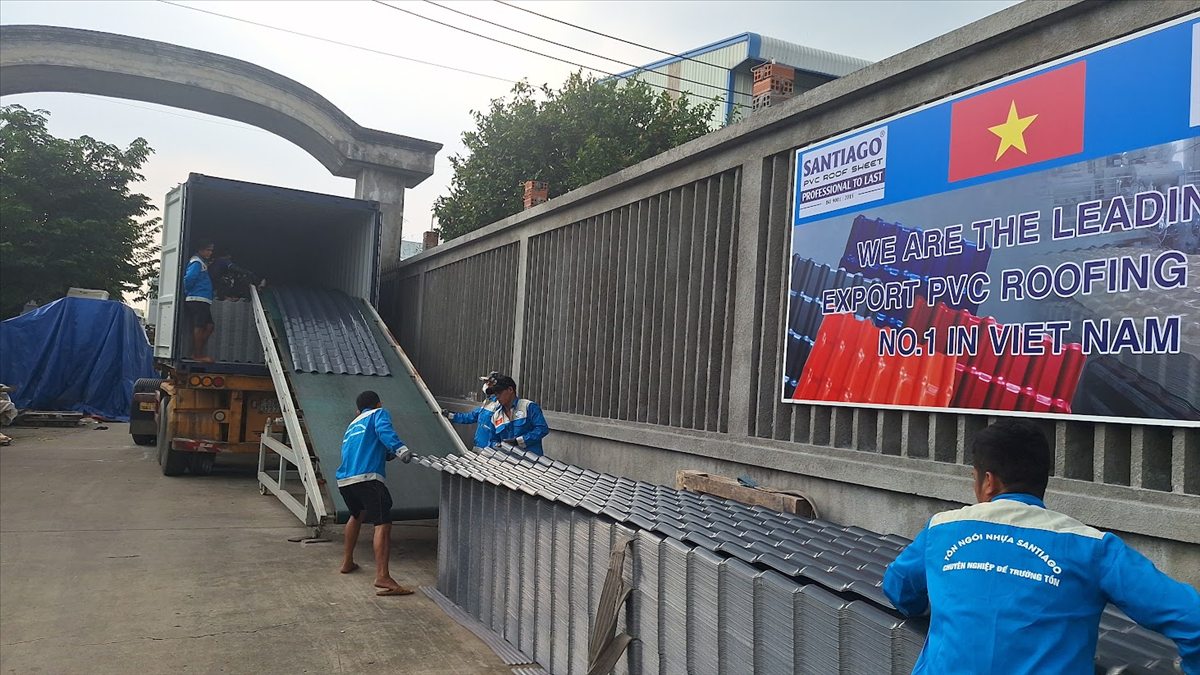
Loading Santiago roof tiles into an export container
Frequently asked questions
Is a radiant barrier better than insulation under a metal roof?
They do different jobs. A radiant barrier blocks radiant heat across an air gap, while mineral wool or foam slows conducted heat. In hot climates they are often used together with a ventilated roof space.
How much does a radiant barrier reduce heat?
University of Florida extension guidance puts the cut in ceiling heat flow at about 30 – 50%, with yearly cooling savings of around 7 – 10% in the US Southeast. It needs an air gap on its shiny side.
Can I glue foam to the underside of a roofing sheet?
Not on an ASA/PVC sheet. The sheet moves with temperature and is fixed through pre-drilled holes so it can expand; glued foam restricts that and can trap moisture. Fix insulation to the frame or a ceiling instead.
Does roof insulation stop condensation?
Only when it keeps humid room air away from the cold sheet. Seal ceiling gaps, ventilate the roof space and ask your builder about a vapour control layer.
Does Santiago supply roof insulation?
No. Santiago supplies ASA/PVC sheets and accessories. Buy insulation locally and check its fire classification under your building code.
Read more
- Corrugated roofing sheets anti-condensation guide
- PVC roof sheet underside: can it be the ceiling?
- Noise reduction roofing: how to stop rain noise
- Cool roofs: solar reflectance and SRI
- ASA/PVC roof tile sheet
Read next on this topic
Main guide: Heat Resistant Roofing Sheet for a Hot Climate
Sources for the figures in this article
- Profiles, 2.5–3.0 mm thickness and 10-year warranty: Santiago ASA/PVC product specification.
- About 6–8 °C cooler than bare metal sheet and about 80% less rain noise: Santiago's own comparisons on finished roofs in Vietnam.
- HS code 3925.90.00: Harmonized System Chapter 39 (builders' ware of plastics), as applied in Vietnam's export tariff.
- Certificates of origin (Form D, AI, AK/VK, AJ/VJ, VC, CPTPP): issued by Vietnam's Ministry of Industry and Trade under the country's free trade agreements.
- Minimum order of one 40 ft container (about 5,000 m) and about 5 days for production and loading: Santiago export desk, October 2026.
Updated 03/11/2026. Santiago Import Export Co., Ltd, Vietnam. WhatsApp +84 935 391 495 (Mr. Quyen), hotline +84 965 437 316 (Mrs. Ly), email salessantiagoroofing@gmail.com.


