


Mr Quyền - Santiago. Posted 21/11/2026
Yes, if the panels are carried by the roof structure, not by the plastic sheet. Mounting brackets or rails must be fixed through the top of the wave into the purlins or rafters, or the panels must sit on a separate steel frame. A corrugated-roof mounting manual sets panels at least 30 cm back from the ridge, gutter and edges. Have the frame checked by an engineer, because Santiago gives no load rating for solar mounting.
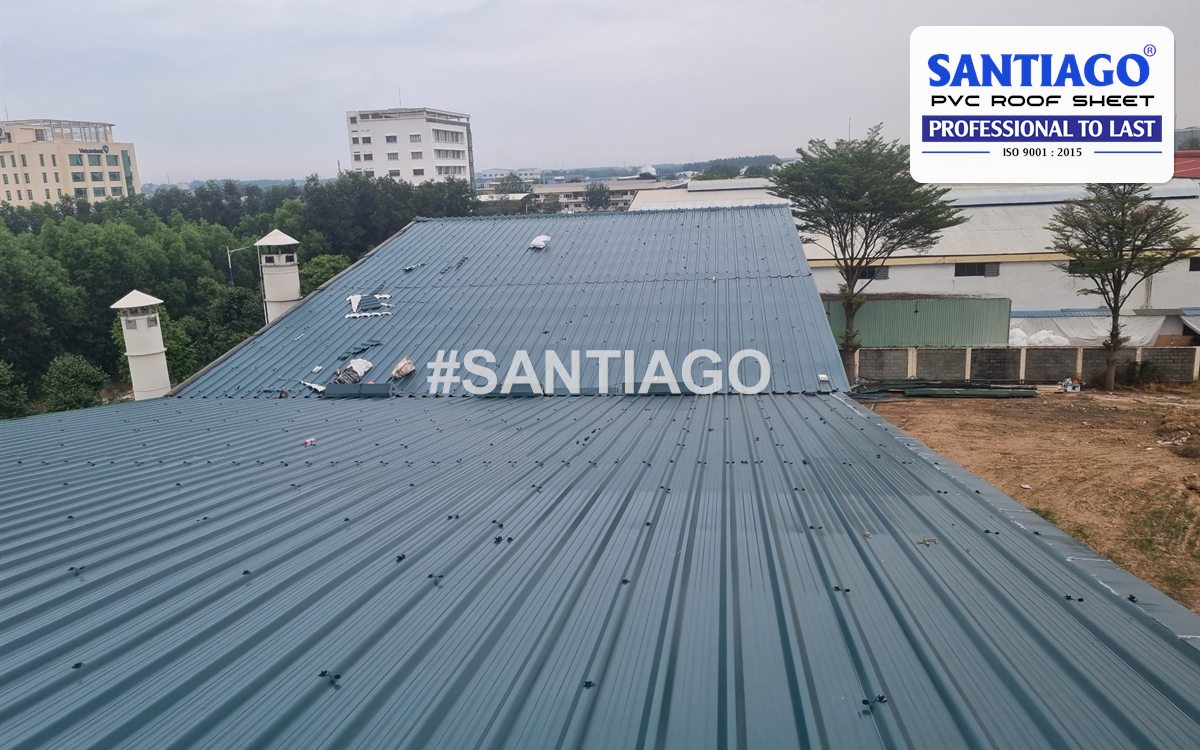
Large green corrugated sheet roof on a factory, Vietnam
Can a plastic roof sheet carry solar panels?
The sheet itself should never carry them. An ASA/PVC sheet spans between purlins and is designed to shed rain and resist wind on its own; it is not a walking surface and has no rating for point loads from panel clamps. What carries the panels is the steel or timber structure underneath. The sheet is only the weatherproof layer the fixings pass through.
That is the same principle mounting makers apply to corrugated metal roofs. The difference with plastic is that the sheet expands more with heat, so every fixing through it needs room to move and a good seal.
What are the ways to mount solar panels over a sheet roof?
| Method | How it works | Points to watch |
|---|---|---|
| Brackets into the purlins | Brackets screwed through the top of the wave into each purlin, rails on the brackets, panels on the rails | Bracket positions agreed with the mounting supplier; oversize, sealed holes in the sheet |
| Separate frame over the roof | A steel frame stands on the building structure and holds the panels above the sheets | Fewer holes in the sheet; the frame needs its own design and tie-down |
| Solar carport or ground mount | Panels on their own structure next to the building | No load on the roof at all; needs space |
For small loads such as a solar water heater, a separate steel stand fixed to the structure is common, as in the photo below. For a full PV array on a factory, the mounting supplier and a structural engineer should work out the bracket layout from the purlin spacing and local wind loads.

Solar water heater on its own steel frame above a red tile-sheet roof, Vietnam
What setbacks and roof pitch apply?
One corrugated-roof mounting manual for solar systems sets these limits; your local code and mounting supplier may set others:
- Roof pitch between 15° and 60° for that system
- At least 30 cm from the ridge and from the gutter, because wind loads are higher there
- At least 30 cm from the side edges of the roof
- No brackets on the first or last wave of a sheet
- Fixings only in positions the sheet supplier allows
Santiago's own rules for its sheets still apply under the panels: purlins less than 700 mm apart, slope 20 – 45%, screws through the top of the wave over a purlin, 6 mm pre-drilled holes so the sheet can move, and an ASA cap or a sealed bracket over every penetration. Never fix in the valley of the wave, where water runs.
How do installers reach the panels without damaging the sheets?
Plan access before the array goes up. Installers should stand only over purlins on boards laid across at least two of them, never on the sheet between purlins. On large roofs, a permanent walkway on its own supports along the array saves the sheets during cleaning and repairs. Leave a gap between the panels and any skylight sheets so daylight still reaches the room below.
What should be checked before ordering a solar system?
- Ask a structural engineer whether the frame can carry the panels plus wind loads.
- Measure the purlin spacing and the purlin sizes.
- Agree the bracket type and positions with the mounting supplier.
- Check the local electrical and fire rules for rooftop PV.
- Plan cable routes so no cable lies in a valley or rubs on the sheet.
- Plan access and cleaning.
Why does a bare metal roof feel so hot, and what changes with a tile sheet?
Mr Quyen holds a white tile sheet in the Santiago factory in Vietnam and explains in English, with captions, why bare metal roofs are hot, noisy in rain and costly to repair. The short then moves to a red tile roof on a house and a finished grey tile roof beside the gutter.
Heat and rain noise: Santiago ASA/uPVC roofing explained (Santiago video on YouTube).
More short videos on heat
Two more English shorts from the Santiago YouTube channel. Each one is about a minute or less.
How does the sheet react to strong heat?
The heat-test short: grey and red sheets under a flame, Mr Quyen on grey sheets at the factory, then a warehouse roof re-laid in blue. It shows how the sheet behaves under heat, not a certified fire rating.
Heat test and a warehouse re-roof with uPVC sheets (Santiago video on YouTube).
Can foam be added under the sheet in very hot places?
A 48-second short from the Santiago channel that answers a question buyers often ask: whether a foam layer can be added under an ASA/uPVC roofing sheet.
Foam under an ASA/uPVC roofing sheet (Santiago video on YouTube).
Santiago – a leading exporter of ASA/PVC roofing from Vietnam
Santiago roofing is produced and loaded into containers at our factory in Vietnam. It has been exported to India since 2023, Thailand since 2024 and the USA since 2025. Every export shipment comes with a commercial invoice, packing list, bill of lading and a certificate of origin (C/O) issued by Vietnam's Ministry of Industry and Trade, which importers use to claim the duty preference of their trade agreement.
| Item | Details |
|---|---|
| HS code | 3925.90.00 (ASA/PVC roofing sheets) |
| Certificate of origin | Form D (ASEAN), Form AI (India), Form AK / VK (Korea), Form AJ / VJ (Japan), Form VC (Chile), CPTPP proof of origin |
| Shipped from | Vietnam, by container |

Certificate of origin Form AI (ASEAN–India) for Santiago ASA/PVC roofing sheets, HS 39259000, certified on 24 September 2026. Buyer details are hidden.
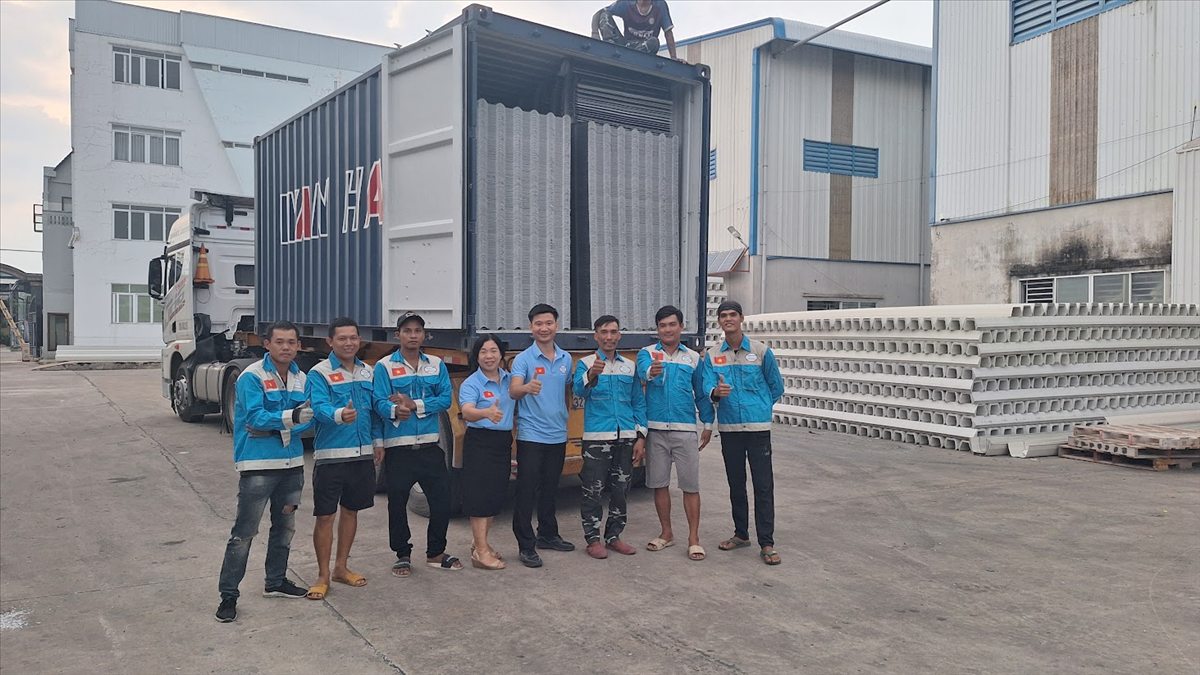
The Santiago team beside a loaded export container at the factory, November 2024
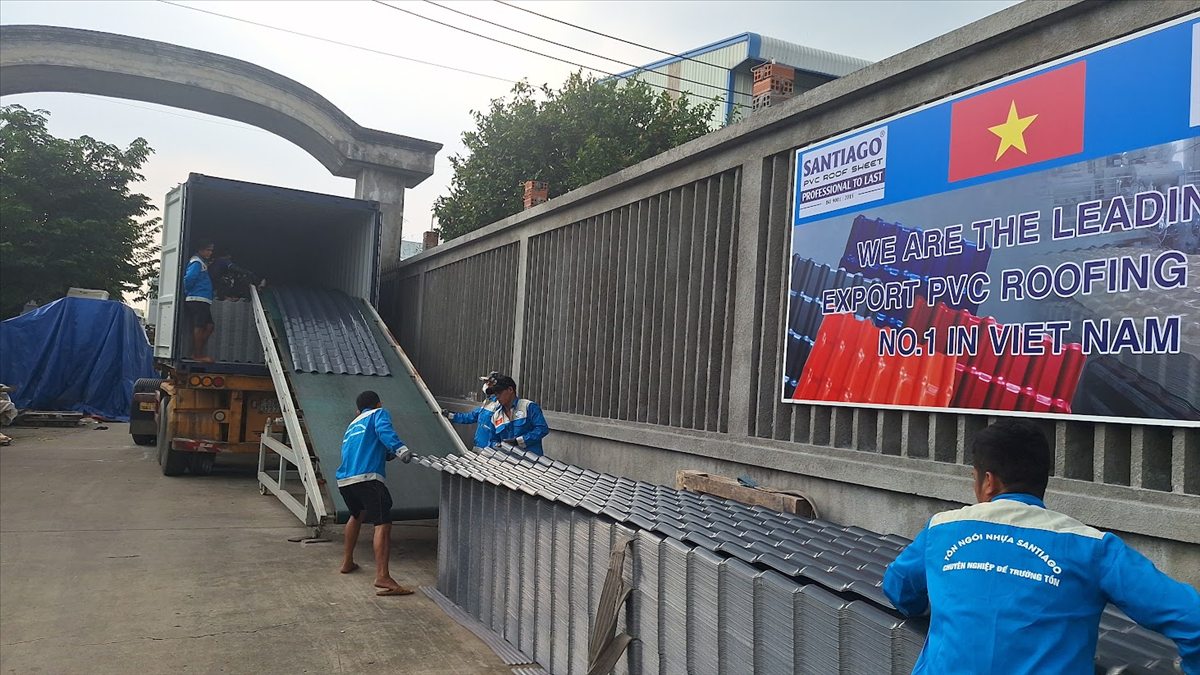
Loading Santiago roof tiles into an export container
Frequently asked questions
Can you put solar panels on a PVC roof?
Yes, if the panels are carried by the purlins or a separate frame, not by the sheet. Brackets go through the top of the wave into the purlins, with sealed holes, or the panels stand on their own frame.
Can you walk on a PVC roof to install solar panels?
No. Stand only over purlins on a board laid across at least two of them, or use a walkway on its own supports.
How far from the edge should solar panels be on a corrugated roof?
One corrugated-roof mounting manual asks for at least 30 cm from the ridge, gutter and side edges. Follow your mounting supplier and local code.
Does Santiago give a load rating for solar on its sheets?
No. Santiago gives no structural or solar load rating. The roof structure must be checked by an engineer.
Read more
- Screws and ASA caps: fixing guide
- Anti-corrosion roofing sheet for factories and farms
- Skylight roofing sheets
- Roof maintenance checklist
- ASA/PVC roof tile sheet
Versión en español
Sí, siempre que los paneles solares los soporte la estructura y no la lámina de PVC. Los soportes o rieles se fijan por la cresta de la onda a las correas, o los paneles van sobre una estructura de acero aparte. Un manual de montaje para techos ondulados pide al menos 30 cm desde la cumbrera, la canaleta y los bordes. Santiago no da carga admisible para paneles; un ingeniero debe revisar la estructura.
¿Se pueden poner paneles solares en un techo de PVC?
La lámina ASA/PVC es la capa que protege de la lluvia; no está hecha para cargas puntuales ni para caminar sobre ella. Los paneles deben apoyarse en las correas o vigas por medio de soportes, o en una estructura independiente. Como el plástico se dilata con el calor, cada perforación necesita holgura y un buen sellado.
| Método | Cómo funciona | Qué vigilar |
|---|---|---|
| Soportes a las correas | Soportes atornillados por la cresta a cada correa, rieles y paneles encima | Posiciones acordadas con el proveedor del montaje; agujeros sellados |
| Estructura aparte | Marco de acero sobre la estructura del edificio | Menos perforaciones; requiere diseño propio |
| Cochera solar o suelo | Paneles en estructura propia | Ninguna carga sobre el techo |
Reglas para la lámina debajo de los paneles
Correas a menos de 700 mm, pendiente de 20 – 45%, tornillos por la cresta sobre una correa, agujeros de 6 mm para la dilatación y un capuchón ASA o un soporte sellado en cada perforación. Nunca fije en el valle de la onda. Para montar y limpiar, pise solo sobre las correas con un tablón apoyado en al menos dos de ellas.
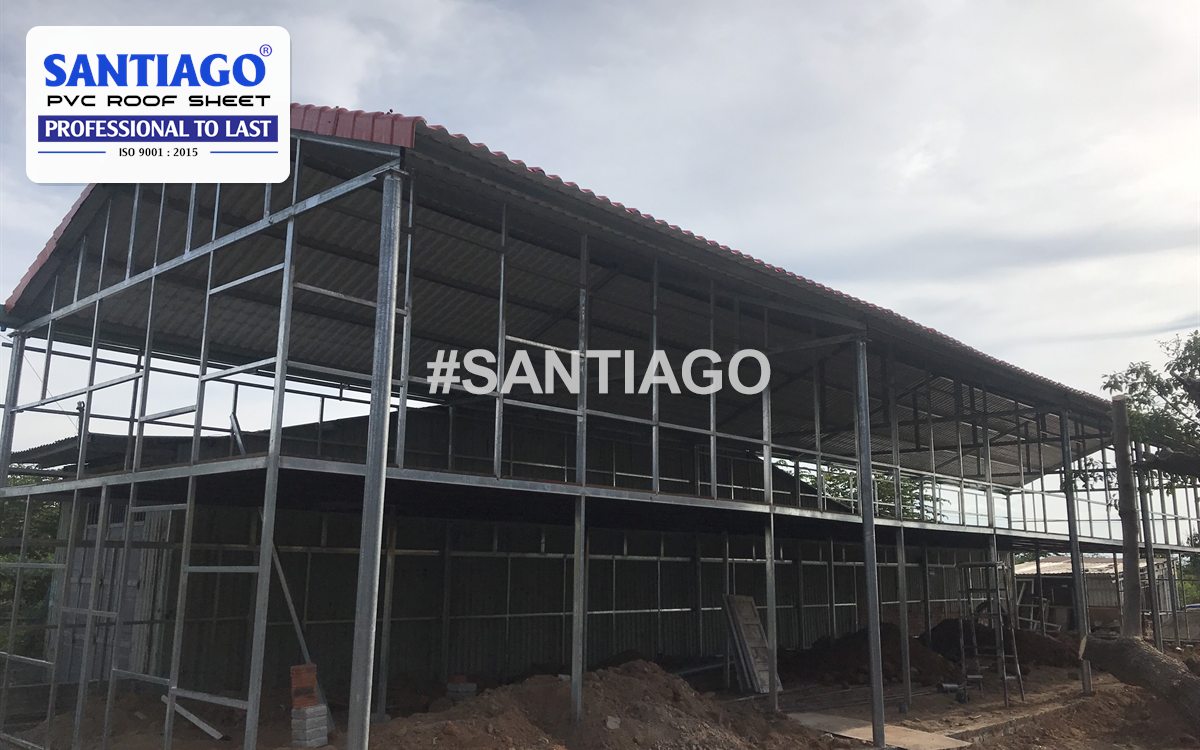
Galpón con estructura de acero y techo de lámina tipo teja, Vietnam
¿Qué revisar antes de instalar?
Que un ingeniero confirme que la estructura soporta los paneles y el viento, medir la separación de las correas, acordar los soportes con el proveedor del sistema solar, cumplir las normas eléctricas y de incendio locales y prever el acceso para limpieza.
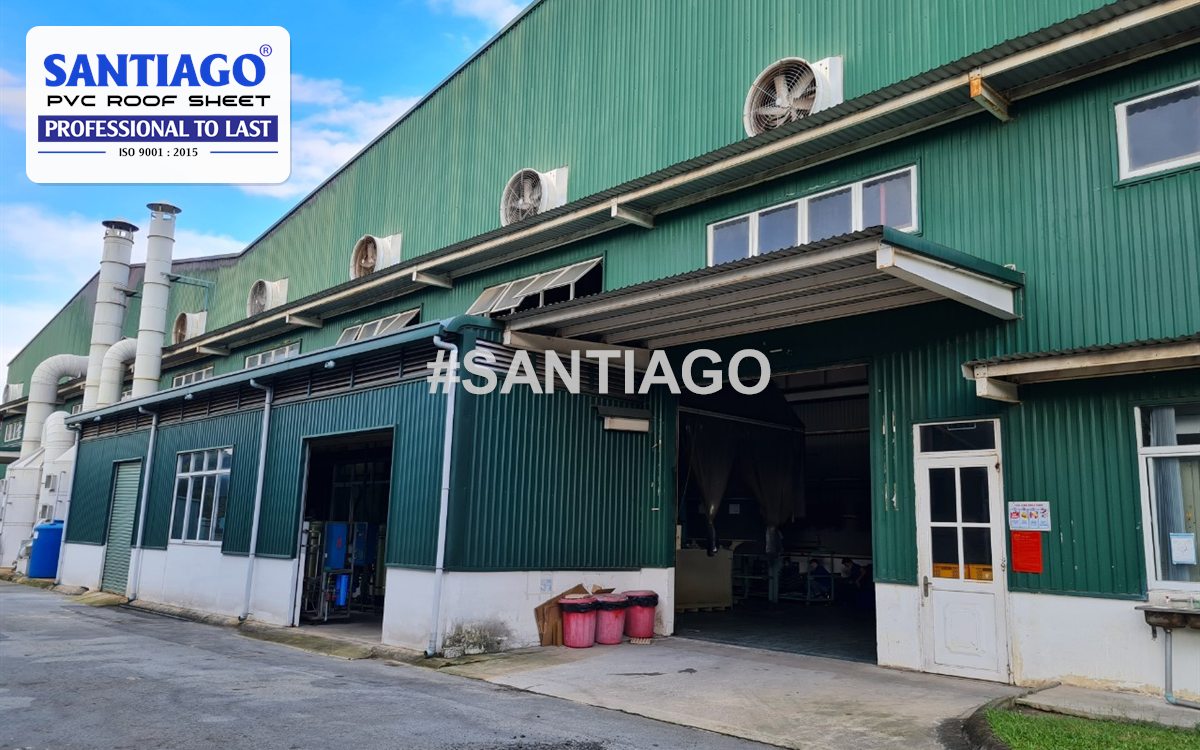
Edificio de fábrica con techo de lámina verde, Vietnam
Preguntas frecuentes
¿Se pueden instalar paneles solares en un techo de PVC?
Sí, si los soportan las correas o una estructura aparte, no la lámina. Los soportes van por la cresta con agujeros sellados.
¿Se puede caminar sobre un techo de PVC?
No. Pise solo sobre las correas con un tablón apoyado en al menos dos de ellas.
¿Santiago garantiza la carga de paneles solares?
No. Santiago no da carga admisible; la estructura la revisa un ingeniero.
Read next on this topic
Main guide: How to Install PVC Roof Tile Sheets: 8 Steps
Sources for the figures in this article
- Profiles, 2.5–3.0 mm thickness and 10-year warranty: Santiago ASA/PVC product specification.
- HS code 3925.90.00: Harmonized System Chapter 39 (builders' ware of plastics), as applied in Vietnam's export tariff.
- Certificates of origin (Form D, AI, AK/VK, AJ/VJ, VC, CPTPP): issued by Vietnam's Ministry of Industry and Trade under the country's free trade agreements.
- Minimum order of one 40 ft container (about 5,000 m) and about 5 days for production and loading: Santiago export desk, October 2026.
Updated 03/11/2026. Santiago Import Export Co., Ltd, Vietnam. WhatsApp +84 935 391 495 (Mr. Quyen), hotline +84 965 437 316 (Mrs. Ly), email salessantiagoroofing@gmail.com.


