


Mr Quyền - Santiago. Posted 23/11/2026
A school roof in a hot, rainy country has two jobs besides keeping water out: limit the heat that reaches the classroom and keep rain noise low enough to teach. The WHO guideline for background noise in a classroom is 35 dB, and US research links each 1 °F (0.56 °C) hotter school year to about 1% less learning. ASA/PVC roof sheets help with both: Santiago's tests show 6 – 8 °C lower temperature under the roof and about 80% less rain noise than bare metal sheet.
Santiago Import Export Co., Ltd (Vietnam) makes ASA/PVC roof tile sheets and corrugated roofing sheets and exports them by the container. WhatsApp +84 935 391 495 (Mr. Quyen), hotline +84 965 437 316 (Mrs. Ly).
This guide follows the order a school building committee usually asks in: why heat and noise matter, how the roof sets classroom temperature, how loud rain gets, how roof sheets compare, what else the roof plan needs, and what Santiago supplies.
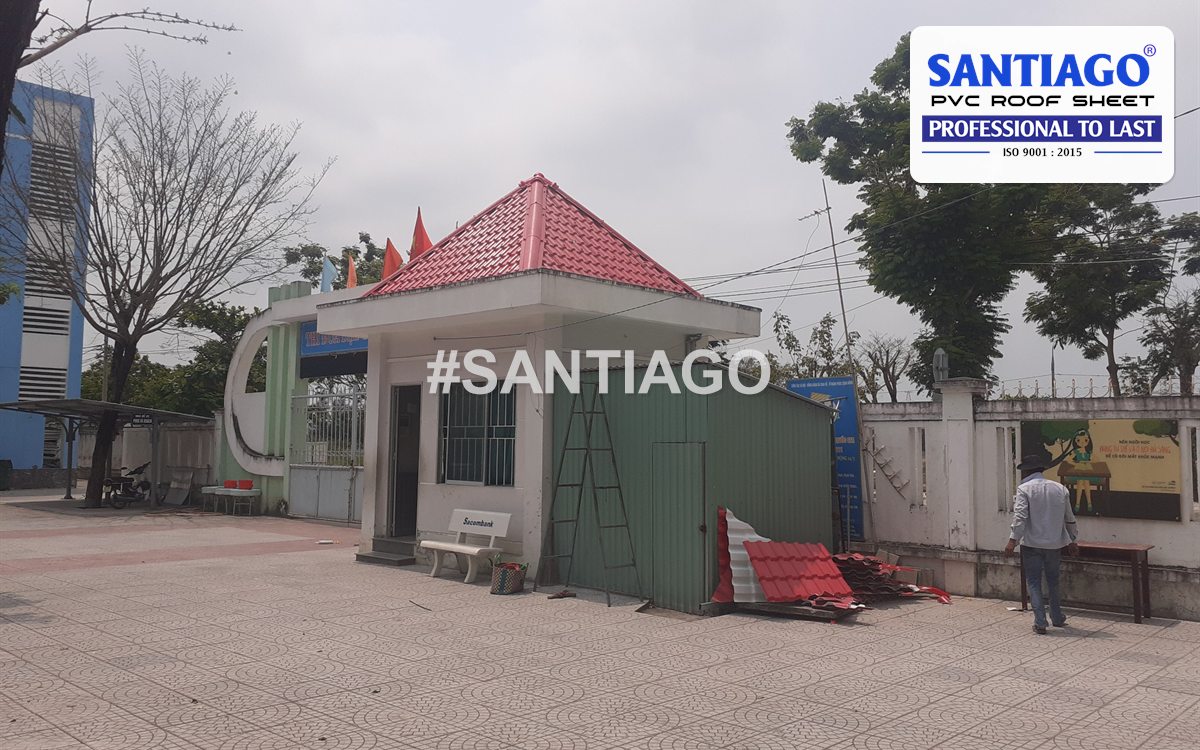
Guard house at a school gate roofed with Santiago red tile sheets, Vietnam
Why do roof heat and rain noise matter in a classroom?
Heat and noise both cut into teaching time. The World Health Organization's Guidelines for Community Noise (1999) set 35 dB LAeq as the background level for a classroom during lessons, because pupils must hear speech clearly. The US classroom acoustics standard ANSI/ASA S12.60 uses the same 35 dBA limit for core learning spaces.
Heat has a measured cost too. Park, Goodman, Hurwitz and Smith (American Economic Journal: Economic Policy, 2020) found that in US schools without air conditioning, each 1 °F hotter school year reduced that year's learning by about 1%. In a single-storey school, the roof is the surface between pupils and both problems.
How does the roof decide how hot a classroom gets?
The roof is the largest surface facing the sun in a single-storey school, so it sets most of the heat that reaches the room. Bare metal sheet heats quickly and radiates that heat straight down when there is no ceiling. Three things lower it: a cooler roof covering, airflow under the roof, and a ceiling or insulation layer.
- Roof covering: ASA/PVC sheet does not conduct heat like metal; Santiago's tests show 6 – 8 °C lower temperature under the roof than under bare metal sheet
- Colour: light colours reflect more sunlight than dark ones of the same material
- Airflow: openings at the eaves and ridge let hot air leave the roof space
- Ceiling: a ceiling with an air gap stops most radiant heat from reaching pupils
Airflow is often the cheapest of the four to add to an existing block. The details are in our guide to roof ventilation for hot, humid climates.
How loud is heavy rain on a school roof?
Heavy rain on thin metal sheet is loud enough to stop a lesson. Laboratories measure rain noise with the method in ISO 10140-1 (Annex K), which defines heavy rain as 40 mm per hour; a light, thin roof is the worst case because the sheet itself rings. A thicker plastic sheet damps the impact instead of ringing.
Santiago's tests show about 80% less rain noise under its 2.5 mm ASA/PVC sheet than under bare metal sheet. A ceiling below the roof cuts the remaining noise further, which matters during monsoon months when afternoon storms fall in class time. We compare quieter options in noise reduction roofing for rain.
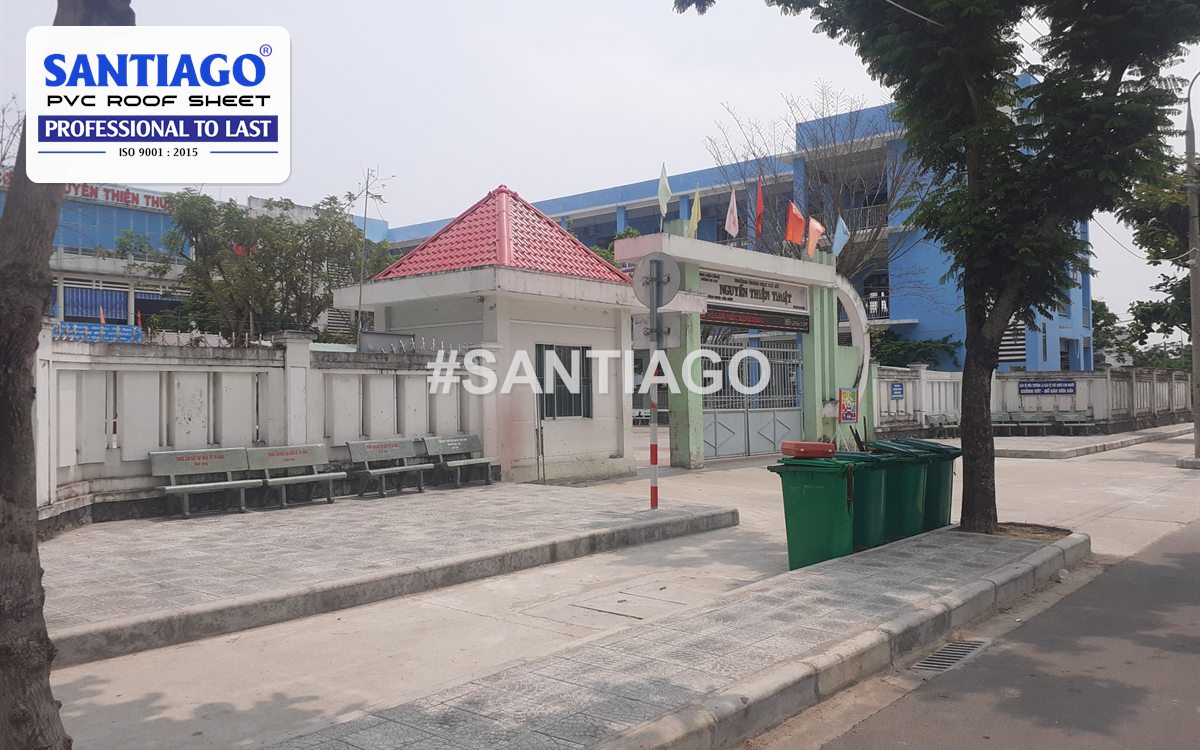
School gate and guard house with a red tile-sheet roof, school building behind, Vietnam
Which roof sheet suits a school building?
For a school in the tropics, the main trade-offs are heat, rain noise, rust, weight and upkeep. The table compares common choices in general terms; local prices and fire rules decide the final pick.
| Roof covering | Heat under the roof | Rain noise | Rust | Weight | Upkeep |
|---|---|---|---|---|---|
| Bare metal sheet | High without a ceiling | High | Rusts at cut edges and screws, faster near the sea | Light | Repaint and replace screws |
| Metal sheet with insulation | Lower | Lower | Same as metal | Light to medium | As metal, plus the insulation layer |
| ASA/PVC sheet (Santiago) | 6 – 8 °C lower than bare metal (Santiago test) | About 80% lower than metal (Santiago test) | None, no metal in the sheet | About 5.2 kg per m² (2.5 mm) | Rinse; replace screw caps if damaged |
| Clay or concrete tile | Low | Low | None | Much heavier; check the dead load with an engineer | Replace broken tiles |
ASA/PVC sheet suits schools that need a light roof on a steel frame, sit near the coast or have no budget for repainting. Clay or concrete tile suits buildings whose frame was designed for its weight.
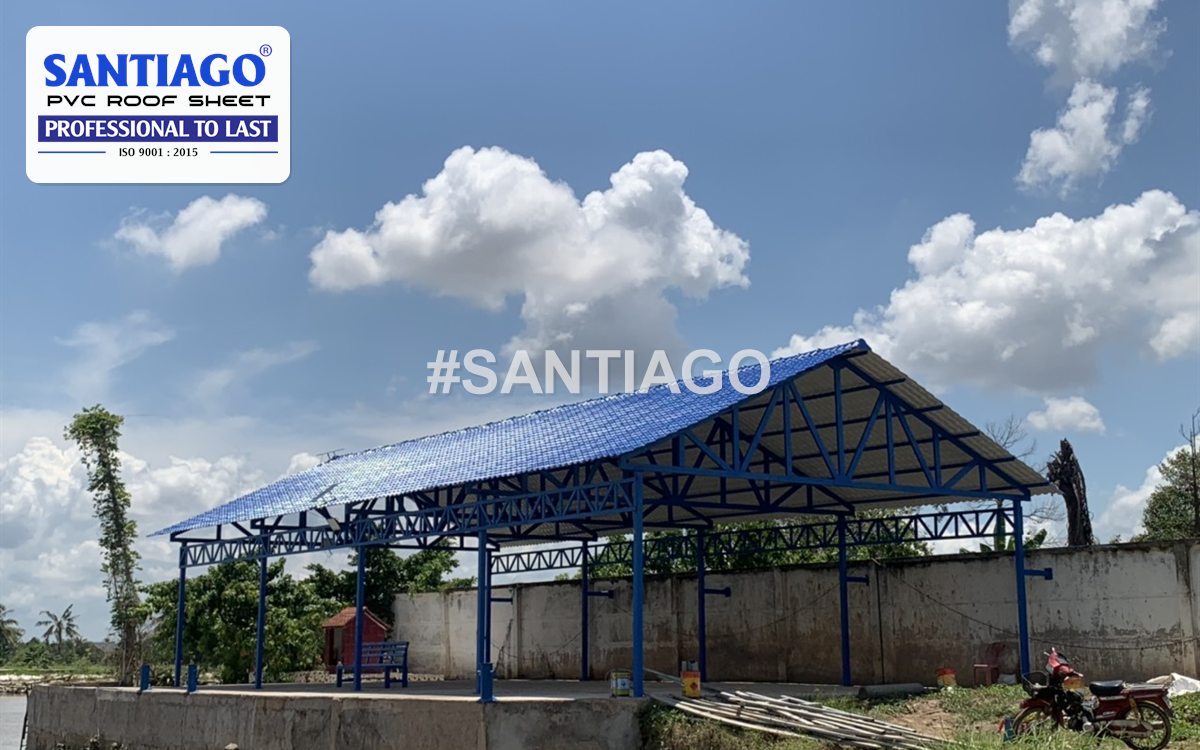
Open steel-frame hall with a blue tile-sheet roof, Vietnam
What else should a school roof plan include?
The roof sheet is one part of the plan. A school roof works best when the structure, water and safety details are settled before ordering.
- Check the frame: purlins less than 700 mm apart for ASA/PVC sheet, and a structural check for any re-roof
- Add a ceiling where classrooms sit directly under the roof
- Leave openings at the eaves and ridge for airflow
- Size gutters and downpipes for local storm rainfall so water does not pour onto walkways
- Ask the local authority which fire rules apply to school roofs, and request the test reports you need before you order
Do fire rules apply to a school roof?
Many countries set stricter fire rules for schools than for houses. Check the code that applies to your building first, then ask any supplier for test reports. Our article on what PVC roofing sheets can claim about fire explains which wording to look for.
What does Santiago supply for school roofs?
Santiago makes two ASA/PVC profiles that fit school buildings: a Spanish-style roof tile sheet for a tiled look, and corrugated sheets for halls, canteens and covered walkways. Both carry an ASA top layer that showed no colour change after 2,000 hours of artificial UV.
- Roof tile sheet: 1.05 m wide, 0.96 m cover width, cut to length in 219 mm tile steps
- Corrugated sheet: 5-wave, 6-wave and 11-wave profiles
- Fixing: 70 mm screws with ASA caps through the top of the wave, 4 – 5 screw sets per m²
- Warranty: 10 years for 2.5 mm and thicker sheet installed as Santiago recommends
- Export: one 40 ft container holds about 5,000 m of sheet; colours, profiles and ridge pieces can be mixed
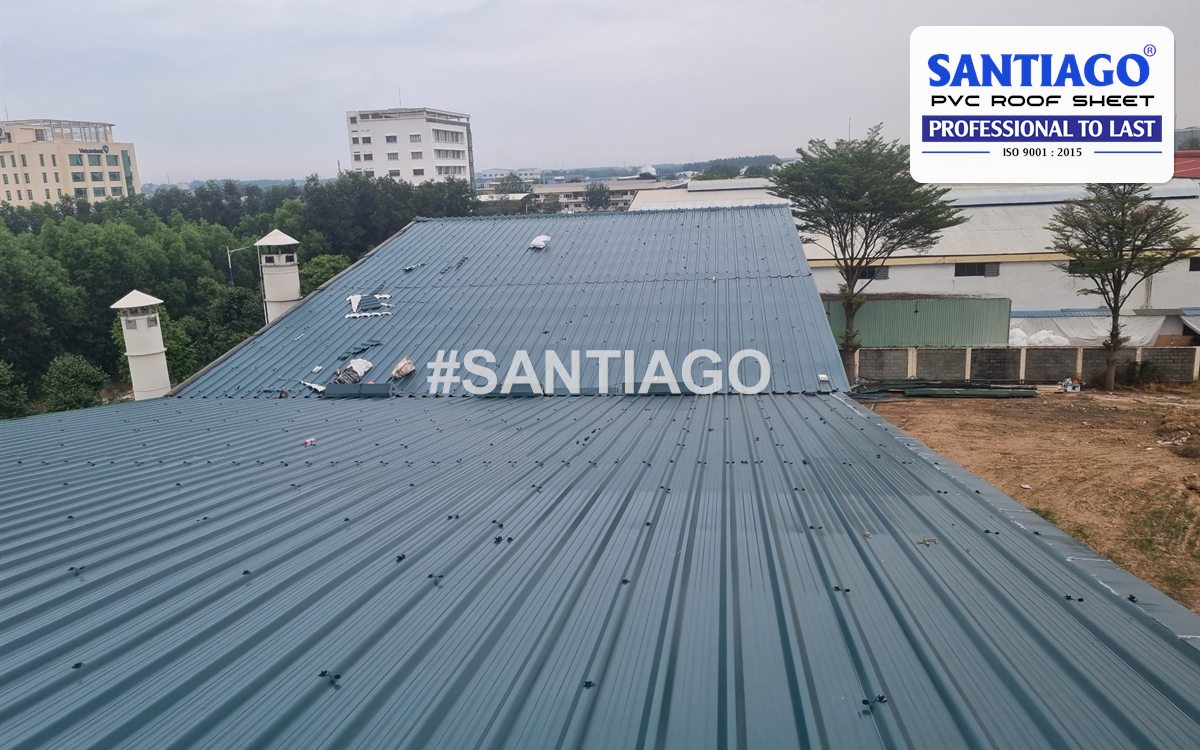
Large factory building roofed with corrugated sheets, Vietnam
For classrooms and halls that need a tiled look, start with the ASA/PVC roof tile sheet; for canteens, sheds and walkways, see the 5, 6 and 11-wave corrugated sheets.
Why are terrace rooms under metal sheets so hot and loud?
A one-minute short with English captions: Mr Quyen explains why bare metal roofs are hot, noisy in rain and costly to repair, first in the factory and then on finished red and grey tile roofs.
Heat and rain noise: Santiago ASA/uPVC roofing explained (Santiago video on YouTube).
More short videos on rain and roofs
Both clips below come from Santiago's own YouTube channel and were filmed at the factory in Vietnam or on Santiago roofs.
Why are thin metal roofs loud in rain?
Mr Quyen holds a white tile sheet in the Santiago factory and explains in English, with captions, why bare metal roofs are hot, noisy in rain and costly to repair. The short then shows a red tile roof on a house and a finished grey tile roof beside the gutter.
Heat and rain noise: Santiago ASA/uPVC roofing explained (Santiago video on YouTube).
How do tile sheets cope with sun and rain?
This one-minute short moves from red tile sheets going up onto a house to a flame test on a stack of sheets, then a blue warehouse roof under installation. A flame test is a demonstration, not a fire rating.
Santiago PVC roofing tiles in real conditions (Santiago video on YouTube).
Santiago – a leading exporter of ASA/PVC roofing from Vietnam
Santiago roofing is produced and loaded into containers at our factory in Vietnam. It has been exported to India since 2023, Thailand since 2024 and the USA since 2025. Every export shipment comes with a commercial invoice, packing list, bill of lading and a certificate of origin (C/O) issued by Vietnam's Ministry of Industry and Trade, which importers use to claim the duty preference of their trade agreement.
| Item | Details |
|---|---|
| HS code | 3925.90.00 (ASA/PVC roofing sheets) |
| Certificate of origin | Form D (ASEAN), Form AI (India), Form AK / VK (Korea), Form AJ / VJ (Japan), Form VC (Chile), CPTPP proof of origin |
| Shipped from | Vietnam, by container |
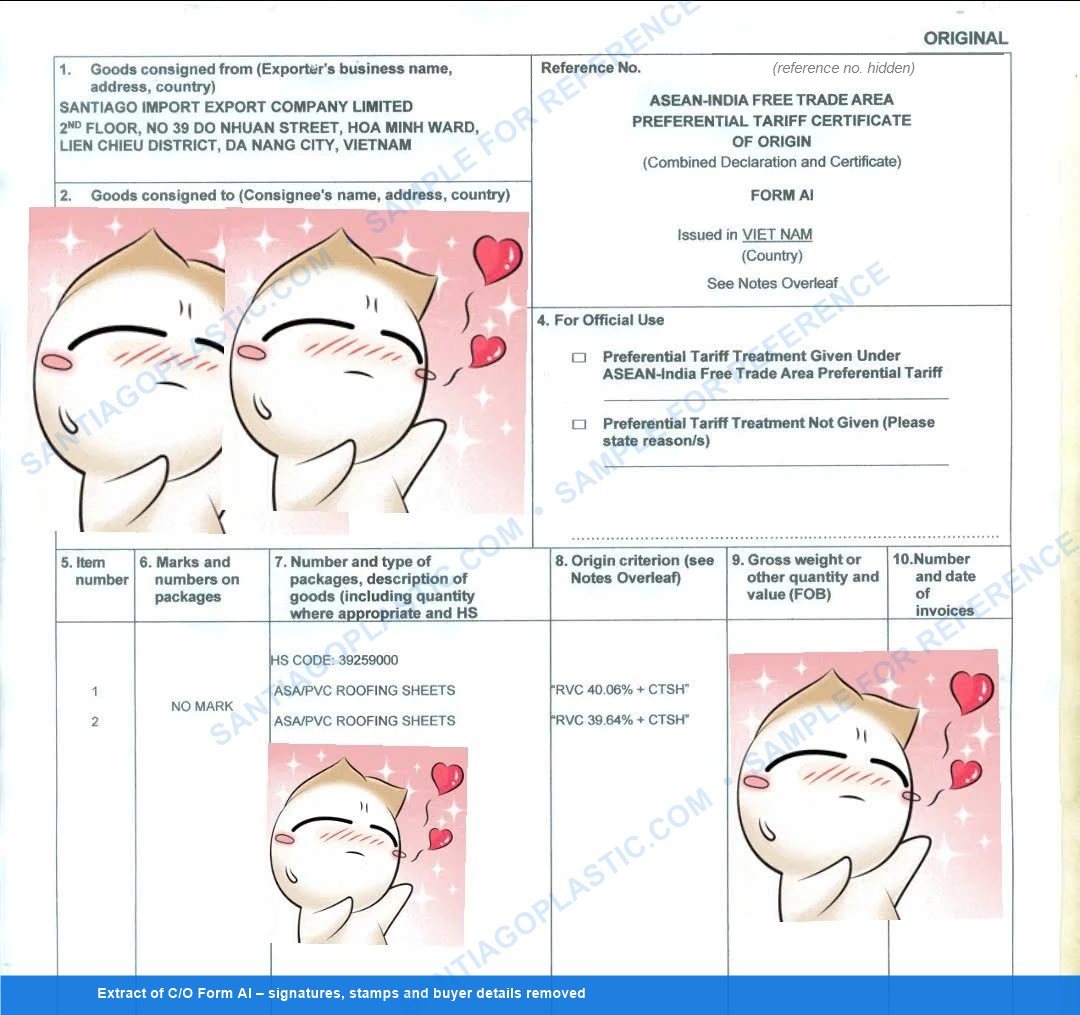
Certificate of origin Form AI (ASEAN–India) for Santiago ASA/PVC roofing sheets, HS 39259000, certified on 24 September 2026. Buyer details are hidden.
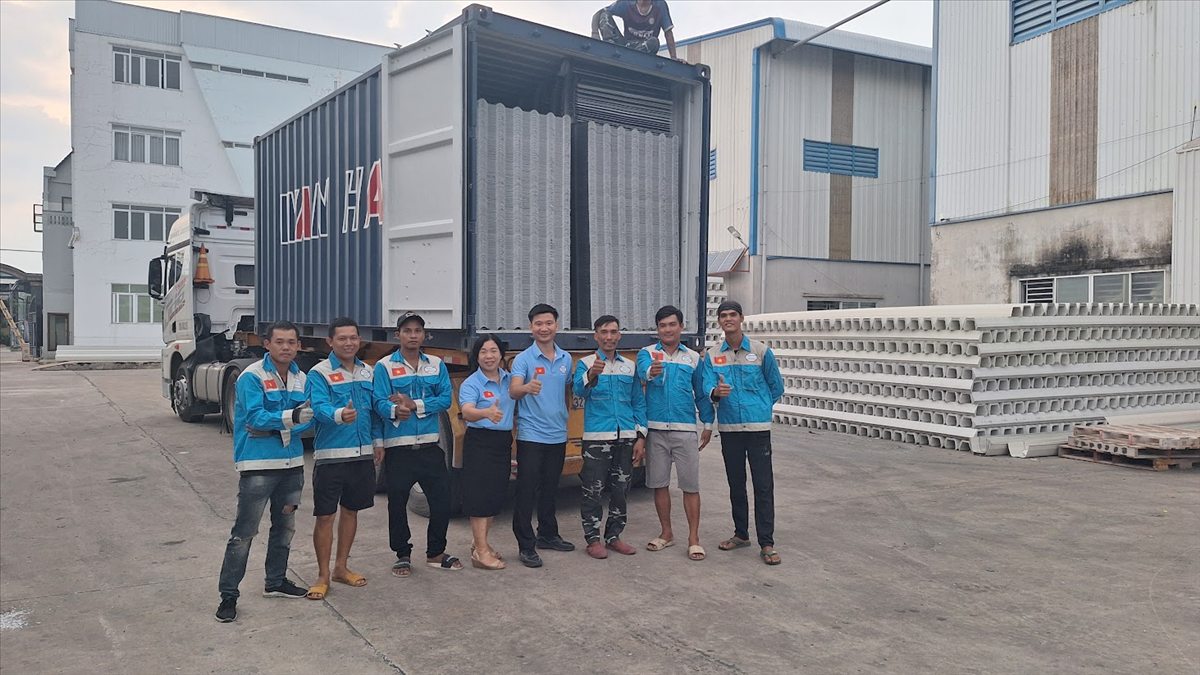
The Santiago team beside a loaded export container at the factory, November 2024
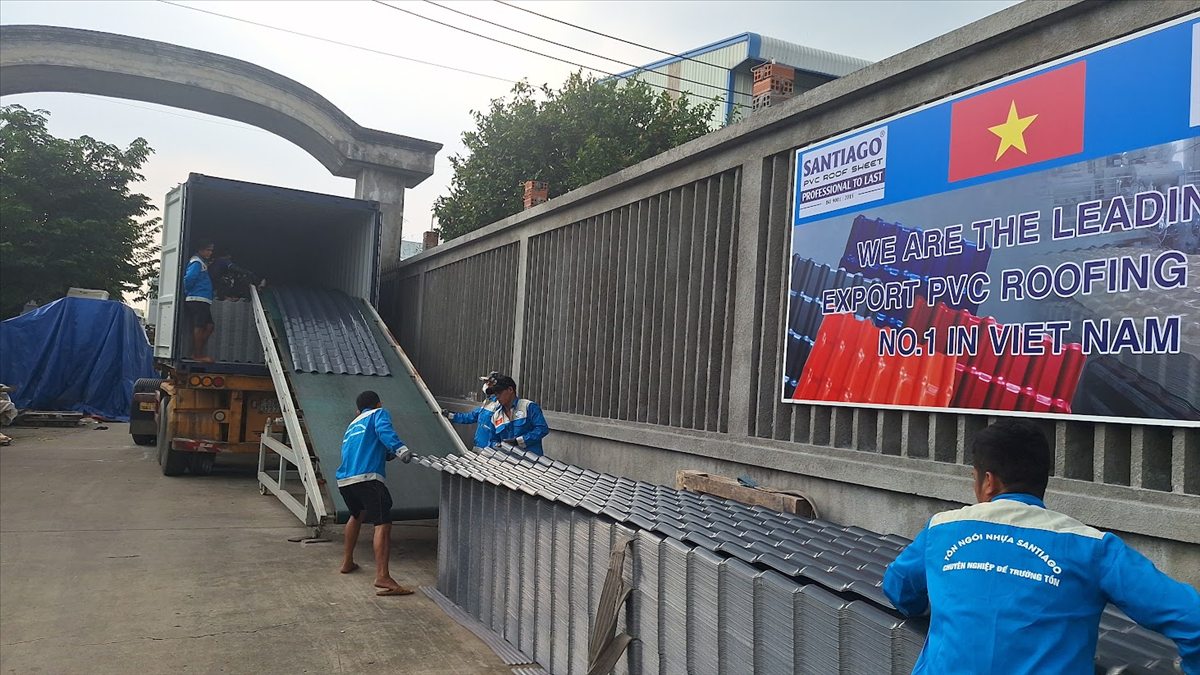
Loading Santiago roof tiles into an export container
Frequently asked questions
What is the best roof for a school in a hot country?
A roof that keeps heat and rain noise low, does not rust and suits the frame. ASA/PVC sheet with a ceiling and airflow under the roof works for many single-storey schools; heavy clay tile suits frames designed for its weight.
How quiet should a classroom be?
The WHO guideline for background noise in a classroom during lessons is 35 dB LAeq. The US standard ANSI/ASA S12.60 uses 35 dBA for core learning spaces.
Does classroom heat affect learning?
Yes. A 2020 study of US schools without air conditioning found that each 1 °F hotter school year reduced that year's learning by about 1%.
Is a plastic roof quieter than metal in rain?
Santiago's tests show about 80% less rain noise under its 2.5 mm ASA/PVC sheet than under bare metal sheet. A ceiling under the roof reduces noise further.
How heavy is an ASA/PVC school roof?
A 2.5 mm Santiago sheet weighs about 5.2 kg per m², much lighter than clay or concrete tile, so it suits light steel frames with purlins less than 700 mm apart.
Read more
- Heat resistant roofing sheet for a hot climate
- Insulation under a sheet roof
- Cool roof colours and SRI
- Gutter size from roof area and rainfall
- Roofing sheet types compared
Read next on this topic
Main guide: Heat Resistant Roofing Sheet for a Hot Climate
Sources for the figures in this article
- Profiles, 2.5–3.0 mm thickness and 10-year warranty: Santiago ASA/PVC product specification.
- About 6–8 °C cooler than bare metal sheet and about 80% less rain noise: Santiago's own comparisons on finished roofs in Vietnam.
- HS code 3925.90.00: Harmonized System Chapter 39 (builders' ware of plastics), as applied in Vietnam's export tariff.
- Certificates of origin (Form D, AI, AK/VK, AJ/VJ, VC, CPTPP): issued by Vietnam's Ministry of Industry and Trade under the country's free trade agreements.
- Minimum order of one 40 ft container (about 5,000 m) and about 5 days for production and loading: Santiago export desk, October 2026.
Updated 03/11/2026. Santiago Import Export Co., Ltd, Vietnam. WhatsApp +84 935 391 495 (Mr. Quyen), hotline +84 965 437 316 (Mrs. Ly), email salessantiagoroofing@gmail.com.


